
Lieferung heute & morgen

Qualitätsgarantie

Willkommens-Angebote freischalten: KOSTENLOSE Lieferung | Bis zu 80 % RABATT | Kostenlose 30-Tage-JoyPlus-Testphase
App herunterladen
Smart LED light panels combine decorative wall design with controllable lighting. Depending on the model, features can include RGB colours, warm white light tones, dimming, music reactivity, pixel art and voice commands. The selection ranges from modular LED wall lighting for living rooms and bedrooms to animated RGB LED panels for gaming setups.
To ensure your purchase remains suitable for both your room and your technical setup over time, you should look beyond the number of colours or eye-catching app images.
RGB lighting looks striking in product images, but it is not practical for every situation. If you also want to use the panels for reading, working or relaxing, check whether they offer separate white tones, an adjustable colour temperature and a dimming function. Pure colour-light systems are better suited to accent lighting and cannot replace functional room lighting.
A starter kit normally contains the basic components required for operation, while an expansion pack requires additional panels. Before buying, check the following:
A low individual price can be misleading if you later need several additional packs to cover the desired wall area.
Many smart wall lights are attached using adhesive strips. This makes installation easier, but can cause problems with delicate wallpaper, uneven surfaces or frequent moves. Before installation, consider the wall material, load-bearing capacity and cable routing. The systems mentioned are intended for indoor use and, according to the product specifications, are not waterproof.
Pay attention to the specifications for lumens, colour temperature and dimming. Lumens describe luminous flux. A higher value means that more light is emitted, but this alone says nothing about how the light is distributed or how it will actually look on the wall.
The following features are relevant for decorative smart-home lighting:
According to the product description, Nanoleaf light panels such as the Elements series offer adjustable white tones from 1,500 to 4,000 Kelvin. This is useful if you want warm or cooler white light as well as decorative scenes.
Wi-Fi light panels can generally be controlled via an app and integrated into existing networks. Before buying, check whether the model you want works with your platform. Commonly supported systems include Alexa, Google Assistant and Apple HomeKit. Actual support may vary depending on the product generation, region and firmware.
Bluetooth can be useful for initial setup or local control. Wi-Fi, on the other hand, usually offers more options for remote control, automations and integration into a smart-home system. With pixel-based products, you should also check the firmware requirements.
Modular LED wall lighting can be arranged in a variety of shapes. Before buying, it is worth planning your design using paper templates in the actual size. This lets you check whether the pattern will fit above your desk, next to the television or behind the bed.
The differences in materials are clearly visible: the Nanoleaf Elements Wood-Look Light Panels feature a wood-like appearance, while the Shapes Hexagons and Govee Pixel Light have a more technical or gaming-oriented look. For rented properties, it is also important to check whether the adhesive mounting can be removed without leaving residue. Follow the manufacturer’s instructions.
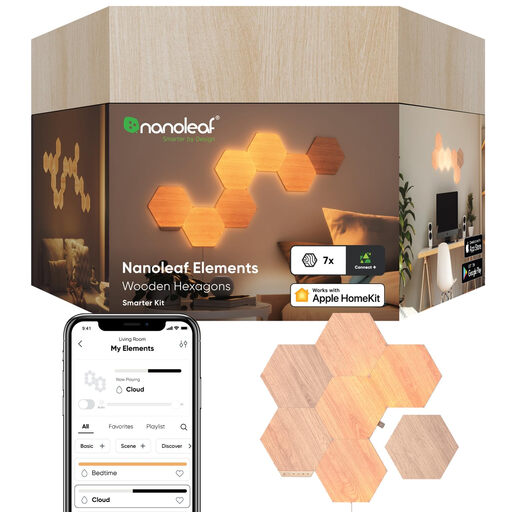
Why this product suits this profile: The 7-panel starter kit offers a clearly defined introduction to modular LED wall lighting. Its wood-like surface suits living rooms, bedrooms and home offices without being focused exclusively on a gaming aesthetic.
The set size is clearly stated. App, touch and voice control, along with adjustable white tones, are also specified instead of focusing solely on colour effects.
7 panels, Wi-Fi control, warm and cool white light tones from 1,500 to 4,000 Kelvin, and a stated power consumption of 14 watts.
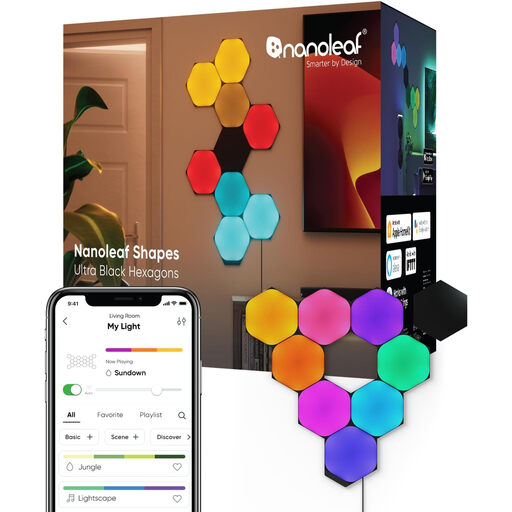
Why this product suits this profile: The 9-panel starter kit is aimed at users planning a larger geometric wall design with RGBW lighting, touch control and smart-home integration.
The product data specifies the quantity, dimming function, RGBW colour and Wi-Fi connectivity. This allows buyers to check the key criteria before placing their order.
9 hexagon panels, RGBW lighting, dimming function, touch control and, according to the product specifications, up to 1,500 lumens of luminous flux.
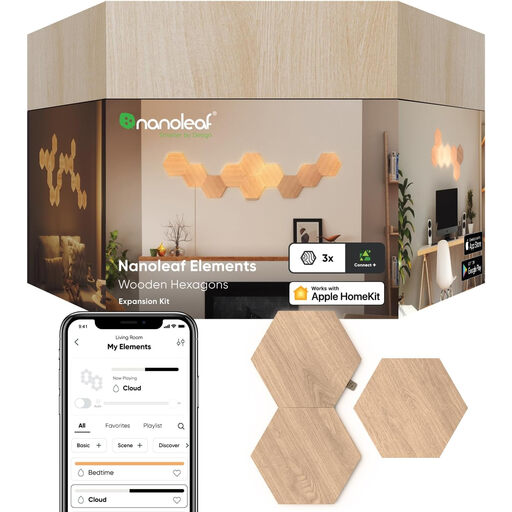
Why this product suits this profile: The expansion pack is designed for owners of a compatible Nanoleaf system who want to enlarge their existing design step by step.
Labelling it as an expansion pack makes it clear that a compatible base system is required for operation. This reduces the risk of making an unsuitable individual purchase.
3 additional Wood-Look panels, modular arrangement, app and voice control, plus Wi-Fi and Thread connectivity according to the product specifications.
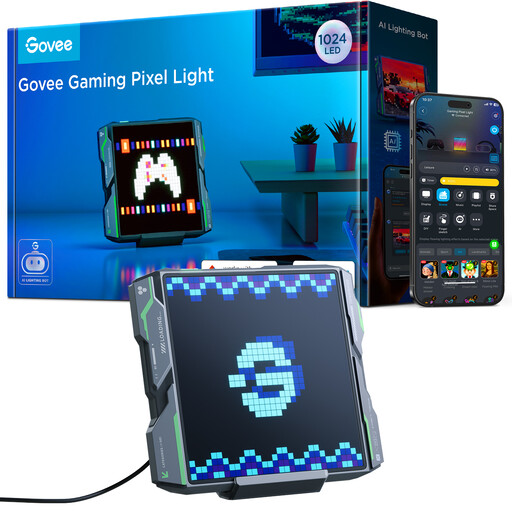
Why this product suits this profile: The 32×32 LED grid is designed for pixel art, animated content and gaming-oriented wall décor. It can also display music in various modes.
The 32×32-pixel resolution is clearly stated. The required firmware update is also highlighted, so it can be scheduled before full use.
32×32 LED grid, Bluetooth and Wi-Fi, app control, animated pixel art and 10 music-reactive modes according to the product description.
When integrating with Alexa, Google Assistant or Apple HomeKit, users should check whether an additional account is required for scenes, group control or automations. The panels consume electricity even when left in standby. Power consumption is the key factor when calculating running costs.
The basic calculation is:
Power in watts ÷ 1,000 × operating hours × electricity price per kilowatt-hour
A 14-watt panel operated for four hours a day uses approximately 20.4 kilowatt-hours per year in theory. Actual consumption depends on brightness, standby mode and usage time. Energy efficiency class G is listed in the product data for the Nanoleaf Elements models mentioned.
We have compiled a complete, regularly updated list of products that fully meet these strict selection criteria and the safety regulations applicable in the EU.
Most models are attached using the supplied adhesive strips or mounting elements. The surface should be clean, dry and as smooth as possible. With wallpaper or delicate paint, it is advisable to test the product first in an inconspicuous area. The planned design, including the cable route, should be finalised before mounting.
LEDs generally have a long expected service life. Actual lifespan depends, among other things, on operating hours, heat generation, the power supply and the electronics. Specific manufacturer lifespan information should be checked directly for the product in question. Replacing individual LEDs is generally not possible with permanently installed light sources.
This depends on the luminous flux, room size and arrangement. Many decorative panels are primarily designed for accent and ambient lighting. For a desk, kitchen or other areas with specific lighting requirements, an additional functional light may be useful.