
Lieferung heute & morgen

Qualitätsgarantie

Willkommens-Angebote freischalten: KOSTENLOSE Lieferung | Bis zu 80 % RABATT | Kostenlose 30-Tage-JoyPlus-Testphase
App herunterladen
The quality of today's smartphone cameras allows for video recordings that, just a few years ago, were exclusive to professional equipment. Yet, even the most advanced internal image stabilisation hits its limits during movement. A smartphone gimbal promises a solution, delivering cinematic, smooth footage. However, the path to the right model often leads through a jungle of marketing promises and technical data that confuse more than they clarify. Before you make a purchasing decision, you should know the most common pitfalls that lead to disappointment and unnecessary expense.
As a Joybuy Product Recommendation Officer, I see it as my duty to filter market information and provide you with objective, practical advice so you can make an informed choice.
Many devices look similar at first glance, but the differences are in the details—and it's precisely these details that determine long-term usability.
To avoid these traps, you should focus on a few crucial technical parameters. These form the basis for a reliable smartphone stabiliser.
The key difference lies in the number of axes a gimbal compensates for. While simple models only stabilise two axes (tilt and pan), a 3-axis gimbal is the standard for professional-looking results. It additionally compensates for the roll movement—the sideways tilting. This is essential to ensure truly steady and horizontal shots when walking, running, or during fast camera pans.
Before buying, check the weight of your smartphone (including its case) and compare it with the maximum payload of the gimbal. There should always be a reserve of at least 15–20% so that the motors do not run under full load permanently. This is especially important if you use a larger model, require an iPhone gimbal for a current device, or use an Android phone with a large display, or if you plan to attach external accessories like microphones.
For a gimbal for vlogging or long travel days, battery life is a critical criterion. Runtimes of around 10 hours or more are a good benchmark. Practical additional features, such as a built-in power bank to charge the smartphone during operation or a detachable smartphone tripod with a remote, significantly increase its utility and make separate accessories redundant.
Based on the criteria mentioned above, we have identified a few models that represent a considered choice for different requirement profiles.
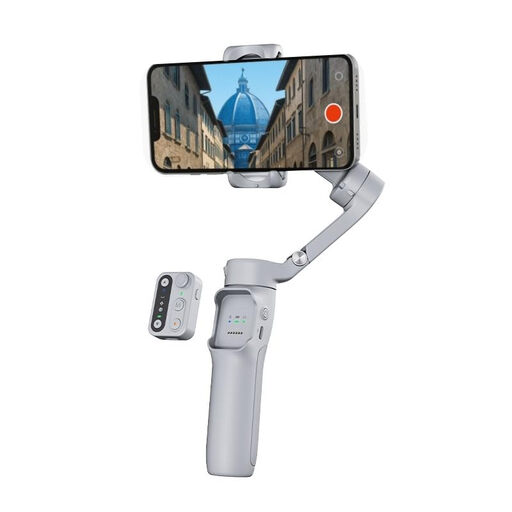
Why This Fits Their Persona: This model focuses on the core functions: reliable 3-axis stabilisation and solid battery life. It is ideal for users who want to enter the world of stabilised video without complex extra features.
The foldable design is built for durability, and control of the basic functions is not necessarily tied to an app. It focuses on a stable payload for common smartphones.
Long Battery Life: With up to 11 hours, it's ready for extended shooting days. Detachable Remote: Allows for remote shooting without needing an extra person.
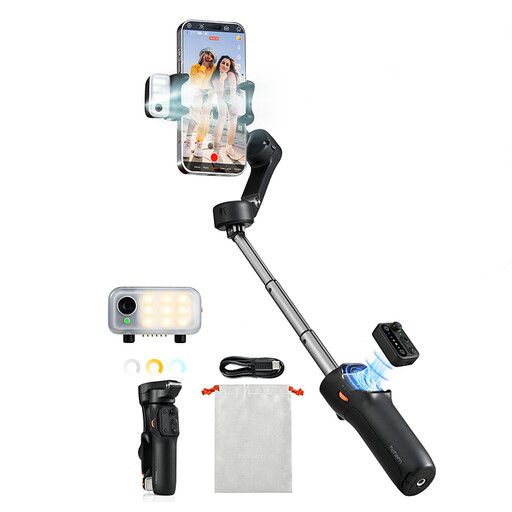
Why This Fits Their Persona: For vloggers who often film alone, this model is an all-in-one solution. The integrated fill light, AI tracking, and built-in tripod make additional equipment unnecessary and significantly simplify the workflow.
According to the manufacturer, the magnetic AI tracking module works without an app or Bluetooth connection. This bypasses the app dependency trap and conserves the smartphone's battery.
Integrated Fill Light: Improves image quality in low-light conditions. App-Independent AI Tracking: The tracking is controlled by gestures and reliably follows the subject.
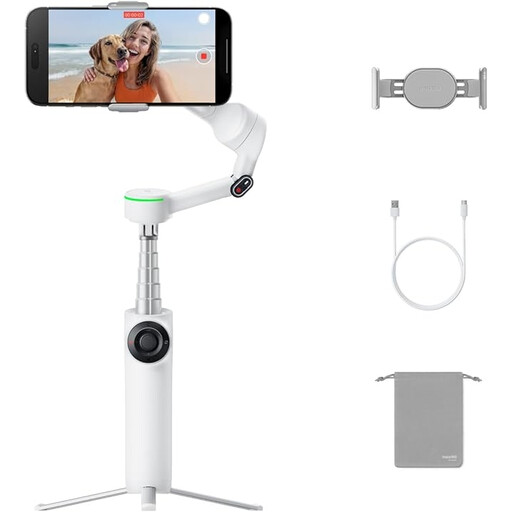
Why This Fits Their Persona: This bundle is aimed at users seeking advanced creative possibilities. With features like Active Zoom Tracking and Multi-Person Tracking, it is suitable for complex scenarios such as sporting events or group shots.
Although it relies on an app for advanced features, Insta360's software is known for its stability and regular updates. The robust construction and high payload minimise compatibility issues.
Active Zoom Tracking: Allows for tracking subjects even at high zoom levels. Multi-Person Tracking: Automatically keeps an entire group in the frame, ideal for family or team videos.
We have compiled a complete, up-to-date list of products that fully meet these strict selection criteria and safety regulations.
Not necessarily. The basic 3-axis stabilisation on most models works without an app as soon as the device is turned on and the smartphone is balanced. However, for advanced features like time-lapses, object tracking, or special shooting modes, the manufacturer's app is usually required. As mentioned above, some newer models offer AI tracking that is activated by gesture and functions independently of an app.
No. The most important factor is compatibility in terms of weight and dimensions. Check the gimbal's maximum payload and the weight of your smartphone, including its case. A phone that is too heavy or too wide can overload the motors and impair stabilisation performance. Pay close attention to the compatible dimensions specified by the manufacturer.
The lifespan heavily depends on the build quality and usage. A high-quality foldable gimbal with robust metal joints can last several years with careful handling. Cheaper models with plastic joints can wear out more quickly with frequent use. It is also important to never turn on the gimbal without a smartphone mounted, as this can damage the motors.