
Lieferung heute & morgen

Qualitätsgarantie

Willkommens-Angebote freischalten: KOSTENLOSE Lieferung | Bis zu 80 % RABATT | Kostenlose 30-Tage-JoyPlus-Testphase
App herunterladen
Shaky videos can make even the most interesting content look unprofessional. A smartphone gimbal promises smooth, cinematic footage straight from your phone. But the market is flooded with devices making grandiose marketing claims that often disappoint in practice. Before you invest, it's crucial to understand the common pitfalls that can lead to a bad purchase.
As your Joybuy Product Recommendation Officer, I'll help you objectively evaluate technical specs and find a device that truly fits your needs. We'll focus on the facts, not the marketing hype.
Many buyers focus on advertised features that later turn out to be impractical or prone to errors. Pay special attention to these two points:
To avoid a bad purchase, you should focus on measurable and objective criteria. These two parameters are fundamental to a gimbal's performance.
The core function of a gimbal is mechanical stabilisation. A high-quality camera stabilizer uses three separate motors to compensate for movement on three axes:
Models with only two axes or purely electronic image stabilisation (EIS) cannot deliver comparably smooth results, especially during fast movements or while walking. A 3-axis gimbal is therefore the technical baseline for professional-looking footage.
Before buying, always check the specifications for payload (given in grams) and the maximum supported smartphone dimensions. Compare these values with the weight and size of your phone, including its case.
Furthermore, the design plays a role in its intended use. A foldable gimbal is significantly more compact and easier to transport, making it an ideal travel tripod. Rigid models are often more robustly built and can support a higher payload, but they are bulkier. The weight of the gimbal itself is also a factor, as a heavy device can quickly become fatiguing during long shoots.
Based on these objective criteria, we have identified a few models that represent a smart choice for specific user profiles.
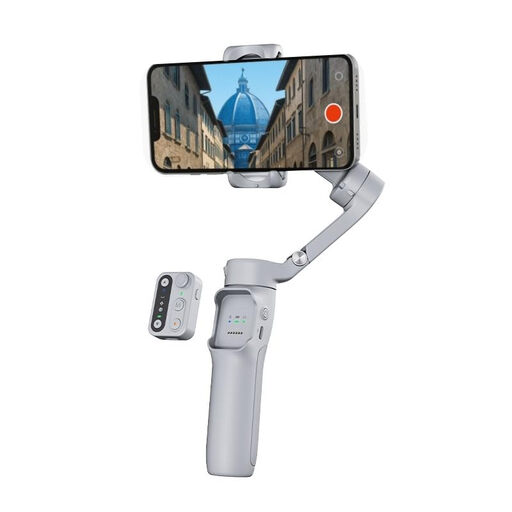
Why This Fits Their Persona: Ideal for users looking to upgrade their social media videos without diving deep into the tech. The foldable design and detachable remote are practical for solo creators and travel.
This model focuses on the core function—solid 3-axis stabilisation—without overwhelming the user with a bloated app. The payload is sufficiently rated for most common smartphones.
The detachable remote allows for shooting from up to 10 metres away. Its compact, foldable design makes it highly portable.
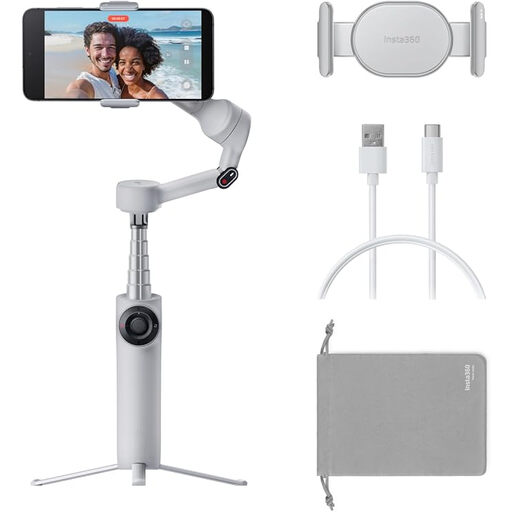
Why This Fits Their Persona: Designed for content creators seeking a reliable all-in-one solution. The built-in tripod, selfie stick, and advanced AI tracking features make it a powerful tool for vlogging and professional productions.
While it relies on an app, the Insta360 software provides genuine value with its precise AI tracking and AI-powered editing tools. The motors are strong enough for current smartphones, thus avoiding balance issues.
Advanced AI tracking that reliably keeps subjects and objects in frame. The all-in-one design with an integrated tripod and selfie stick reduces the amount of gear needed.
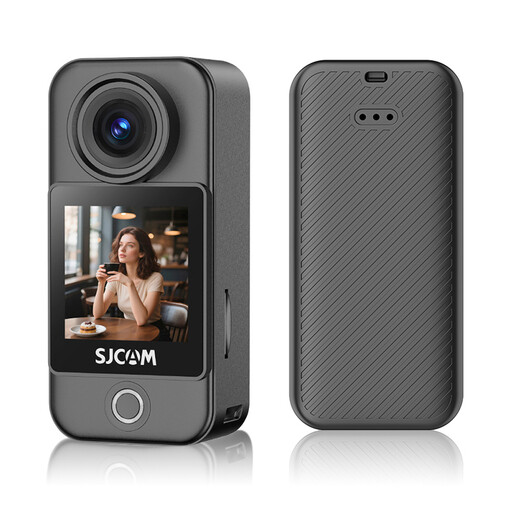
Why This Fits Their Persona: For users who prioritise compactness, durability, and quick deployment. This Action Camera 4K is an alternative to a gimbal, as its internal stabilisation is sufficient for many outdoor activities.
This device completely bypasses the typical mechanical weaknesses of a gimbal (motors, balance). It offers a purely electronic solution for stable footage in an extremely durable and small package.
The 6-axis gyro stabilisation delivers smooth 4K footage even during movement. With its case, it is waterproof up to 30m and extremely lightweight at just 54g.
We have compiled a complete, up-to-date list of products that fully meet these strict selection criteria and relevant safety standards.
For static shots or slow pans, the internal stabilisation of modern smartphones may suffice. However, as soon as you start moving, walking, or running, the difference becomes obvious. A 3-axis gimbal mechanically compensates for these complex movements, creating a smooth, professional look that purely electronic stabilisation cannot achieve. It is often essential for a high-quality vlogging camera setup.
Battery life varies greatly depending on the model and usage. Manufacturer claims (often 8-12 hours) usually refer to ideal conditions with a perfectly balanced, lightweight smartphone and minimal movement. During active use with a heavy phone and frequent, rapid pans, the actual runtime can drop to 4-6 hours. Models with a reverse charging feature can charge your smartphone during operation, which further affects the total usage time.
Many smartphone gimbals, especially foldable models, have a small, integrated tripod for camera applications or a standard 1/4-inch thread at the bottom of the handle. This allows you to place the gimbal on a flat surface for static shots, time-lapses, or self-portraits. It then functions as a mini travel tripod. However, always follow the manufacturer's safety instructions regarding stability on uneven or windy surfaces.