
Lieferung heute & morgen

Qualitätsgarantie

Willkommens-Angebote freischalten: KOSTENLOSE Lieferung | Bis zu 80 % RABATT | Kostenlose 30-Tage-JoyPlus-Testphase
App herunterladen
A smartphone gimbal with tripod combines several filming aids in one device: video stabilisation, hands-free recording, flexible viewing angles and, depending on the model, an integrated selfie stick. For vloggers, travellers, livestreamers, families and social media users, this can be more practical than a single phone holder or a separate smartphone tripod.
However, many models look very similar in product images. This makes certain specifications particularly important before you buy. As a Joybuy Product Recommendation Officer, I filter the relevant product data and show you what to look for when choosing.
A Bluetooth selfie stick with tripod enables you to take photos from a distance and can hold your smartphone hands-free. However, it does not compensate for movement while walking in the same way as a motorised 3-axis gimbal. If you regularly walk, pan or create vlog footage, you should therefore distinguish between a basic selfie stick and active video stabilisation.
The term “gimbal with AI tracking” does not automatically describe the same technology. Depending on the model, tracking may require an app, Bluetooth or a dedicated additional module. Compatibility with iPhone and Android may also vary. Before buying, you should check that the desired tracking function works with your smartphone and the app you use.
A long telescopic pole may seem practical at first glance. However, when fully extended, the weight of the smartphone, wind and uneven ground can affect stability. It is therefore not just the maximum length that matters, but also the base design, material, locking mechanism and centre of gravity.
A motorised gimbal uses motors to compensate for smartphone movement. A 3-axis gimbal typically controls tilt, pan and roll. For walks, indoor filming or vlogging, this can produce smoother footage than a simple hand holder.
The following are also important:
A model with an integrated selfie stick and tripod also reduces the amount of vlogging equipment you need. For stationary filming only, a smartphone tripod without a motor may be sufficient.
The folded size determines whether the accessory will fit in your rucksack or a drawer. According to the product specifications, the 1.6 m Reverse Folding Projector Tripod Stand folds down to 60 cm and can be adjusted between 40 and 160 cm. Its aluminium construction, triangular support and non-slip feet are designed for different working heights.
When choosing a selfie stick, buyers should also check whether the head switches securely between portrait and landscape orientation. The stated maximum length of the Verbex K50 is approximately 193 cm, while the S05S reaches approximately 100 cm. A greater reach is particularly useful for group photos or full-body shots, but is not automatically necessary for every desk.
Motorised gimbals require a battery. Battery life should match the planned recording time. According to the manufacturer’s specifications, the DJI Osmo Mobile 7P offers up to 10 hours of use, the hohem 3-axis model up to 13 hours and the Insta360 Flow 2 Pro Bundle up to 10 hours.
With Bluetooth selfie sticks, the remote control is often powered by a separate battery. The stated remote-control range for the Verbex models is approximately 10 metres. A fill light, detachable shutter button or additional smartphone charging port can be useful, but they also increase the number of components. You should therefore check whether spare batteries, USB-C charging or an app are required.
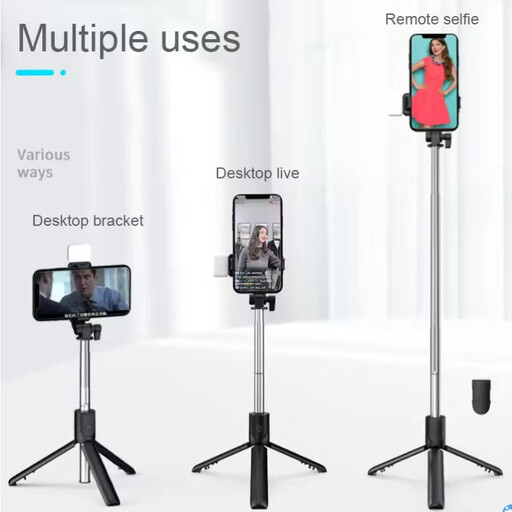
Why this product suits this profile: According to the product data, this Bluetooth selfie stick combines a stated length of 100 cm with tripod functionality and a fill light. It supports iOS and Android and is suitable for simple selfies, family photos or short livestreams.
The product data specifies the range, weight, Bluetooth connection and tripod function. This clearly distinguishes its features from active gimbal stabilisation.
Tripod function, Bluetooth remote control and integrated fill light, with a stated weight of 200 g.
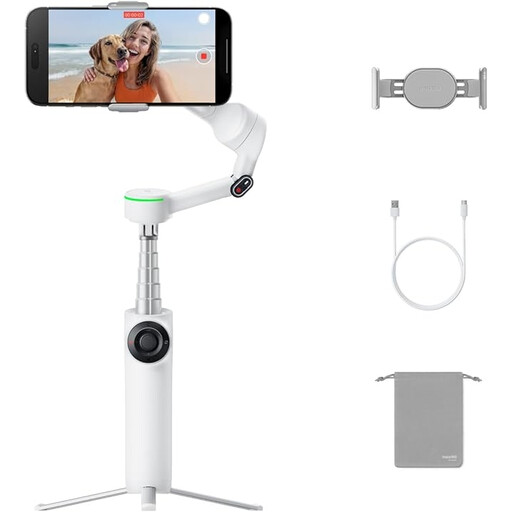
Why this product suits this profile: According to the product description, this foldable 3-axis gimbal features an integrated tripod, selfie stick, remote control and up to 10 hours of battery life. Apple DockKit support is intended for compatible iPhone models.
The specifications distinguish between native iOS functions, tracking and stabilisation. Before buying, you should check compatibility with your iPhone.
Integrated recording features and 360-degree pan tracking according to the product description.
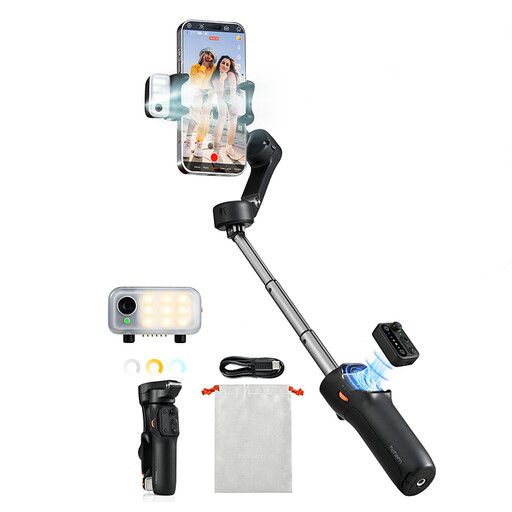
Why this product suits this profile: This model combines 3-axis stabilisation, AI tracking, a fill light, detachable remote control, tripod and extendable pole. According to the product data, it offers up to 13 hours of battery life.
The product description explicitly states that its magnetic tracking works independently of apps and Bluetooth. Even so, the smartphone must be balanced and securely clamped before every recording.
Foldable design, detachable remote control, fill light and stated 13-hour battery life.
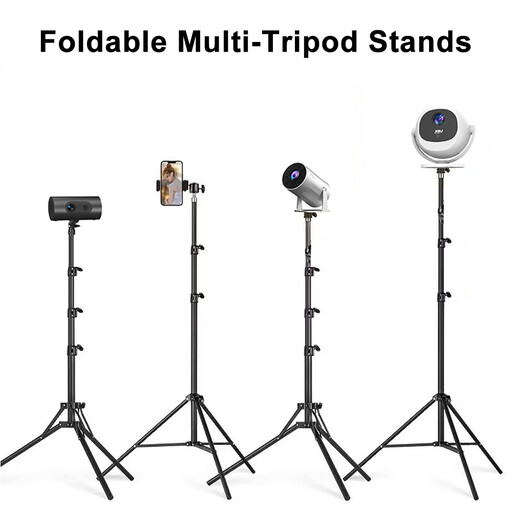
Why this product suits this profile: This height-adjustable projector stand has a 1/4-inch thread, smartphone clip and adapter. It can therefore be used for smartphone photography, ring lights, cameras or projection.
The stated height adjustment from 40 to 160 cm and folded size of 60 cm make its intended use clear. However, it is not a motorised gimbal.
1/4-inch connection, 360-degree horizontal rotation, adjustable height and aluminium construction according to the product specifications.
We have put together a complete, regularly updated list of products that fully meet these strict selection criteria and the safety regulations applicable in the EU.
A phone gimbal stabilises the smartphone during movement using motors, often across three axes. A selfie stick with tripod, on the other hand, holds the device in a fixed position and usually allows remote triggering via Bluetooth. A gimbal is better suited to walks and moving videos, while a selfie stick may be enough for group photos or stationary filming.
Battery life depends on the model, tracking, fill light and charging habits. For example, the products mentioned offer up to 10 or 13 hours. These figures are based on manufacturer specifications and may be lower with intensive use. Before longer recording sessions, it is advisable to fully charge the device and, if necessary, bring a power bank.
No. Some functions can be controlled directly using buttons, Bluetooth or a separate tracking module. However, advanced filming aids, editing functions or certain tracking modes may require a manufacturer’s app. According to the product information, the DJI Osmo Mobile 7P’s DJI Mimo app is not available in the Google Play Store due to a platform compatibility issue and should be obtained from the official DJI website.