People keeping to a calorie budget
If you want a bar to fit within your planned calorie budget, you’ll need to know the weight of the portion you actually eat, as well as the kcal per 100 g.


If you’re looking for a lower-calorie snack bar from a budget supermarket range, start by comparing the kcal per 100 g and the weight of each bar. Sugar or protein figures aren’t a substitute for comparing portions: EDEKA lists 349 kcal per 100 g for its GUT&GÜNSTIG chocolate muesli bar with no added sugar.
If you want a bar to fit within your planned calorie budget, you’ll need to know the weight of the portion you actually eat, as well as the kcal per 100 g.
If you’re looking for a lower-sugar bar from a budget supermarket range, check the sugar and energy values separately. It’s also worth checking the ingredients list on products labelled ‘no added sugar’.
If you’re considering a protein bar instead of a classic muesli bar, compare the protein and energy values on the same per-100-g basis. Also check the portion size, ingredients and consumption advice.
Start with the energy value per 100 g, work out what that means for an individual bar, then check the nutritional values and ingredients that matter to you.
| Criteria | What to check | Who it matters to |
|---|---|---|
| Calories per bar | Compare the kcal per 100 g with the weight of each bar; check the pack if the stated weights don’t match. | If I want to include an individual bar in my calorie budget, I need to know the energy content of the portion I’ll actually eat. Around 42% of consumers prioritise this calorie check when choosing a bar. |
| Sugar and ingredients | Check ‘of which sugars’, the energy value and the ingredients list together; don’t take ‘no added sugar’ to mean that the product is low in calories. | For an everyday snack, I want less sugar without losing sight of the calories. For around 33% of consumers, this sugar-conscious comparison comes first. |
| Protein and consumption advice | Compare protein and kcal per 100 g; check the ingredients and pack advice for polyols. | If I’m choosing a protein bar for a specific reason, I want to assess its nutritional values and consumption advice together. Around 25% of consumers focus on this. |
EDEKA lists 349 kcal per 100 g for its GUT&GÜNSTIG chocolate muesli bar with no added sugar. So the claim about added sugar doesn’t tell you its energy value; EDEKA also says this variety contains sugar substitutes.
Check the energy value, sugar content and ingredients list together before choosing this variety.
A small pack doesn’t tell you how many calories are in an individual bar. That depends on the bar’s weight and the kcal per 100 g.
Compare the nutritional information on the same basis, then work it out for the portion you want to eat.
The bars considered here differ in their ingredients and allergen information. ALDI SÜD also warns that excessive consumption of the ALDI SPORTS protein bars considered here may have a laxative effect because they contain polyols.
If you have allergies, check the current packaging. For bars containing polyols, follow the relevant consumption advice.
The product ranges below include different types of muesli and protein bars. For an accurate comparison, always check the information for the specific variety on its current packaging.
EDEKA’s own brand includes the peanut muesli bar and chocolate muesli bar with no added sugar considered here, both in packs of 8 × 25 g.
REWE’s own-brand range includes chocolate muesli bars with no added sugar and sweet-and-salty peanut muesli bars, both in packs of 8 × 25 g.
The Lower Carb Protein Bar Coconut-Almond and High Protein Bar Nougat varieties described by ALDI SÜD are protein bars, not classic muesli bars.
The range listed by REWE includes several Corny lines, including Haferkraft, Free and Protein varieties.
These muesli and cereal bars are worth comparing for their portion sizes and nutritional information. To decide whether a variety fits your calorie goal, check the current packaging and the amount you plan to eat.
 No image available
This Cocoa variety is an option if you want to compare the portion size of an oat muesli bar.
The product title states 4 × 35 g, while another product detail gives a different bar weight. Check the weight on the packaging before calculating the calories per bar.
 No image available
If you want to compare a muesli bar with a stated individual weight, the product description gives you a starting point: 12 bars of 50 g each.
Check the kcal per 100 g on the packaging to work out your portion. For a peanut variety, it’s especially important to check the current ingredients and allergen information if you need to avoid peanuts.
 No image available
For a smaller snack portion with a stated individual weight, the product description lists six cereal bars of 20 g each.
Check the energy value in the nutritional information: ‘No Added Sugar’ alone doesn’t tell you how many calories are in each bar. Also check the ingredients and consumption advice on the packaging.
 No image available
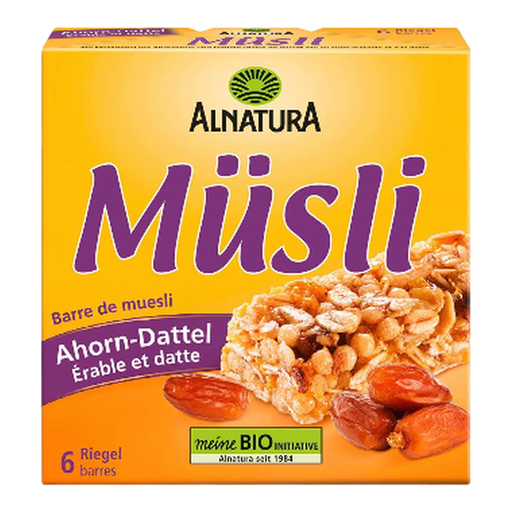
If you want to compare muesli bars in 25 g portions, the product description lists six bars in this Maple & Date variety.
A smaller portion doesn’t replace comparing the kcal per 100 g. For your choice, also check the ingredients and allergen information on the current packaging.
No. ‘No added sugar’ doesn’t tell you the energy value. Lebensmittelklarheit, run by the Verbraucherzentrale, explains that these products may still be sweetened with sweeteners or sugar substitutes; EDEKA lists 349 kcal per 100 g for its GUT&GÜNSTIG chocolate muesli bar with no added sugar.
First compare the nutritional information per 100 g, then take the weight of an individual bar into account. This lets you work out the kcal for the portion you actually want to eat. If the weight isn’t clear, check the packaging first.
As well as the sugar content, check the ingredients list and consumption advice. For the ALDI SPORTS protein bars considered here, ALDI SÜD lists polyols and warns that excessive consumption may have a laxative effect.
Not necessarily. EDEKA says the GUT&GÜNSTIG products considered here may not be available in every store. If you’re looking for a particular variety, check your local store’s range and the information on the packaging there.