What should you look for when buying?
If you have coeliac disease, first check the gluten-free labelling on the specific bar. Then compare the nutrition information for your portion, and read the ingredients list if you have any other requirements.
| Criterion | What to check | Who should pay particular attention |
|---|
| Gluten-free status |
Check that the specific bar is labelled “gluten-free”, even if it contains oats. According to the Verbraucherzentrale, this claim is subject to a maximum limit of 20 mg gluten per kg of food. |
If I want to eat a bar on the go with coeliac disease, its gluten-free labelling must be clear. This is the top priority for around 50% of shoppers. |
| Energy per portion |
Compare the kilocalories per 100 g and the weight of the bar you’ll eat; portion information on the pack can make comparisons easier. |
For a single snack, I want to know how much energy the portion I actually eat provides. This comparison is the priority for around 30% of shoppers. |
| Ingredients and allergens |
Read the ingredients list, highlighted allergens and any precautionary “may contain” statements for the variety you’ve chosen. |
If I also need to avoid certain ingredients or choose a particular recipe, the gluten-free claim alone isn’t enough. For around 20% of shoppers, finding a suitable mix of other ingredients is the main priority. |
“Low calorie” is a regulated nutrition claim for solid foods: according to the European Commission, it can only be used when a product contains no more than 40 kcal per 100 g. This is different from the energy content of an individual bar. For example, Schär Shop Germany lists the Schär Cereal Bar at 419 kcal per 100 g, with each bar weighing 25 g. These figures apply to this product, not to other varieties.
Brands to help guide your choice
The brands listed offer a range of bars and snack products. When choosing, check the information for the specific variety rather than relying on the brand name alone.
Schär
Schär offers, among other things, gluten-free labelled cereal products and sweet snacks.
- Schär Shop Germany sells the Cereal Bar as a 25-g bar and lists 419 kcal per 100 g.
- The nutrition information for this bar doesn’t apply to other Schär varieties; check their ingredients and portion sizes separately.
Alnavit
Alnavit offers gluten-free labelled oat bars, including chocolate and peanut varieties.
- Alnavit describes its 50 g Hafer Riegel Schoko as gluten-free and vegan.
- Alnavit states that the peanut variety contains 27% roasted peanuts. Check the ingredients and nutrition information for the variety you’re planning to buy.
Hammermühle
Hammermühle offers, among other things, gluten-free labelled Oat Bars.
- Hammermühle lists gluten-free oats as an ingredient in its Bio Oat Bar Peanut & Chocolate.
- Other ingredients and allergen information vary by variety; the gluten-free claim says nothing about its calorie content.
Lifefood
The Lifebar range includes fruit- and nut-based bars as well as oat snacks.
- Lifefood describes gluten-free wholegrain oats as the base of its Lifebar Oat Snack Protein Hazelnut Crunch.
- For the variety you choose, check its gluten-free labelling, other ingredients and energy per portion.
Gluten-free labelled bars at Joybuy
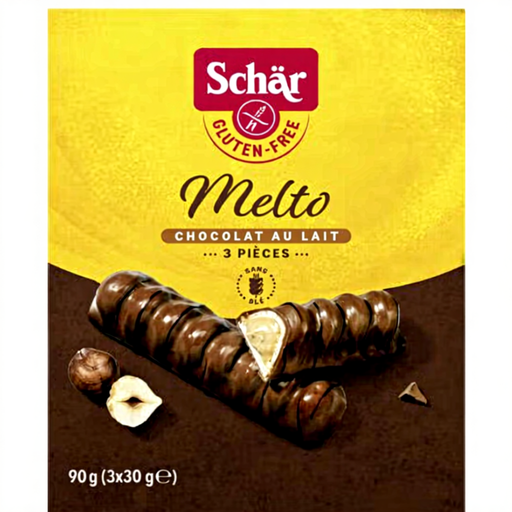
This bar is labelled as a gluten-free snack option and comes in individual 30-g portions. If you have coeliac disease and want to keep an eye on portion size, the labelling and nutrition information on the specific pack are what matter.
 No image available
Schär Melto Hazelnut Wafer Bars, gluten-free, 3 × 30 g
These hazelnut wafer bars are labelled gluten-free and are a suitable option if you’re looking for an individually portioned snack. The pack contains 3 × 30 g. For the portion you eat, compare the nutrition information and check the ingredients and allergen labelling on the specific pack.
View at Joybuy
Frequently asked questions
What does “gluten-free” mean on a snack bar?
Under current EU labelling rules, the claim “gluten-free” can be used in Germany when a food contains no more than 20 mg gluten per kg, as explained by the Verbraucherzentrale. It doesn’t mean that tests have found absolutely no gluten.
Is every oat bar suitable for people with coeliac disease?
No. The presence of oats alone isn’t enough to make a bar suitable. Standard oats can come into contact with cereals containing gluten, so look for clear gluten-free labelling on the specific bar.
How do I compare the calories in two bars of different sizes?
First compare the energy per 100 g, using the same basis, then take into account the weight of the portion you’ll actually eat. If the pack lists kilocalories per bar, you can compare those figures directly for your portion.
Do I need to check for other allergens in a gluten-free bar?
Yes. The “gluten-free” claim doesn’t tell you whether a product is suitable for other allergies. Read the ingredients list, highlighted allergens and any precautionary “may contain” statements for the specific flavour.


