Travellers with a small appetite
If you only want to pack a small snack for a short train journey, the fat content per 100 g and the portion size are more useful than a product name featuring ‘fitness’ or ‘light’.


If you’re looking for a snack bar with a lower fat content for a train journey, start by comparing the figures per 100 g, then check the weight of each individual bar. Also check the ingredients and allergen information: a comparatively low fat content tells you nothing about whether a bar suits you, or whether it can be labelled ‘low fat’.
If you only want to pack a small snack for a short train journey, the fat content per 100 g and the portion size are more useful than a product name featuring ‘fitness’ or ‘light’.
For a longer journey, you might prefer a protein bar to a cereal bar. Compare the protein and fat content on the same basis, and check the ingredients in the specific variety.
If certain ingredients are a concern for you, check the allergen information and look for details of sugar alcohols before your journey. Verbraucherzentrale notes that sugar alcohols can have a laxative effect when consumed in large quantities.
When comparing snack bars for a train journey, start with the nutritional information per 100 g. The portion size then tells you how much you’ll actually pack and eat in one bar.
| Criterion | What to check | Who it matters to |
|---|---|---|
| Fat content | Compare fat per 100 g; for ‘reduced fat’ claims, also check what the comparison is based on. | For a small snack, I mainly want to compare the fat content of different bars clearly. This criterion comes first for around 42% of consumers. |
| Protein and portion size | Check the protein per bar and per 100 g, as well as the weight of each bar. | On a longer journey, a compact bar with a stated protein content matters more to me than the smallest portion. This need is a priority for around 33% of consumers. |
| Ingredients and suitability | Read the allergen information and look out for sugar alcohols in sweetened bars. | When I’m travelling, I want to avoid ingredients that don’t agree with me, even if another variety contains less fat. This is the main concern for around 25% of consumers. |
A bar may contain less fat than a comparison product without being ‘low fat’. Lebensmittelklarheit states that solid foods must contain no more than 3 g of fat per 100 g to be labelled ‘low fat’.
Compare the fat content per 100 g and, if a reduced-fat claim is made, check what it is being compared with.
A smaller bar may contain less fat per serving, even if its fat content per 100 g is higher. The individual portions being compared are different sizes.
Use the figures per 100 g to compare products, and the portion information to check how much you’ll actually eat.
A bar with little sugar may contain sugar alcohols. Verbraucherzentrale says these can have a laxative effect when consumed in large quantities.
Check the ingredients list for polyols. If you’re sensitive to them, check the specific variety before your journey.
Depending on the variety, the protein bars considered here contain ingredients such as milk, soya or collagen hydrolysate; other allergens may also be listed as possible traces.
Read the ingredients and allergen information for the specific variety before packing it for your journey.
The Chocolate-Caramel protein bar is an example for travellers who pay particular attention to the stated fat content of protein bars.
The Lowcarb Protein Bar Chocolate-Banana is a compact example for comparing protein content, fat content and ingredients.
The Chocolate & Almond cereal bar is a different type of bar for travellers looking for a smaller individual portion rather than a protein bar.
This selection includes cereal and oat bars, as well as a protein bar for train journeys. Compare the information on each pack with your priorities for fat content, portion size and ingredients; these bars are not all the same type of product.
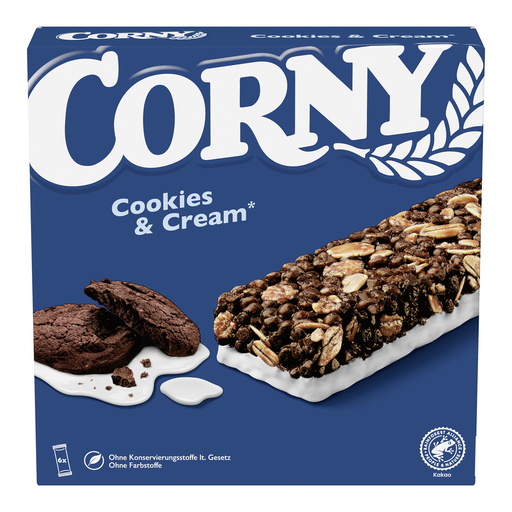 No image available
An option if you’d like to pack a smaller cereal snack for your journey.
The pack contains six bars, each weighing 23 g. Compare the fat content per 100 g and check the allergen information before choosing.
 No image available
An option if you’d like to compare a protein bar with other varieties by fat content for your train journey.
REWE lists 7.3 g of fat per 100 g for the Chocolate-Caramel bar. Before buying, check the pack and portion size for the specific product, along with its ingredients and allergen information.
 No image available
An oat bar for your journey if you prefer a larger individual portion than a small cereal bar.
The pack contains twelve bars, each weighing 50 g. If you need to avoid peanuts or sugar alcohols, check the ingredients and allergen information for this variety.
 No image available
An oat flapjack for travellers who want to take a single bar with a stated pack size.
The product name gives the weight as 60 g. Check the fat content per 100 g, along with the ingredients and allergen information, before comparing it with other bars.
No, the two claims don’t mean the same thing. Lebensmittelklarheit says that solid foods must contain no more than 3 g of fat per 100 g to be labelled ‘low fat’. Compare the figure in the nutritional information and, for ‘reduced-fat’ claims, also check what the comparison is based on.
A protein bar may suit you if the stated protein content matters; a cereal bar is another option for a smaller snack. In either case, check the portion size, fat content and ingredients rather than assuming the type of bar alone makes it suitable.
No, a low sugar content doesn’t tell you whether a bar will suit you. These bars may contain sugar alcohols, which Verbraucherzentrale says can have a laxative effect when consumed in large quantities. Read the ingredients list before your journey, especially if you’re sensitive to them.
The information for the specific variety is what matters. Depending on the product, the bars considered here list ingredients such as milk, soya, gluten-containing cereals, almonds or bovine collagen hydrolysate. A claim about protein or low sugar doesn’t tell you whether a bar meets your needs.