Households that regularly pack lunchboxes
If you’re thinking of buying a larger pack to keep in the cupboard, consider how much your household will actually use and how you’ll portion out small amounts for school.


A larger pack of snack mix can work for lunchboxes if your household will use it up, you portion out small amounts for the lunchbox and the ingredients and school rules are suitable for your child. Salty snacks should remain a planned extra: the Verbraucherzentrale lists bread, fruit and vegetables as parts of a varied lunchbox. When a mix contains several types of snack, it’s especially important to check the ingredients list.
If you’re thinking of buying a larger pack to keep in the cupboard, consider how much your household will actually use and how you’ll portion out small amounts for school.
If snacks are only meant to be a small extra, a lunchbox with separate compartments that you fill in advance can help. That way, you won’t need to send the whole pack to school.
If you need to avoid peanuts, cereals containing gluten, milk, soya or sesame, check the labelling on the specific pack. Also check which rules apply at your child’s school or in their class.
Start by choosing a pack size your household can use up. Then check the portion for the lunchbox, the ingredients and how the snack fits alongside the other foods in it.
| Criteria | What to check | Who it matters to |
|---|---|---|
| Pack size and cupboard stock | Compare the pack weight with how much your household uses, and plan how you’ll store it once opened. | If I pack lunchboxes regularly, I want to use up the contents of a larger pack before the quality starts to deteriorate. This need to keep snacks in stock is a priority for around 36% of consumers. |
| Portion control | Portion out a small amount in advance. If a manufacturer’s serving size is given, don’t assume it’s a prescribed portion for a child. | I want to pack a manageable amount in the lunchbox without sending the whole pack to school. Around 29% of consumers place particular importance on this portioning routine. |
| Ingredients and allergens | Check the ingredients list and any precautionary allergen statements on the specific pack against individual requirements and school rules. | If certain ingredients need to be avoided, I need to know exactly what’s in the mix. For around 21% of consumers, this check takes priority. |
| How it fits into the lunchbox | Check the nutritional information per 100 g and consider what other foods will fit in the lunchbox. | I only want to pack a snack occasionally alongside bread, fruit or vegetables, not instead of them. For around 14% of consumers, putting together the lunchbox is the most important selection criterion. |
A large pack doesn’t determine how much savoury snack you put in the lunchbox. The Verbraucherzentrale also classifies salty snacks as treats.
At home, portion a small amount into a separate container instead of sending the pack along.
A pack containing several types of snack may include a variety of ingredients and allergens. Lorenz lists peanuts, wheat, milk and soya among the ingredients in Snack-Hits.
Check the ingredients list and precautionary allergen statements on the pack you’re actually buying against your individual requirements and the school’s rules.
A salty snack can’t take the place of all the other foods in the lunchbox. The Verbraucherzentrale lists bread, fruit and vegetables as options for a varied lunchbox.
Plan the other items first, then decide whether to add a small portion of snack.
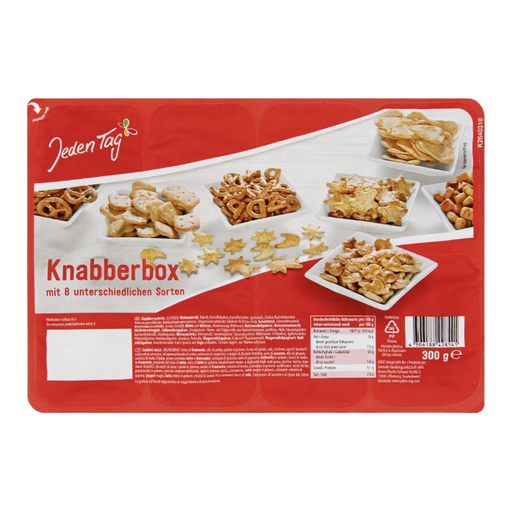
EDEKA24 sells a Gut & Günstig Snack Mix, a savoury snack mix in a 300-g pack.
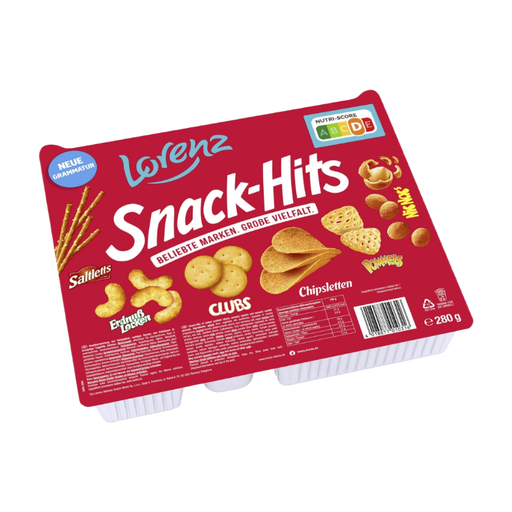
Lorenz describes Snack-Hits as a mix of six types of snack; REWE sells a 280-g pack.
funny-frisch sells Goldfischli Original in a 100-g pack and gives a manufacturer’s serving size of 30 g. It’s a cracker option rather than a large mixed pack.
This selection includes larger snack mixes and a set containing several types of snack. For a lunchbox, the portion size, the labelling on the specific pack and the other foods in the lunchbox are important for every option.
 No image available
The 300-g pack could suit a household that wants to keep a mix in stock and portion out small amounts for lunchboxes.
Before packing it, check the ingredients and allergen information on the specific pack against your child’s requirements. Treat the mix as an extra, not the main part of the lunchbox.
 No image available
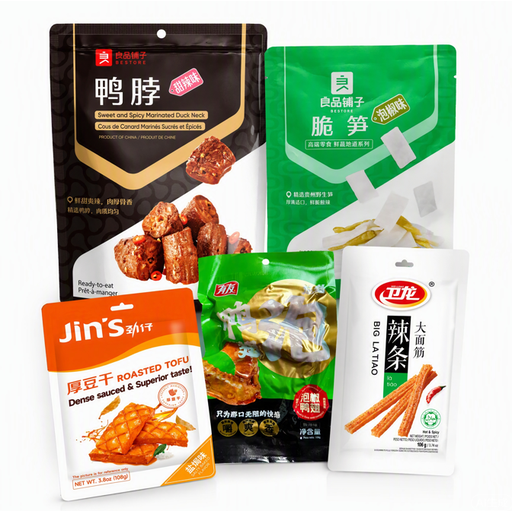
The five-piece set, weighing 810 g in total, could suit households that want to store several types of snack separately and choose individual packs before taking them out.
A warning about a colouring and its possible effects on children’s activity and attention is given for this set. Before packing it for lunch, check the exact labelling, as well as the ingredients and allergens in each individual pack.
 No image available
The 280-g mix could suit households looking for a variety of savoury snacks and wanting to portion out a small amount for the lunchbox themselves.
Lorenz lists peanuts, wheat, milk and soya among the ingredients in Snack-Hits; check the ingredients on the specific pack. For young children, also take note of the warning about the risk of choking on nuts.
A salty snack mix isn’t intended to be the only thing in a lunchbox. The Verbraucherzentrale counts salty snacks as treats and lists bread, fruit and vegetables as parts of a varied lunchbox. You could include a mix as a small extra.
A mixed pack may contain several allergenic ingredients, so you need to check the labelling on the pack you’re actually buying. Lorenz lists peanuts, wheat, milk and soya among the ingredients in Snack-Hits; if you have specific requirements, check any precautionary allergen statements too.