Shoppers keeping an eye on calories per portion
You want a single bar with your coffee, so you compare the kcal per bar rather than looking only at the nutrition information per 100 g.


If you want to keep an eye on the calories in your coffee break, start by comparing the kcal in the bar you’ll actually eat, taking its weight into account. Protein and sugar figures don’t replace this comparison. Also check the ingredients, allergens and sweetener information on the pack.
You want a single bar with your coffee, so you compare the kcal per bar rather than looking only at the nutrition information per 100 g.
You’re interested in sugar or protein, but still want to know how many kcal are in a portion. You can also check the ingredients and serving advice if needed.
For example, you may be checking for milk, soya, gluten, nuts, sesame or sweeteners. Always check the information for the specific product variant on the current pack.
First decide how much of a bar you’ll actually eat during your break. Then compare the energy for that amount, followed by any other nutrition information and ingredients that matter to you.
| Criterion | What to check | Who it matters to |
|---|---|---|
| Calories per portion | Check the kcal per bar, or calculate it from the kcal per 100 g and the bar’s weight. | I want to plan for exactly one bar with my coffee and know its energy content; around 39% of shoppers put calories per portion first. |
| Sugar and protein | Compare the sugar and protein per portion as well as the kcal. | Low sugar or a particular protein content matters to me, but I don’t want to overlook the energy in a portion; this additional criterion is the main priority for around 23% of shoppers. |
| A portion size to suit your break | Compare the bar’s weight and serving information with the amount you want to eat. | I want a bar that suits my appetite during a short break; around 23% of shoppers focus primarily on this practical question of portion size. |
| Ingredients and suitability | Read the ingredients list, allergen and trace information, and any information about sweeteners. | I need to avoid certain ingredients or want to take sweetener information into account; this check takes priority for around 15% of shoppers. |
These claims don’t tell you how much energy is in each bar. The Verbraucherzentrale recommends checking the nutrition information, even when particular nutritional qualities are highlighted.
Compare the kcal per bar and per 100 g before considering sugar or protein as additional criteria.
The figure per 100 g alone doesn’t tell you how many kcal are in the portion you eat. The European Commission explains that nutrition information is given per 100 g and may also be shown per portion.
If there’s no figure per bar, multiply the kcal per 100 g by the weight of your bar in grams, then divide the result by 100.
The Verbraucherzentrale points out that sugar substitutes can have a laxative effect when consumed in large quantities. This is particularly relevant if you eat these bars regularly or have several at a time.
Read the ingredients list and serving advice for the specific product variant.
Ingredients and allergen information are just as important as kcal when deciding whether a product is suitable. ALDI SÜD notes that information for the Lower-Carb bars it has reviewed may vary between suppliers.
If you have specific ingredient requirements, check the labelling on the pack you actually buy and eat.
The Lower-Carb protein bars featured here come as individually wrapped 45 g bars.
The Chocolate-Caramel protein bar featured here lets you compare sugar, protein and energy per portion.
For the Dark-Chocolate-Salted-Almond protein bar featured here, energy per bar matters as well as protein content.
The Active Protein Bar White Chocolate-Vanilla featured here can be assessed using its declared nutrition information and ingredients.
This selection includes an individually portioned cereal bar and a chocolate bar that you can break into smaller pieces. For both, what matters in a coffee-break comparison is the energy in the amount you actually eat.
 No image available
The individually wrapped 20 g bars are a handy option if you want to compare a fixed portion for your coffee break. Check the kcal and ingredients on the pack currently on offer; the product name’s claim about added sugar doesn’t answer the question of calories.
 No image available
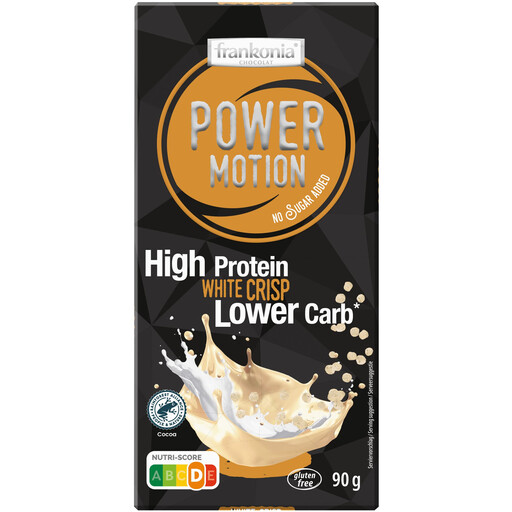
If you only want a smaller amount of this 90 g chocolate with your coffee, you’ll need to break off a portion deliberately. Compare the kcal for that amount and read the ingredients and serving advice on the current pack; the information in the product name doesn’t replace this check.
The kcal per bar matter for the amount you actually eat; the figure per 100 g helps you compare products of different sizes on a like-for-like basis. If there’s no figure per portion, calculate it using the bar’s weight and the kcal per 100 g.
No. Sugar and protein figures don’t tell you how many kcal are in each bar. For example, REWE lists 0.7 g of sugar, 20 g of protein and 135 kcal per 40 g portion for the Premier Protein bar featured here. So always compare the energy per portion too.
Read the ingredients list, highlighted allergens, any trace information and product-specific serving advice on the current pack. The Verbraucherzentrale points out that sugar substitutes can have a laxative effect when consumed in large quantities.
Under the EU rules explained by the European Commission, this nutrition claim is only permitted for solid foods containing no more than 40 kcal per 100 g. A bar may contain few kcal per serving without meeting the requirements to be labelled “low energy”.