
Lieferung heute & morgen

Qualitätsgarantie

Willkommens-Angebote freischalten: KOSTENLOSE Lieferung | Bis zu 80 % RABATT | Kostenlose 30-Tage-JoyPlus-Testphase
App herunterladen
A good socket set, often called a ratchet set, is the foundation for countless repair and maintenance jobs on cars, motorcycles, and around the house. However, the market is crowded, and many products fail to deliver on their promises. Before you invest, it's crucial to understand the common pitfalls that often lead to frustration and unnecessary expense. This guide will help you separate the wheat from the chaff and make an informed decision.
Many buyers focus on superficial features and overlook critical quality aspects. You should avoid these three mistakes:
To avoid a bad purchase, focus on three verifiable technical features. These determine the durability and functionality of your tools.
The material is the decisive factor for durability and lifespan. Look for the Chrome Vanadium Steel (Cr-V) designation. This alloy offers high hardness and toughness, making the tools resistant to deformation and breakage. An additional chrome plating provides effective protection against corrosion. For bits within a set, S2 steel is a mark of higher strength and wear resistance, which is especially important for screw-driving tasks.
The mechanism of the ratchet determines how efficiently you can work.
A good automotive tool set often includes ratchets and sockets in 1/4-inch and 1/2-inch sizes to cover a broad range of applications.
Instead of focusing on the sheer number of pieces, check if the included parts are practical for your needs. A good socket set for home use should seamlessly cover metric sizes from about 8 mm to 19 mm. For automotive work, larger sockets (up to 24 mm or more), spark plug sockets, and extensions are often necessary.
Here are some recommendations tailored to different needs and use cases.
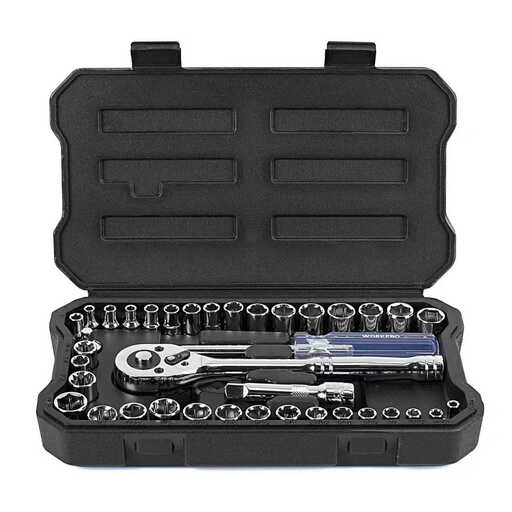
Why This Fits Their Persona: Ideal for household tasks and occasional repairs on a bike or car. This compact set combines the two most common drive sizes and provides a solid basic toolkit without cluttering your tool chest.
Instead of focusing on a huge piece count, this set concentrates on essential metric and SAE sizes. All core components are made from Chrome Vanadium Steel, ensuring good durability.
Combines 1/4" and 3/8" drives for high flexibility. Compact case for easy storage and transport.
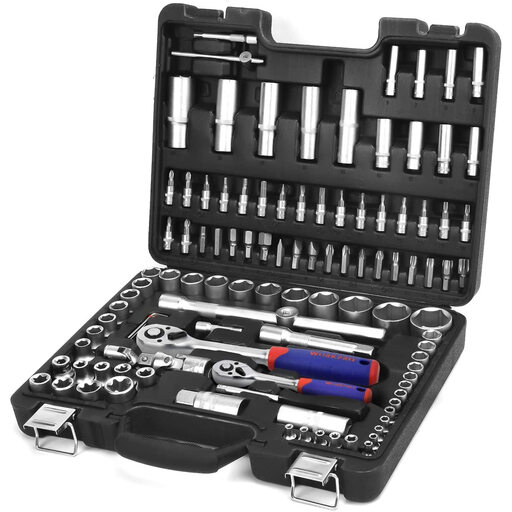
Why This Fits Their Persona: For anyone who regularly works on their own car or motorcycle. This comprehensive automotive tool set covers almost any job with its 1/4" and 1/2" drives, from small screws to suspension components.
The focus is on a practical composition. The 72-tooth ratchets enable efficient work, and the Chrome Vanadium Steel construction ensures longevity even under heavy use.
Broad application range thanks to two drive sizes. Includes spark plug sockets and extensions. Sturdy case for organisation.
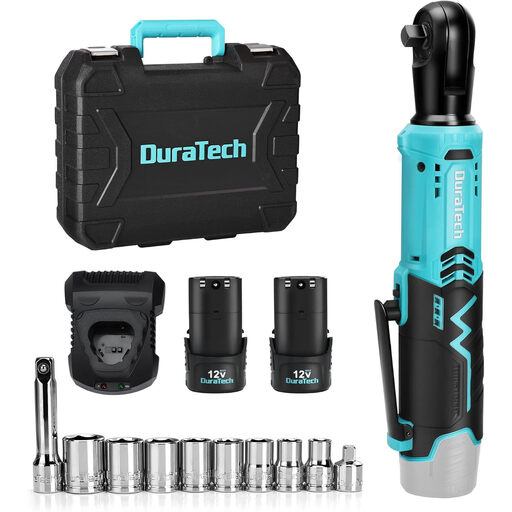
Why This Fits Their Persona: For users who want to save time and work without fatigue. This cordless ratchet significantly speeds up loosening and tightening screws and is especially useful for repetitive fastening or in hard-to-reach spots.
This tool is not a replacement but a supplement for specific tasks. It solves the problem of tedious manual work in tight spaces. According to the manufacturer, the motor delivers up to 65 Nm of torque, which is sufficient for many applications.
Enormous time savings and low-effort operation. Integrated LED light for dark work areas. Set includes two batteries and a charger.
We have compiled a complete, up-to-date list of products that fully meet these strict selection criteria and German safety regulations.
1. Which socket set is best for cars? For basic car maintenance (e.g., oil changes, battery replacement), a set with a 3/8-inch drive is often sufficient. For more extensive repairs on the chassis or engine, a combined automotive tool kit with 1/4-inch and 1/2-inch drives is recommended. Ensure it includes spark plug sockets and enough extensions. For the final tightening of safety-critical bolts (e.g., lug nuts, cylinder head), a torque wrench is also essential.
2. What does Chrome Vanadium Steel mean in a socket set?Chrome Vanadium (Cr-V) is a steel alloy used to manufacture high-quality tools. The chromium provides high hardness and corrosion resistance, while the vanadium increases toughness and wear resistance. A ratchet wrench set made from Cr-V steel is therefore significantly more durable and robust than tools made from simple carbon steel.
3. How many teeth should a good ratchet have? A higher tooth count means a smaller working angle, which is advantageous in tight spaces. A ratchet with 72 teeth requires only a 5° swing to turn the fastener. Models with 90 teeth need only 4°. Ratchets with 48 teeth or fewer are less suitable for professional or ambitious automotive work, as they require more room to operate.