
Lieferung heute & morgen

Qualitätsgarantie

Willkommens-Angebote freischalten: KOSTENLOSE Lieferung | Bis zu 80 % RABATT | Kostenlose 30-Tage-JoyPlus-Testphase
App herunterladen
A good socket set, often called a ratchet set, is the cornerstone of any well-equipped workshop. Whether for professional auto repairs, machine maintenance, or demanding DIY projects, the right choice determines the efficiency, safety, and longevity of your work. However, the market is flooded with sets that impress at first glance but quickly turn out to be a bad investment. As your Joybuy Product Recommendation Officer, I'll help you separate the wheat from the chaff and avoid the common pitfalls.
Before you invest, you should know the marketing tricks that often lead to disappointment. Many sets are designed to dazzle with sheer size but fall short on crucial quality features.
To avoid a bad purchase, focus on three verifiable criteria. These determine whether a ratchet set is suitable for your needs.
The drive size, specified in inches, defines the application range of the ratchet and its corresponding sockets. Each size has its specific strengths:
Comprehensive sets often include ratchets and sockets for multiple drive sizes, which significantly increases flexibility.
For durable and resilient professional tools, Chrome Vanadium Steel (Cr-V) has established itself as the industry standard. This alloy offers high strength and toughness, preventing the tool from breaking or deforming under load. Look for this designation. The surface finish also plays a role:
The heart of every ratchet set is the reversible ratchet. In addition to the aforementioned tooth count, which determines the working angle (e.g., 72 teeth = 5° angle, 90 teeth = 4° angle), the following features are crucial:
Here are some recommendations tailored to specific needs that meet the quality criteria mentioned above.
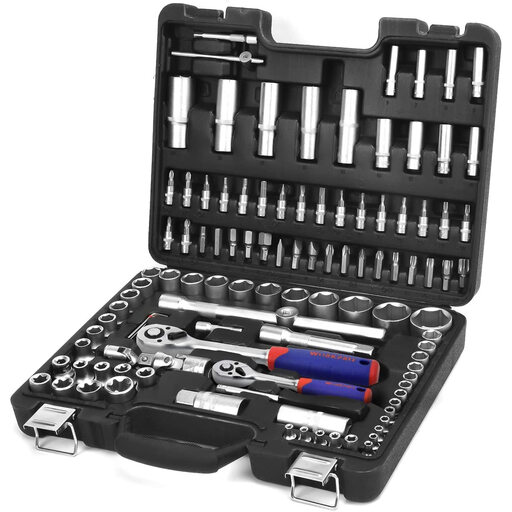
Why This Fits Their Persona: This set provides a solid foundation for most household repairs and basic automotive work. It combines the two most important drive sizes and offers a wide selection of accessories at a reasonable price.
The set is clearly declared as being made from chrome vanadium steel and avoids the trap of incomplete cases by bundling the common 1/4" and 1/2" drives with accessories like extensions and joints in one case.
Comprehensive scope for two drive sizes; Sturdy carrying case for organized storage.
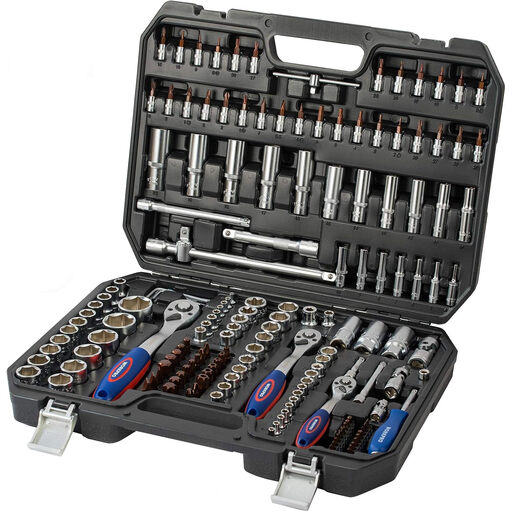
Why This Fits Their Persona: For mechanics and DIYers who regularly work on vehicles and need a system that leaves nothing to be desired. This set covers almost every conceivable fastening task.
This is the opposite of an incomplete case. With 1/4", 3/8", and 1/2" drives as well as a huge selection of standard, deep, Torx sockets, and bits, you are prepared for almost any eventuality. The need to buy individual parts is minimized.
Extremely comprehensive with three drive sizes; Includes many specialty bits and sockets (e.g., E-Torx); Made from Cr-V and S2 steel.
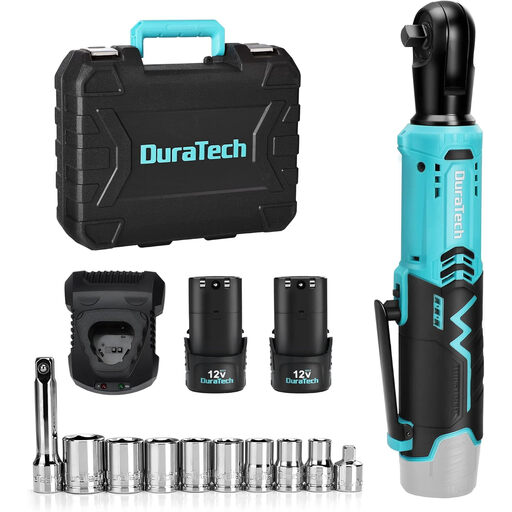
Why This Fits Their Persona: This tool is designed for users where time is money. It dramatically speeds up repetitive fastening tasks and reduces physical strain, especially in tight or hard-to-reach areas of the engine bay.
A cordless ratchet wrench bypasses the debate over tooth count by motorizing the rotation. Instead of tedious back-and-forth ratcheting, the motor does the work quickly and continuously after the fastener has been manually broken loose.
Massive time savings on repetitive fastening; LED light to illuminate the work area; Complete set with two batteries, charger, and sockets.
We have compiled a complete, up-to-date list of products that fully meet these strict selection criteria and quality standards.
1. What is the practical difference between a 72-tooth and a 90-tooth ratchet? A 72-tooth ratchet requires a 5-degree swing arc to engage the next tooth. A 90-tooth ratchet only needs 4 degrees. This one-degree difference can be crucial in extremely tight spaces, such as deep in an engine bay, determining whether you can move the ratchet at all. For most applications, however, a high-quality 72-tooth ratchet is perfectly sufficient and often more robust.
2. What material is recommended for a durable socket set? Look for the Chrome Vanadium Steel (Cr-V) designation. This alloy is the proven standard for high-quality hand tools because it combines high strength with sufficient toughness to withstand high torque without breaking. For bits, S2 steel is also often used, which has even greater hardness.
3. Do I really need a set with 1/4, 3/8, and 1/2 inch drives? That depends on your field of application. For general household use and bicycle repairs, a set with 1/4" and/or 3/8" is often sufficient. However, if you regularly work on cars or larger machinery, an automotive tool kit that covers all three sizes is a worthwhile investment. It saves you from buying additional tools when you work on chassis parts (1/2"), engine components (3/8"), and interior trim (1/4").