
Lieferung heute & morgen

Qualitätsgarantie

Willkommens-Angebote freischalten: KOSTENLOSE Lieferung | Bis zu 80 % RABATT | Kostenlose 30-Tage-JoyPlus-Testphase
App herunterladen
A well-equipped toolbox is the foundation for any successful repair or assembly project. Whether you're working on a car, a bicycle, or furniture, stubborn bolts and nuts can often be an insurmountable obstacle without the right tools. A versatile socket set is a central element in this regard. However, the selection of sets is vast, and the differences are in the details.
This article serves as a guide. We will introduce objective criteria relevant to choosing a suitable set and present a selection of models for various applications. Our goal is to provide you with an informed basis for your decision, so you can find the ratchet set that perfectly meets your requirements.
Before you decide on a model, several technical features should be considered. These determine which tasks a socket set is suited for and how efficiently you can work with it.
The drive size, specified in inches, defines the connection point between the ratchet and the socket. The most common sizes are:
The scope of the set (number of pieces) should match your planned projects. A set for occasional home use requires fewer parts than a toolbox for car repairs, which demands a wide range of metric sizes.
The longevity of a tool set depends significantly on its material. Chrome vanadium steel (Cr-V) is a proven material that offers high strength and corrosion resistance. A matte or chrome-plated finish provides additional protection against rust.
The heart of every set is the ratchet. An important quality indicator is the number of teeth in the mechanism. A 72-tooth ratchet has a small return swing angle of just 5 degrees. This means you need very little space to move the ratchet—a critical advantage when working in tight engine bays or behind panels. A tool set with a ratchet of this design significantly increases work efficiency.
Based on the criteria mentioned, we have compiled a selection of sets that are suited for different user profiles due to their specific features.
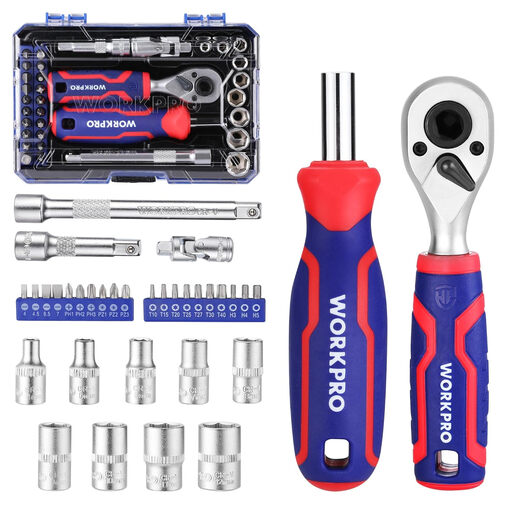
What makes this set stand out This set combines a compact 1/4-inch socket set with a comprehensive selection of bits. Its special feature is the 72-tooth dual-head ratchet, which accommodates both a 1/4-inch square drive for sockets and a 1/4-inch hex drive for bits.
Advantages
Who is it for? This set is an excellent choice for DIY enthusiasts and homeowners who need a lightweight, portable, and versatile tool for everyday repairs, furniture assembly, and fine adjustment work.
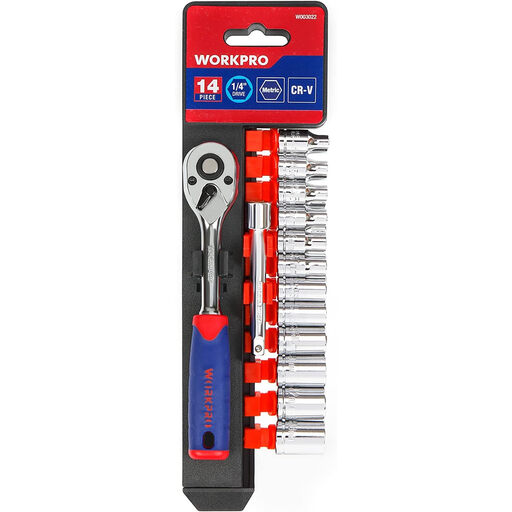
What makes this set stand out This set focuses on the essentials: a rock-solid socket set with the most common metric sizes from 4 to 13 mm. The high-quality craftsmanship and thoughtful ergonomics are the main focus here.
Advantages
Who is it for? Ideal for beginners looking for a reliable basic kit for general repairs around the house or on a bicycle. It also serves as a compact supplementary set for a tool trolley or for use on the go.
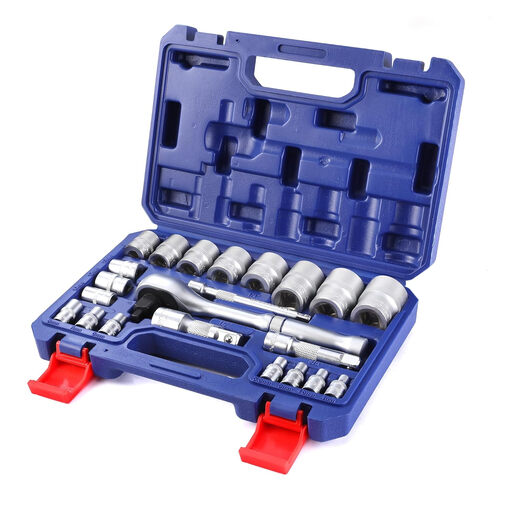
What makes this set stand out The centrepiece of this set is the innovative 3-in-1 ratchet. It combines the three most important drive sizes—1/4-inch, 3/8-inch, and 1/2-inch—into a single tool. This makes the ratchet set exceptionally versatile and space-saving.
Advantages
Who is it for? This set is aimed at ambitious DIYers and hobby mechanics who regularly work on a variety of projects—from bicycles and home appliances to the car. Anyone looking for a maximally flexible set without having to buy three separate ratchets will find a suitable solution here.
Was the right set for your specific project not included, or do you need a different configuration? In our category for tool sets, you will find more specialised and general-purpose options.
Discover more products from the Bar Tool Set category here.
1. What is the difference between a 1/4-inch, 3/8-inch, and 1/2-inch socket set? The inch measurement refers to the size of the square drive that connects the ratchet to the socket. 1/4-inch is intended for fine work with low torque. 3/8-inch is the universal standard for most general repairs. 1/2-inch is used for heavy-duty jobs with high torque, such as car repairs.
2. What does the abbreviation Cr-V mean for tools? Cr-V stands for Chrome Vanadium Steel. It is a steel alloy that becomes particularly hard, wear-resistant, and resistant to corrosion through the addition of chromium and vanadium. This is a quality feature for durable hand tools.
3. How many teeth should a good ratchet have? A higher tooth count is advantageous for working in confined spaces. A 72-tooth ratchet has a return swing angle of only 5 degrees, whereas a 48-tooth ratchet requires an angle of 7.5 degrees. For precise and efficient work in tight areas, a ratchet with 72 or more teeth is recommended.