
Lieferung heute & morgen

Qualitätsgarantie

Willkommens-Angebote freischalten: KOSTENLOSE Lieferung | Bis zu 80 % RABATT | Kostenlose 30-Tage-JoyPlus-Testphase
App herunterladen
A good socket set is the cornerstone of any workshop or household that wants to be prepared for repairs. But the market is flooded with sets that promise more than they deliver. Many DIY enthusiasts invest in a comprehensive tool case, only to find that half the parts are useless or the tools fail after a short time. As your Joybuy Product Recommendation Officer, I'll help you spot the common traps and make an informed decision.
Before you decide on a ratchet set, you should be aware of the three most common problems that lead to frustration and wasted money.
To avoid a bad buy, focus on the following technical features. These determine the durability and functionality of your tool set.
The choice of material is not a marketing gimmick but a decisive quality feature. Look for these two designations:
Ratchets and sockets come in different drive sizes, measured in inches. The three most common sizes for a tool set for cars and home use are:
The mechanics of the ratchet itself are also important. A ratchet with 72 teeth or more allows for a smaller swing arc (typically 5 degrees). This is particularly advantageous in tight spaces where you can barely move the ratchet.
Instead of making a one-size-fits-all recommendation, we have identified products tailored to specific needs.
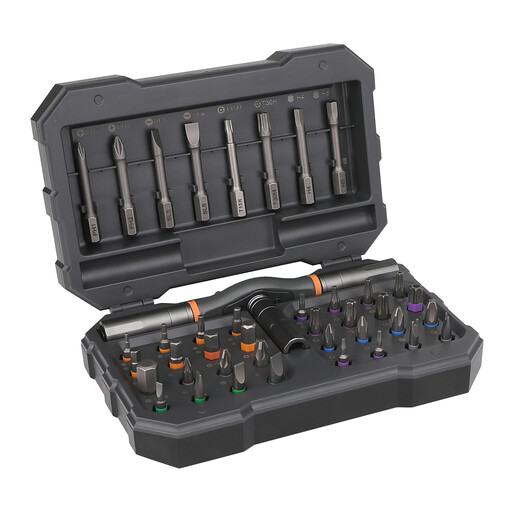
Why this set is a good fit: Ideal for those who need a versatile and compact set for furniture assembly, electronics repairs, and general household tasks. The multifunctional handle is designed for tight spots.
This set avoids the "more is better" trap with a targeted selection of 40 bits. According to the manufacturer, the bits are made of S2 tool steel, which counteracts the problem of inferior materials.
Combines the function of a ratchet screwdriver and a wrench. Includes 8 extended bits (45 mm) for deep-seated screws.
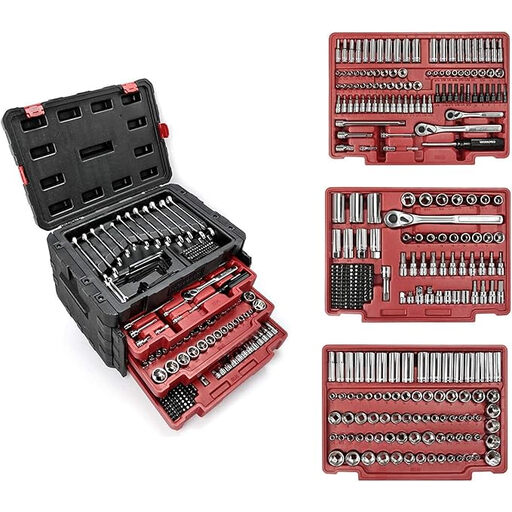
Why this set is a good fit: For users who regularly work on cars, motorcycles, and around the house and need a comprehensive set that covers all common drive sizes (1/4", 3/8", 1/2") and a wide range of sockets.
Although it contains 450 pieces, they are sensibly distributed across the three drive sizes, offering real utility instead of filler. According to WORKPRO, the tools are made of heat-treated, chrome-plated Cr-V steel, and the case is designed for secure and organised storage.
Extremely comprehensive equipment for almost any mechanical task. Includes metric and SAE sizes, making it useful for work on older or imported vehicles as well.
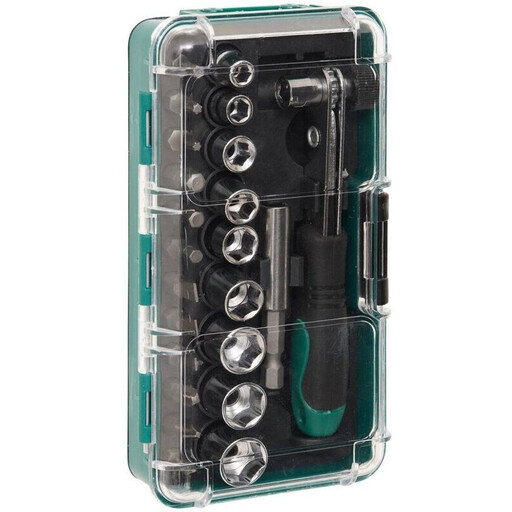
Why this set is a good fit: Perfect for the kitchen drawer or glove compartment. This set is for those who need a minimal yet functional tool for quick repairs and assemblies without sacrificing much space.
This set deliberately focuses on the essentials. It avoids any unnecessary bulk and offers the most common sizes in an ultra-compact, sturdy case that keeps the parts securely in place.
Extreme compactness and portability. The magnetic adapter allows for quick changes between bits and sockets.
We have compiled a complete, up-to-date list of products that fully meet these strict selection criteria and applicable safety regulations.
Cr-V (Chrome Vanadium) is a tough steel ideal for sockets and ratchets because it can withstand high torque without breaking. S2 steel is harder and is used for screwdriver bits to minimise tip wear and prevent slipping. A good set combines both materials for their respective components.
A higher tooth count means a smaller working angle. A ratchet with 72 teeth has a swing arc of 5 degrees, while one with 48 teeth has an arc of 7.5 degrees. For work in tight spaces, such as an engine bay, a ratchet with 72 teeth or more is significantly more comfortable and efficient.
For the vast majority of applications in Germany and Europe, you will need a metric set (with millimeter measurements). Screws and nuts on European vehicles, furniture, and appliances follow the metric system. SAE sizes (Society of Automotive Engineers, measured in inches) are primarily found on older American vehicles or special machinery. A purely metric socket set is generally the right choice for local use.