
Lieferung heute & morgen

Qualitätsgarantie

Willkommens-Angebote freischalten: KOSTENLOSE Lieferung | Bis zu 80 % RABATT | Kostenlose 30-Tage-JoyPlus-Testphase
App herunterladen
A good socket set is the cornerstone of any workshop or garage. Whether for car maintenance, assembling furniture, or household repairs, the right tools make any job easier. However, the market can be overwhelming, and many offers turn out to be poor investments. As your Joybuy Product Recommendation Officer, I'm here to help you spot the common pitfalls and make an informed decision.
Many buyers focus on the sheer number of pieces or on grandiose marketing claims. This often leads to disappointment. Pay attention to these three points to avoid falling for low-quality products:
Instead of being dazzled by the piece count, you should focus on three technical features. These determine the functionality and lifespan of your tool.
Material quality is the most important criterion. Look for the Cr-V steel (Chrome Vanadium steel) designation. This alloy offers significantly higher hardness and toughness than conventional carbon steel.
A socket set made from Cr-V steel is an investment that pays off with a longer service life.
Socket sets are available in different drive sizes, which are measured in inches. The three most common sizes are:
When it comes to the ratchet, pay attention to the tooth count. A ratchet with 72 teeth requires only a small 5-degree swing arc. This is crucial when working in hard-to-reach areas.
A good ratchet set is defined not by the sheer quantity of its parts, but by its thoughtful curation. For most applications, a purely metric set (sizes in millimetres) is usually sufficient. SAE sizes (in inches) are almost exclusively needed for US vehicles or older British models.
A practical, well-rounded set should include:
We have selected products from our range that meet the aforementioned quality criteria and are suited for specific user profiles.
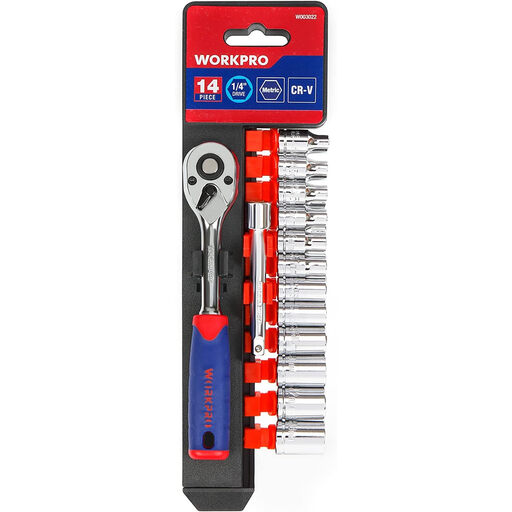
Why This Fits Their Persona: Ideal for anyone seeking a compact yet high-quality set for basic tasks around the house or on a bike. It covers the most common small bolt sizes and is easy to store.
This set avoids unnecessary filler and focuses on the essentials. It is made of durable Cr-V steel, and the 72-tooth ratchet is a hallmark of quality, even at this price point.
Compact size with the most essential metric sockets (4-13 mm). Includes an extension bar for hard-to-reach spots.
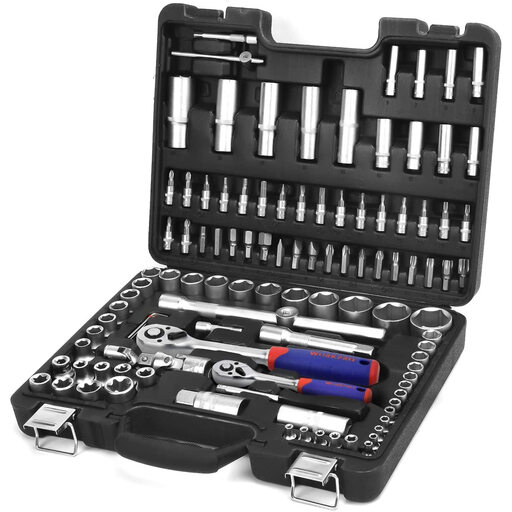
Why This Fits Their Persona: Perfect for DIY mechanics who regularly work on their cars. With both 1/4" and 1/2" drives, this set covers a wide range of applications, from fine adjustments to heavy-duty work on the chassis.
This set is a classic ratchet set that focuses on practical, relevant components. The tools are forged from robust Cr-V steel, and the 72-tooth ratchets enable precise work.
Comprehensive coverage with 1/4" and 1/2" drives. Includes spark plug sockets and extension bars, making it an ideal automotive tool kit.
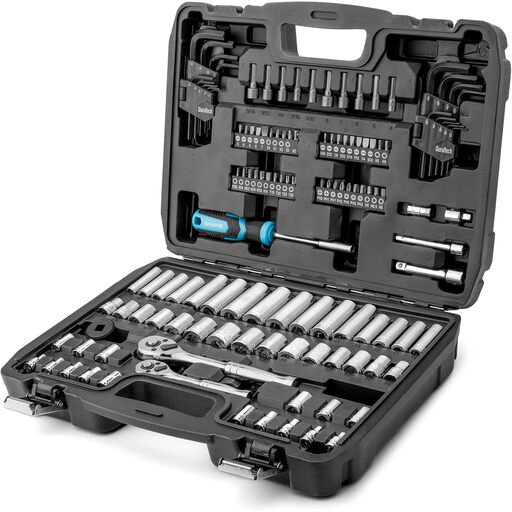
Why This Fits Their Persona: For the demanding DIY enthusiast who needs a versatile set for cars, motorcycles, and general repairs. The combination of sockets, bits, and hex keys makes it extremely flexible.
Despite its large size, this is not an "XXL set" padded with filler. Every piece serves a clear purpose. The heat-treated Cr-V steel construction and efficient quick-release ratchets are a testament to its quality.
Includes both metric and SAE sockets for maximum compatibility. The magnetic bit driver with 40 bits replaces a separate bit set.
We've compiled a complete, up-to-date list of products that fully meet these strict selection criteria and safety regulations.
For automotive work, an automotive tool kit with a 1/2-inch drive is recommended, as high torque is often required (e.g., when changing tyres). The set should include metric sockets from at least 10 mm to 19 mm, and ideally up to 24 mm. A long extension bar and dedicated spark plug sockets are also very useful.
Cr-V stands for Chrome Vanadium steel. It is a steel alloy that, through the addition of chromium and vanadium, is significantly harder, tougher, and more resistant to wear and corrosion than simple carbon steel. For durable and safe tools, Cr-V is the established standard.
A good ratchet for general use should have 72 teeth. This allows for a fine return arc of just 5 degrees. It means you can still tighten or loosen bolts even when there is very little room to move the handle, as is often the case in a car's engine bay. Ratchets with fewer teeth (e.g., 48 or 36) are often unusable in such situations.