
Lieferung heute & morgen

Qualitätsgarantie

Willkommens-Angebote freischalten: KOSTENLOSE Lieferung | Bis zu 80 % RABATT | Kostenlose 30-Tage-JoyPlus-Testphase
App herunterladen
A good socket set, also known as a ratchet set, is the cornerstone of countless repair and maintenance jobs. Whether on your car, bicycle, or around the house – the right tools make tackling nuts and bolts effortless. However, the market is saturated, and many buyers invest in sets that later prove to be impractical or unreliable. Before you make a decision, you should know the most common pitfalls that lead to frustration and unnecessary expenses.
At first glance, many tool sets look complete and high-quality. On closer inspection, however, they often reveal weaknesses that severely limit their practical use.
To avoid a bad purchase, focus on a few, but crucial, technical features. These determine whether a socket set is suitable for your purposes.
The size of the square drive on the ratchet determines which sockets fit and the amount of force the tool is designed for.
The number of teeth in the ratchet head is a direct measure of the mechanism's refinement. A ratchet with 72 or 90 teeth has a very small swing arc (approx. 5° and 4°, respectively). This allows for efficient work even when there is very little room to manoeuvre. Ratchets with fewer than 60 teeth are often unsuitable for tight spaces.
A ratchet is for quick tightening and loosening. It is unsuitable for the final, precise tightening of safety-critical bolts (e.g., on brakes, engines, or carbon parts on a bicycle). This is where a torque wrench is indispensable. It ensures that a bolt is tightened with the exact force specified by the manufacturer. Especially with sensitive materials like aluminium or carbon, as is often the case with a bicycle torque wrench, this prevents expensive material damage. Modern digital models offer high accuracy here.
Instead of presenting an overwhelming list, we have matched products to clearly defined user profiles.
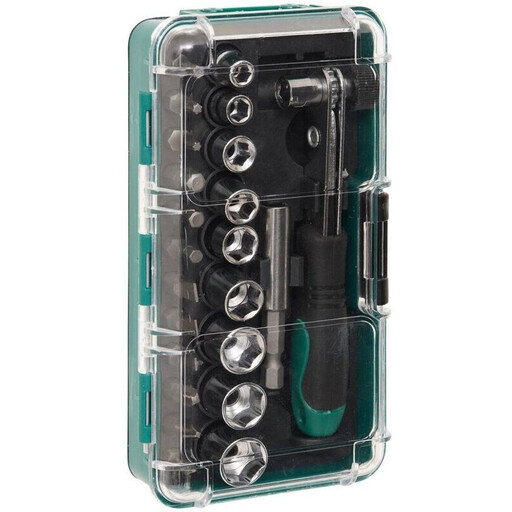
Why This Fits Their Persona: Ideal for individuals who need a compact tool for furniture assembly, tightening loose screws, or simple household repairs. It's small, lightweight, and always ready to hand.
This set avoids the "incomplete" case trap by focusing on a clear task. It offers a well-curated selection of bits and sockets for everyday jobs without pretending to be a full automotive repair kit.
Very compact and organised case; magnetic adapter for quick bit changes.
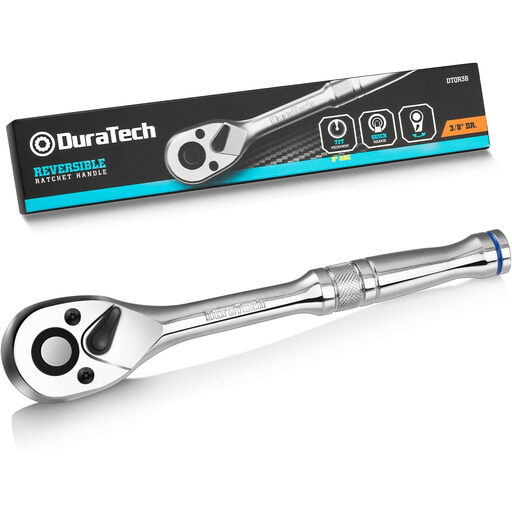
Why This Fits Their Persona: Perfect for users who regularly work on various projects and require maximum flexibility. This tool replaces three separate ratchets, making it ideal for a well-organised workshop where space and efficiency are key.
This tool elegantly solves the drive size problem. Instead of an incomplete set, you get a single, high-quality ratchet for 1/4", 3/8", and 1/2" sockets. The 72-tooth mechanism also offers a great compromise between power and precision.
3-in-1 design for maximum compatibility; made from CR-MO steel at the head for high durability; 5° swing arc.
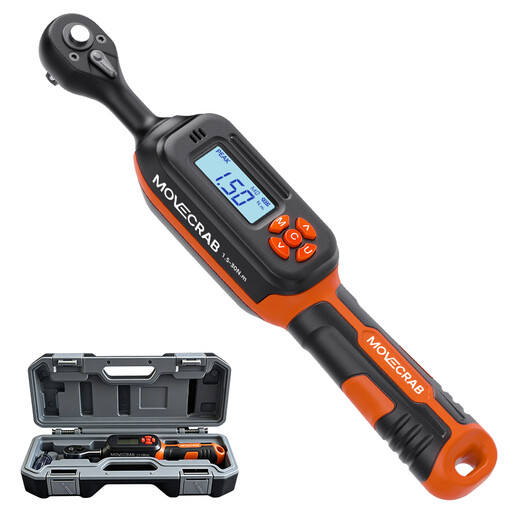
Why This Fits Their Persona: For mechanics and serious hobbyists for whom precise torque values are critical. Indispensable when working on carbon frames, engine parts, and suspension components, where over- or under-tightening can lead to severe damage.
This tool directly addresses the risk of material damage from incorrect torque. While standard ratchets fail here, it provides controlled and verifiable application of force. The digital display is more accurate than many mechanical models.
High accuracy of ±2% (according to manufacturer); triple alarm system (vibration, sound, LED) on reaching target torque; memory for preset values.
For tasks requiring maximum force, like loosening extremely stubborn lug nuts, a long lever arm like the DURATECH 1/2" Drive 600 mm Heavy Duty Flexi Breaker Bar can be a sensible addition. For jobs that demand speed, a cordless ratchet like the EAFC 12V 45NM Electric Ratchet Wrench is worth considering.
We've compiled a complete, up-to-date list of products that fully meet these strict selection criteria and applicable regulations.
For general tools for car repair, a set that covers at least the 3/8-inch and 1/2-inch drive sizes is recommended. Look for a case with common socket sizes (8-24 mm), several extensions, and ideally a universal joint for hard-to-reach places. A fine-toothed ratchet (72 teeth or more) is a great advantage in the engine bay.
The tooth count determines how finely the ratchet mechanism operates. More teeth mean a smaller angle you need to move the handle to engage the next tooth (the swing arc). A 90-tooth ratchet requires only 4° of movement, whereas a 48-tooth ratchet needs about 7.5°. In tight areas, a smaller angle is crucial.
Yes, for safety-critical fasteners, a torque wrench is essential. A normal ratchet provides no control over the applied force. Lug nuts, cylinder head bolts, or components on carbon bicycles must be tightened to a precise, manufacturer-specified torque to prevent damage or loosening of the connection.