
Lieferung heute & morgen

Qualitätsgarantie

Willkommens-Angebote freischalten: KOSTENLOSE Lieferung | Bis zu 80 % RABATT | Kostenlose 30-Tage-JoyPlus-Testphase
App herunterladen
A socket set can replace many individual tools when you’re repairing a vehicle, assembling furniture or carrying out maintenance work. However, choosing the right one isn’t just about the number of pieces. A large ratchet case can be impractical if important sizes are missing, the storage doesn’t have designated slots, or the drive sizes don’t match your intended use.
This buying guide helps DIYers, car and motorcycle owners, and workshop users to correctly interpret technical specifications and avoid common purchasing mistakes.
A claim of “100-piece” or “120-piece” looks impressive at first glance. What really matters, though, is how many of those are actually sockets. Bits, adaptors, extensions and duplicate sizes increase the number of pieces, but they don’t automatically cover more nuts and bolts.
So, before you buy, check:
For many jobs in the UK, a metric socket set is particularly relevant. SAE sockets can also be useful if you work on older, imported or certain types of machinery.
A small 1/4-inch ratchet is fine for smaller screws and tight spaces. For larger fastenings on a vehicle, a 3/8-inch or 1/2-inch drive is often more suitable. An adaptor can connect different sizes, but it doesn’t change the load limit of the tool you’re using.
Important: a standard ratchet isn’t automatically suitable for an impact wrench. Impact-rated sockets are specially marked and differ from standard sockets. For controlled tightening of safety-critical fastenings, for example on a vehicle, you should also use a suitable torque wrench.
Terms like “steel” or “extra tough” aren’t enough for an objective comparison. More meaningful are specific details such as chrome vanadium steel (Cr-V), chrome molybdenum steel (Cr-Mo), heat treatment or a corrosion-resistant finish.
Here’s what to bear in mind:
Fit is also crucial. A socket must sit snugly on the nut without play. A socket that’s too large or damaged can slip and damage the edges of the fastener.
Drive size is given in inches, for example 1/4", 3/8" or 1/2". It describes the connection between the ratchet and the socket, not the size of the nut.
A ratchet set with multiple drive sizes offers more flexibility. Look out for adaptors and extensions, as these increase reach, but not every combination is suitable for high loads.
A useful socket set shouldn’t just contain lots of small sizes. For general assembly and maintenance work, graduated metric sizes are more important than a high number of identical bits.
Think about what you’ll use the set for before you buy:
A tool case with fixed slots prevents individual sockets from getting lost. Clearly readable size markings speed up selection. With a set that includes both metric and SAE sockets, the distinction should be easy to see.
Also pay attention to the weight and dimensions. A 121-piece mechanics tool set offers more components, but at around 4.5 kg it’s less portable than a compact set. For the boot or occasional repairs, a smaller ratchet case can be more practical.
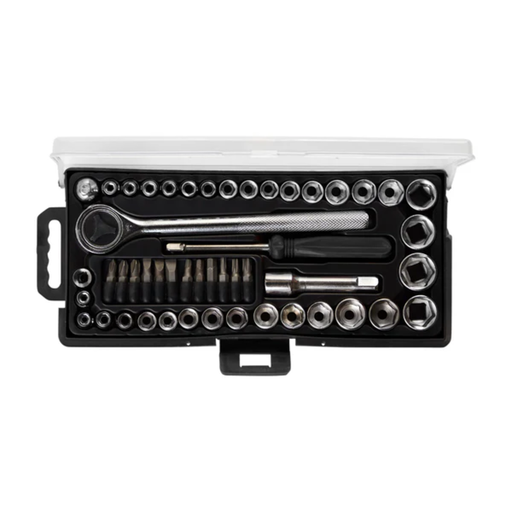
Why this product suits the profile: This set combines a 3/8-inch ratchet handle with a 1/4-inch handle, 16 metric sockets from 4 to 15 mm and additional SAE coverage. That makes it suitable for small repairs, furniture assembly and general DIY tasks.
The piece count is made clear by clearly named sockets, bits, adaptors and a 75 mm extension. The contents are organised in a storage case.
49 pieces, carbon steel, 16 metric sizes from 4 to 15 mm and a combined 1/4- and 3/8-inch drive.
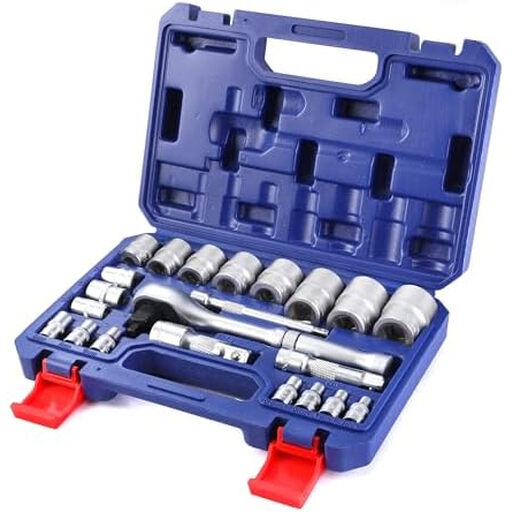
Why this product suits the profile: The 72-tooth ratchet combines 1/4, 3/8 and 1/2 inch in one handle. This is interesting for users who need different drive sizes but prefer a compact set.
The sockets are marked with sizes and divided by drive. Three extensions help with work in hard-to-reach places.
18 metric 6-point sockets from 4 to 24 mm, 72-tooth ratchet and Cr-V steel according to the product description.
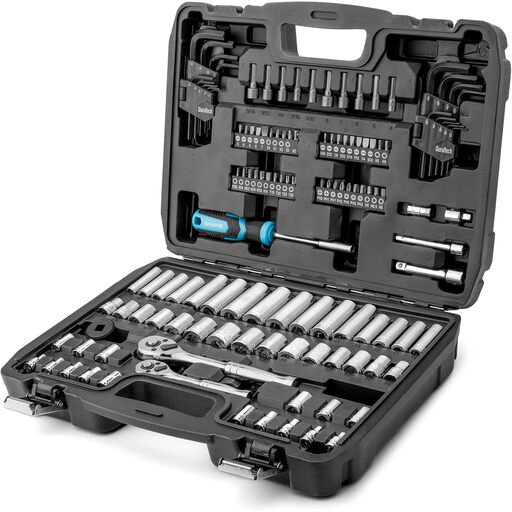
Why this product suits the profile: This mechanics tool set combines sockets, two ratchets, bits, hex keys, adaptors and extensions. It’s aimed at users with varied tasks on cars, motorcycles, appliances and around the home.
The extensive piece count is broken down into clear groups: 47 metric and SAE sockets, two ratchets, 40 bits, ten nut driver bits and 18 hex keys.
121 pieces, heat-treated Cr-V steel according to the product description and a case with labelled slots.
We’ve put together a full, regularly updated list of products that fully meet these strict selection criteria and the safety regulations in force in the EU.
To keep a socket set usable for as long as possible, wipe the tools dry after use and store them in the case. Moisture, dirt and loose storage can affect the surface and the mechanism.
Also bear in mind:
For general work, a metric range of around 4 to 24 mm is practical, provided the sizes are sensibly graduated. For vehicle work, sizes such as 10, 13, 17, 19, 21 and 22 mm are often relevant. However, the exact need depends on your vehicle, appliance or furniture kit.
For smaller fastenings and tight spaces, a 1/4-inch ratchet can be sufficient. For larger bolts, 3/8 or 1/2 inch is often more suitable. What matters are the load limits specified by the manufacturer and using the correct socket.
It’s impossible to give a fixed lifespan. It depends on the material, load, care and correct use. Overloading, using the wrong socket size, and using a hand tool with an impact wrench can significantly increase wear.