
Lieferung heute & morgen

Qualitätsgarantie

Willkommens-Angebote freischalten: KOSTENLOSE Lieferung | Bis zu 80 % RABATT | Kostenlose 30-Tage-JoyPlus-Testphase
App herunterladen
A socket set can make repairs on cars, bicycles, machines and around the home much easier. However, a large number of pieces, shiny finishes and terms such as “universal” do not automatically mean you are choosing the right kit. The key factors are drive size, included socket sizes, material, storage and the intended application.
A ratchet case containing 100 or more pieces may look comprehensive at first glance. However, it may include numerous bits, duplicate sizes or accessories that are hardly needed for the intended tasks. For occasional jobs around the home, a compact socket set with the common metric sizes is often sufficient.
It is therefore worth checking the detailed parts list before buying. Make sure the sizes you need are actually included, and check whether the set contains 6-point sockets, Torx sockets, deep sockets or bits.
The drive size affects both accessibility and load capacity:
A 1/4-inch socket set therefore cannot automatically be replaced by a large 1/2-inch kit. Adapters can extend compatibility, but they do not change the load limit of the particular ratchet or socket.
In a Cr-V steel tool set, the sockets are typically made from chrome vanadium steel. This specification describes the material base, but it is not the only indication of quality. Buyers should also look for clear size markings, a suitable ratchet mechanism and a secure fit.
Standard hand sockets are not designed for impact wrenches. For this application, you specifically need clearly labelled impact sockets, usually made from chrome molybdenum steel. For wheel nuts, for example, thin-wall 1/2-inch impact sockets in 17, 19 and 21 mm can be useful.
In Germany, metric sizes are used predominantly for vehicles, bicycles and household appliances. A metric socket set may include sizes such as 8, 10, 13, 17 or 19 mm. An SAE socket set uses imperial sizes such as 5/32 or 11/16 inch and may be relevant for certain US vehicles, older machinery or imported equipment.
A combination set with metric and SAE sockets is only practical if both measurement systems are used regularly. Otherwise, it mainly increases the storage space required.
According to the product specification, a 72-tooth ratchet requires a smaller swing angle than models with fewer teeth. This can be helpful when working in tight spaces. A 90-tooth ratchet is also marketed with a small working angle. These figures relate to the ratchet mechanism and are not a general indication of load capacity.
Other important features include:
A tool case for car repairs should hold the pieces securely and provide a quick overview. A sturdy plastic case is more suitable for transport and storage than loose inserts. For smaller sets, a tool holder may also be sufficient. After buying, check that all the pieces are present and that the sockets fit onto the ratchet without excessive play.
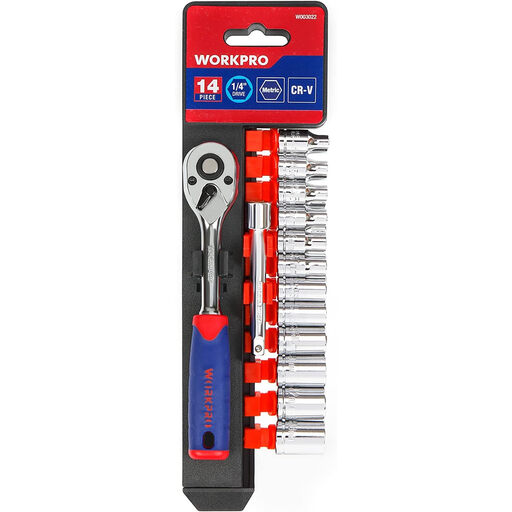
Why this product suits this profile: This compact set focuses on metric sizes from 4 to 13 mm, making it suitable for general DIY jobs, bicycle maintenance and minor repairs.
The number of pieces remains manageable, while the listed socket sizes and 1/4-inch drive system are clearly specified. A 76 mm extension provides extra reach for recessed fasteners.
Cr-V steel, 72-tooth ratchet, quick-release button and socket holder, with a stated weight of 480 g.
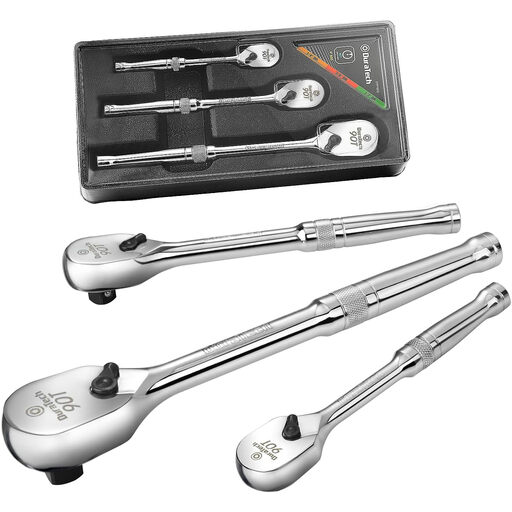
Why this product suits this profile: Three drive sizes cover a range of tasks, while the stated 90-tooth mechanism is designed for working in confined spaces.
The drive sizes are not represented solely through adapters; separate ratchets are provided for each one. According to the product description, the enclosed ratchet head is designed to prevent dirt from getting inside.
Three ratchets, 90 teeth, polished chrome finish and storage case.
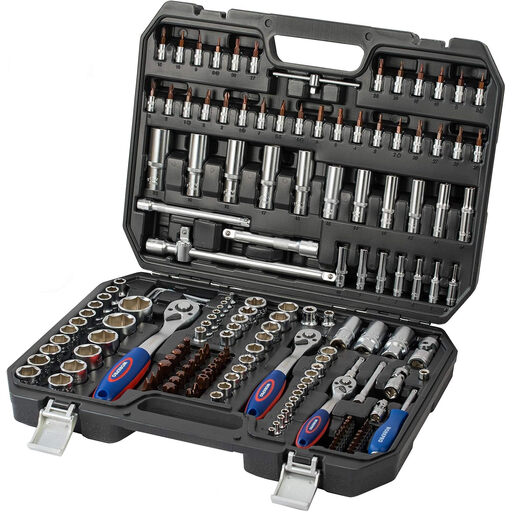
Why this product suits this profile: This extensive set is aimed at users who work on vehicles, motorbikes, bicycles, machinery and household projects involving different types of fasteners.
The parts list specifies separate 1/4-, 3/8- and 1/2-inch ratchets, as well as metric, deep, E-Torx and spark plug sockets. This makes it possible to check the exact contents before buying.
Cr-V sockets, S2 bits, three 72-tooth ratchets, extensions, universal joints and a moulded storage case.
We have put together a complete, regularly updated list of products that fully meet these strict selection criteria and the safety regulations applicable in the EU.
Always use the socket that matches the screw or nut exactly. A profile that is too large or worn can slip and damage the fastener. When dealing with seized fasteners, do not attach an extension bar to the ratchet unless the manufacturer expressly permits it.
After use, remove grease and dirt, store the tools in a dry place and lightly oil the ratchet mechanism when necessary. Damaged, cracked or deformed parts should no longer be used. Hand tools are not insulated and must not be used on live electrical components.
For many jobs on a vehicle, a set with 3/8-inch and 1/2-inch drives is a sensible choice. Common metric sizes, extensions and, where necessary, spark plug or Torx sockets extend its versatility. For wheel nuts used with an impact wrench, you need suitable impact sockets.
For bicycle repairs, furniture, household appliances and smaller screws, a 1/4-inch socket set may be sufficient. For larger or tightly fastened components on a vehicle, a 3/8- or 1/2-inch system is generally more suitable.
Its service life depends on the material, load, care and correct use. The important factors are using the correct socket sizes, staying within the stated load limits and using impact sockets with impact wrenches. Regular checks and dry storage help you identify wear and corrosion at an early stage.