
Lieferung heute & morgen

Qualitätsgarantie

Willkommens-Angebote freischalten: KOSTENLOSE Lieferung | Bis zu 80 % RABATT | Kostenlose 30-Tage-JoyPlus-Testphase
App herunterladen
A socket set is part of the basic toolkit for many DIY enthusiasts, car owners and hobby mechanics. It can be used for assembling furniture, repairing bicycles, carrying out vehicle maintenance or completing household installation tasks. However, socket sets vary considerably in terms of drive size, range, materials and storage.
If you focus only on the number of pieces or eye-catching marketing claims, it is easy to buy a set that is missing important sizes for everyday use or is unsuitable for the intended job. The following criteria will help you assess a suitable socket set objectively.
A comprehensive ratchet case may contain numerous bits, adapters and sockets, while still missing the sizes you use most often. The key factor is therefore not just the total number of pieces, but how they are distributed:
For work in Germany, metric sizes are usually particularly relevant. SAE sockets can nevertheless be useful as an addition, for example for certain imported vehicles or machines.
A 1/4-inch socket wrench is compact and suitable for smaller screws and bolts, as well as work in confined spaces. A 3/8-inch socket wrench offers a good balance between accessibility and load capacity. For larger fasteners, such as those found on vehicles, a 1/2-inch socket wrench is often used.
A smaller drive does not automatically replace a larger one. If you regularly work on wheel fasteners or larger machine components, you should check the drive size and the tool’s permitted load carefully.
Descriptions such as steel or chrome vanadium steel initially only specify the material. For choosing the right set, you should also consider the workmanship, fit, surface treatment and ratchet design. A socket should sit fully on the nut or bolt wherever possible. A poorly fitting profile can slip and damage the fastener or the tool.
When working with an impact wrench, only impact sockets expressly designed for this purpose should be used. An ordinary ratchet case is not automatically suitable for impact loads.
Compare the drive size with the work you intend to carry out:
A multi-drive set can be practical if you need to cover a variety of jobs. When choosing one, pay attention to the actual allocation of the sockets to each drive size.
Hex sockets distribute force across the faces of the nut. The sizes should be permanently and clearly marked. This makes selection easier and reduces the risk of using a socket that is too small or too large.
A ratchet set with a direction switch allows you to tighten and loosen fasteners without removing the socket after every movement. A fine-tooth ratchet requires a smaller return angle and can offer advantages in confined areas. However, the number of teeth alone is not a sufficient quality criterion; the mechanism, handle and intended load also matter.
Chrome vanadium steel, often abbreviated to Cr-V, is used for many sockets and ratchets. The products featured here also specify carbon steel or alloy steel. After use, tools should be wiped dry and stored in a dry case or organiser. Moisture, dirt and a lack of care can encourage corrosion.
A tool case for car and household use should hold its contents securely. Loose sockets can easily be lost in a workshop, garage or vehicle. Labelled compartments make it easier to check that everything is present.
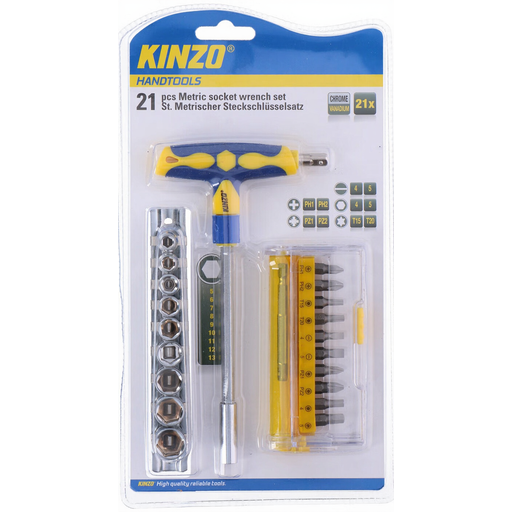
Why this product suits this profile: This compact 21-piece set focuses on metric sizes and is suitable for typical bicycle, vehicle and household tasks.
The piece count is complemented by a clear metric size range. The organiser keeps the components securely in place.
Chrome vanadium steel, ergonomic handle and compact dimensions of 28,1 × 15,9 × 3,2 cm.
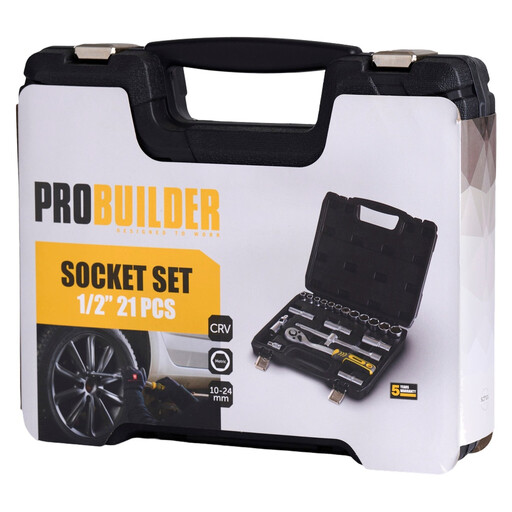
Why this product suits this profile: This 1/2-inch set is aimed at users who prefer a larger drive for vehicle and machine work.
The drive is clearly specified as 1/2 inch. The material and weight details make it easier to assess its suitability for more demanding tasks.
21 pieces made from Cr-V steel, plus a storage case; stated net weight of 3,55 kg.
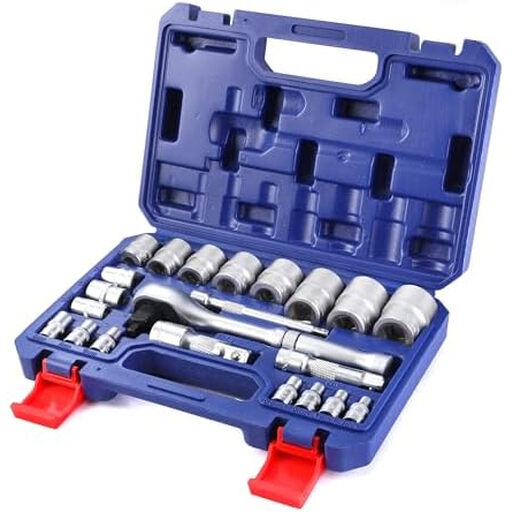
Why this product suits this profile: The combination of 1/4, 3/8 and 1/2 inch covers a range of tasks involving vehicles, bicycles, appliances and household jobs.
The three drive sizes are clearly separated. Size markings and three extensions reduce searching and help overcome reach limitations.
18 metric hex sockets from 4 to 24 mm, 72-tooth ratchet and plastic case.
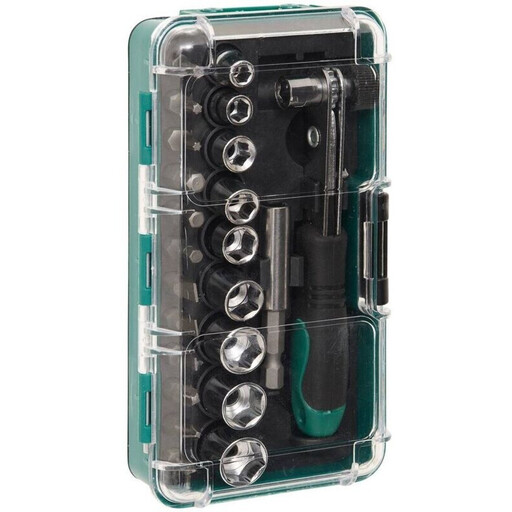
Why this product suits this profile: This small set is suitable for flats, tool bags and occasional assembly tasks where space is limited.
The equipment is compact rather than artificially inflated with numerous accessories. The sockets cover sizes from 4 to 12 mm.
1/4-inch ratchet, 11 bits, 9 sockets, magnetic adapter and compact hard-shell case with a net weight of 0,375 kg.
We have put together a complete, regularly updated list of products that fully meet these strict selection criteria and the safety regulations applicable in the EU.
Before use, check the socket, ratchet and connection for signs of damage. Always use the correct size and place the socket straight onto the fastener. Safety goggles and suitable work gloves may be advisable for assembly tasks. Socket wrenches are not intended for live electrical systems and must not be used as levers, chisels or striking tools.
After use, a dry cloth and returning everything to the case will help protect against dirt, moisture and loss. Damaged or deformed parts should not be used again.
For general vehicle work, a set with metric sockets and a 3/8- or 1/2-inch drive is often a sensible choice. For wheel nuts, the required sizes and suitability for the relevant torque are crucial. When using an impact wrench, you must use impact sockets expressly approved for this purpose.
For household tasks, bicycles and minor repairs, metric sizes in the region of 4 to 15 mm are often relevant. Vehicles may also require larger sockets, such as 17, 19, 21 or 24 mm. Before buying, check the bolt and screw sizes involved in your specific applications.
There is no standard service life. It depends on the material, load, care and correct use. Dry storage, using the right socket sizes and avoiding unsuitable extensions can reduce wear. For heavily loaded tasks, the tool should be used in accordance with the manufacturer’s instructions.