
Lieferung heute & morgen

Qualitätsgarantie

Willkommens-Angebote freischalten: KOSTENLOSE Lieferung | Bis zu 80 % RABATT | Kostenlose 30-Tage-JoyPlus-Testphase
App herunterladen
A socket set can make repairs considerably easier – provided the drive size, socket sizes and material are suitable for the intended use. However, many buyers focus mainly on the number of pieces. A large socket case is not automatically more practical if important sizes are missing, the ratchet has too much play or storage becomes confusing in everyday use.
This buying guide explains what DIY enthusiasts, vehicle owners and workshop operators should look for before purchasing.
A comprehensive tool set often contains bits, extensions, Allen keys or screwdrivers alongside sockets. This can be useful in a tool set for cars and household tasks. For specific jobs, however, what matters is whether the sizes and drive types you actually need are included.
Before buying, check the following:
A ratchet with a high tooth count usually requires a smaller return angle. This is helpful in confined areas of the engine bay, around furniture fittings or underneath a vehicle. However, the tooth count alone does not describe the tool’s overall suitability. The switching mechanism, socket fit, handle size and permitted load are also relevant.
Examples from the product selection: A 90-tooth ratchet with a specified 4-degree working angle is designed for confined working areas. A 72-tooth ratchet with a 5-degree working angle also allows short movements between contact points. These specifications should be viewed as technical guidance, not as a general quality rating.
Terms such as Cr-V steel, chrome vanadium steel or chrome alloy steel provide indications of the material, but they do not replace checking the specific features. A polished or chrome-plated surface can make cleaning easier and support corrosion resistance. However, it does not automatically make a tool suitable for impact drivers.
For jobs involving high torque, you need impact sockets specifically designed for this purpose. Standard sockets should not be used as impact tools or levers.
The three common drive sizes are:
A ratchet set with all three drive sizes covers many applications. Also check whether adapters are included and whether they provide a secure fit.
Metric sizes are particularly common in everyday use in Germany. However, metric and imperial sockets may be required for older vehicles, imported machinery or certain bicycle and vehicle components. The specifications should be clearly separated and easy to read on the sockets and inside the case.
A compact socket set covering 4 to 13 mm may be sufficient for light assembly work. For vehicle repairs, a wider range up to 19 mm or above is often more practical. The maximum size is not the only important factor: check whether intermediate sizes such as 10, 13, 15, 17 or 19 mm are included.
A quick-release ratchet makes changing sockets easier using a push button. The direction switch should be operable with your thumb, without removing the ratchet from the workpiece. In confined areas, a slim head and a small return angle are also advantageous.
Before buying, check:
A tool case with a ratchet should hold every socket securely. Loose inserts can easily go missing in the workshop or boot. Labelled compartments, sturdy fasteners and a compact design make it easier to check that the set is complete.
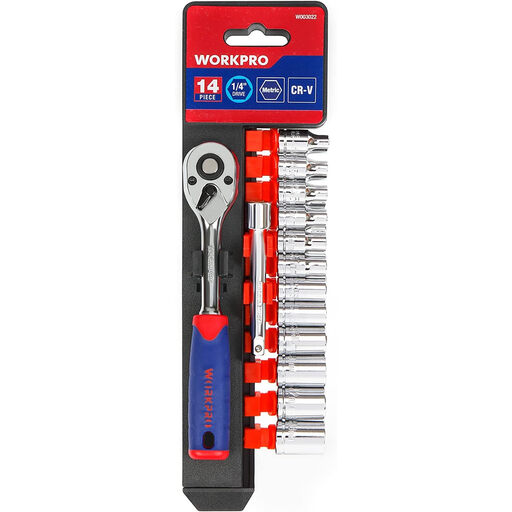
Why this product suits this profile: The set focuses on metric sizes from 4 to 13 mm, making it suitable for general DIY and household jobs of a manageable scope.
The piece count remains manageable, while the sizes, 1/4-inch drive, extension and storage holder are clearly specified.
Cr-V steel, 72-tooth ratchet, quick-release button and 76 mm extension.
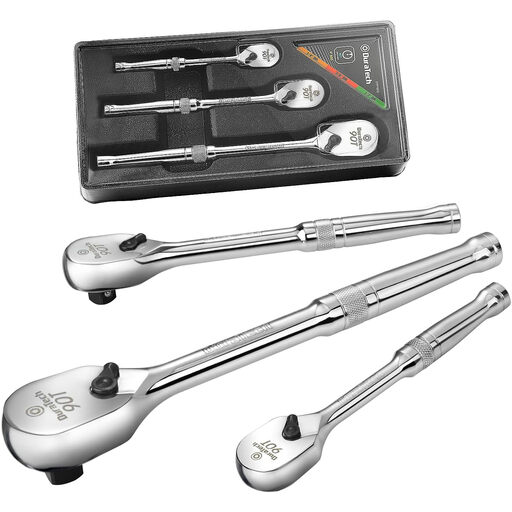
Why this product suits this profile: If you already own sockets, three different ratchets allow you to add the drive sizes you need in a targeted way.
The three drive sizes are clearly specified. The fully enclosed head is designed to make it harder for dust and dirt to get inside.
90-tooth mechanism with a specified 4-degree working angle and storage case.
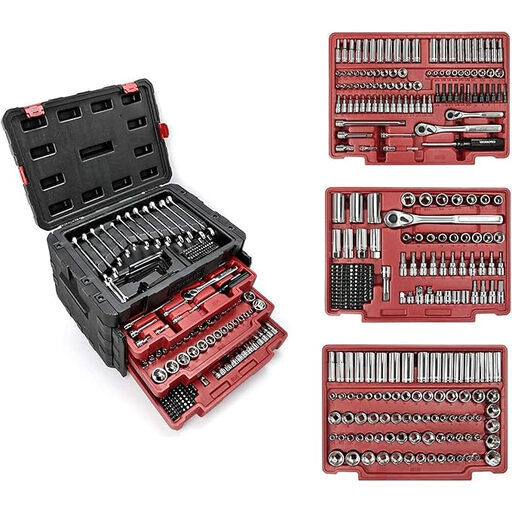
Why this product suits this profile: This extensive set is aimed at users who want to combine a versatile automotive tool set with accessories for the home and workshop in one case.
The included metric and SAE sockets are listed separately. Four inserts in the case help keep everything neatly organised.
450 pieces, 1/4-, 3/8- and 1/2-inch drive, Cr-V steel and quick-release ratchet.
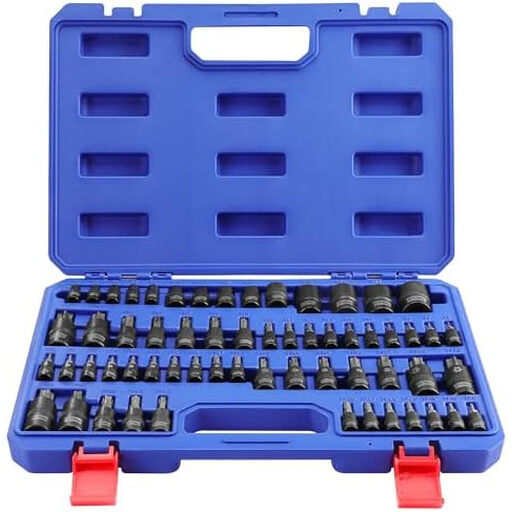
Why this product suits this profile: For repairs to vehicles, machinery and equipment with Torx, Torx Plus or security profiles, this bit socket set offers a specialist selection.
The size ranges E4 to E24 and the T, TT and TP profiles are clearly specified and marked on the inserts.
60 pieces, S2 steel for the bits, Cr-V steel for the sockets and reinforced storage case.
Choose a socket that fits the fastener without any play. A socket that is too large can slip and damage the edges. Do not use damaged, cracked or heavily worn parts. When working on a vehicle, safety glasses and suitable gloves are recommended.
A socket set is not designed for work on live electrical components. After use, the tools should be cleaned dry, the ratchet mechanism lightly oiled if necessary and all pieces returned to their designated compartments.
We have put together a complete, regularly updated list of products that fully meet these strict selection criteria and the safety regulations applicable in the EU.
A 3/8-inch ratchet is versatile enough for many vehicle repairs. For larger fasteners, such as those found around the suspension, a 1/2-inch ratchet may be more suitable. Small fasteners can often be handled with a 1/4-inch ratchet. The specific size depends on the vehicle, the fastener and the torque required.
For typical jobs in Germany, metric sockets are usually the first choice. Imported vehicles, older machinery or certain components may require imperial sizes. If you maintain different vehicles or machines, a set containing both measurement systems may be beneficial.
The service life depends on the material, load, maintenance and correct use. Cr-V steel, a suitable surface treatment and dry storage can help maintain usability. Sockets should not be used as levers or impact tools. You should also check the manufacturer’s load specifications before applying high forces.