
Lieferung heute & morgen

Qualitätsgarantie

Willkommens-Angebote freischalten: KOSTENLOSE Lieferung | Bis zu 80 % RABATT | Kostenlose 30-Tage-JoyPlus-Testphase
App herunterladen
A dead car battery or a flat tyre rarely happens at a convenient time. For many drivers, a portable jump starter is therefore an indispensable part of their car's emergency kit. But the market is filled with devices whose performance claims often create more confusion than clarity. Conventional lithium models, in particular, frequently show weaknesses in practice, making them unreliable tools in an emergency.
As your Joybuy Product Recommendation Officer, I'll help you identify the essential features and avoid common pitfalls. We will focus on objective criteria so you can make an informed decision for a reliable and long-lasting device.
Common Problems with Conventional Jump Starters:
To find a safe jump starter that also serves as a power bank with a compressor, you should check three core parameters. These will help you separate marketing claims from real-world functionality.
The key innovation on the market is sodium-ion technology. Unlike lithium-based batteries, it offers fundamental advantages for use in a vehicle:
Pay less attention to the advertised peak current and more to the specifications for engine size compatibility. Reputable manufacturers state the engine size (in litres for gasoline and diesel engines) for which the car jump starter is designed. This is a practical indicator of its actual performance. A device rated for an 8-litre gasoline engine offers significantly more reserve power than one specified only for small cars with up to 3-litre engines.
A jump starter with an air pump is more than just an emergency tool. Check the following specs here:
Here are some recommendations tailored to different user profiles and their specific needs.
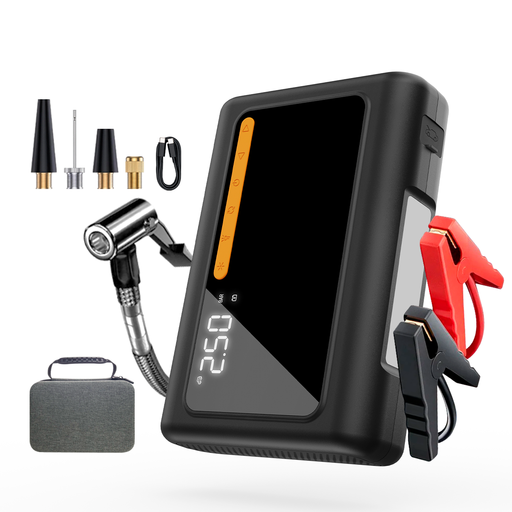
Why This Fits Their Persona: Ideal for drivers who want a device they can put in their car and forget about. The sodium-ion technology ensures it's ready to go even after long periods and in extreme temperatures.
Thanks to its extremely low self-discharge rate of about 1% per month, the need for constant recharging is eliminated. Its chemical stability and wide operating temperature range (-40°C to 80°C) solve the safety and reliability issues of lithium batteries.
Long Standby Time: Holds a charge for up to 5 years, according to the manufacturer. Inherent Safety: No risk of fire from thermal runaway. 4-in-1 Functionality: Jump starter, 150 PSI compressor, PD60W power bank, and LED light.
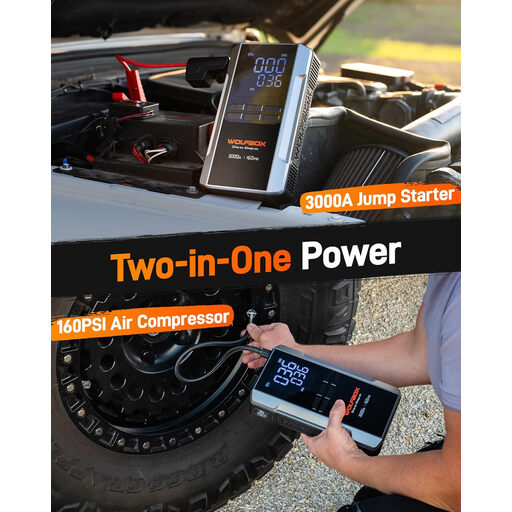
Why This Fits Their Persona: Suitable for owners of vehicles with large-displacement engines (up to 8L gas, 6L diesel) who need high starting power and value fast recharging of the unit.
This lithium model addresses the performance pitfall with a high, specified 3000A peak current and clear engine compatibility ratings. A smart LED display shows its status, and 10 protection features minimise user error.
High Starting Power: Designed for large gasoline and diesel engines. Fast Recharging: Supports 65W fast charging to quickly power up the unit itself. Powerful Compressor: Delivers up to 160 PSI for rapid inflation.
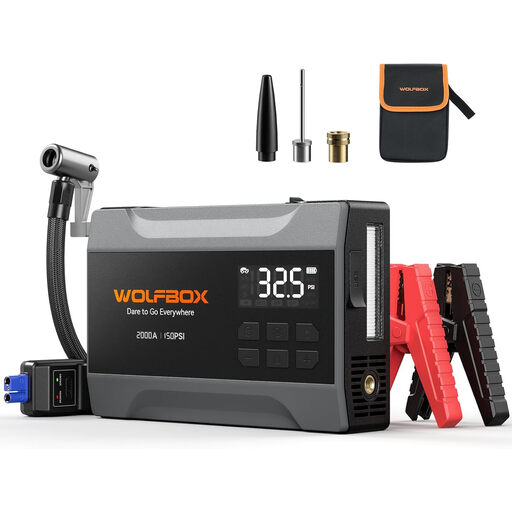
Why This Fits Their Persona: A solid all-in-one solution for drivers of small to mid-size cars (up to 5L gas engines) who want a functional emergency kit without paying for oversized performance.
This device focuses on the essential functions for common vehicle classes. It avoids the pitfall of paying for unnecessarily high peak current ratings that aren't required for a compact car.
Great Value: Offers the core functions of a jump starter, compressor, and power bank in one package. Compact Design: Takes up minimal space in the trunk or glove compartment. Sufficient Power: The 2000A peak current is designed for most gasoline engines up to 5 litres.
We've compiled a complete, up-to-date list of products that fully meet these strict selection criteria and safety standards.
Due to their very low self-discharge rate of about 1% per month, a fully charged sodium-ion jump starter can hold its charge for several years. Manufacturers like GOKKCL state a standby time of up to 5 years. This significantly reduces maintenance compared to lithium devices, which often need to be recharged every 3 to 6 months.
Most compressors in jump starters offer a maximum pressure of around 150 PSI (approx. 10.3 Bar). This is more than sufficient for standard car tyres, which typically require a pressure of 2.2 to 2.5 Bar. They are also suitable for bicycle tyres, motorcycle tyres, and inflating sports balls or air mattresses. However, they are generally not designed for large truck tyres.
The critical safety advantage lies in the chemical composition of the cathode. In the event of damage, a short circuit, or extreme heat, lithium-ion batteries are prone to releasing oxygen, which strongly promotes a fire reaction (thermal runaway). Sodium-ion batteries use cathode materials that do not release oxygen. This chemically eliminates the risk of a fire or explosion, even under severe mechanical damage.