
Lieferung heute & morgen

Qualitätsgarantie

Willkommens-Angebote freischalten: KOSTENLOSE Lieferung | Bis zu 80 % RABATT | Kostenlose 30-Tage-JoyPlus-Testphase
App herunterladen
A sofa bed is a practical solution for many living situations—whether as a space-saving piece in a first apartment, a versatile guest sofa for spontaneous overnight stays, or multi-functional seating in a home office. But the sheer number of options can be overwhelming, and not every model delivers on its promises. Before you make a decision, it helps to understand the common pitfalls that often only become apparent after the purchase.
Two widespread problems frequently lead to disappointment:
An informed choice based on solid criteria will help you avoid these pitfalls and find a solution that you'll be happy with for years to come.
To find the right model, let objective product features—not marketing promises—guide your decision. Three factors are particularly important: construction, cushioning, and dimensions.
The way a sofa converts into a bed is a key determinant of its durability and ease of use. While classic models rely on pull-out or foldable metal frames, there is an increasingly popular alternative: the assembly-free sofa.
These models, often called floor sofas, consist of dimensionally stable foam blocks and require no internal frame. The conversion is done by simply folding or rearranging the upholstered elements. The advantage is obvious: there are no mechanical parts that can wear out or squeak. Furthermore, they are often delivered compressed and expand to their full size within about 72 hours of unboxing, which makes transport to upper floors or through narrow hallways much easier.
The comfort of a sofa bed depends directly on the quality of its cushioning. A crucial indicator here is the use of high-density foam. This material provides firm yet yielding support that ensures good pressure distribution for both sitting and sleeping. Unlike soft, pliable fillings, high-density foam retains its shape over the long term and prevents the typical sagging.
Pay attention to the upholstery fabric as well. Materials like corduroy or chenille are not only visually appealing but also durable and easy to care for. A hard-wearing fabric ensures that the sofa remains presentable even with regular use as a sofa bed.
Before buying, measure your available space carefully—in both its folded and unfolded states. A sofa bed for small spaces should be compact but still offer a sufficiently large sleeping area. A 2-seater sofa bed is often a good compromise between seating comfort and space requirements.
Also consider functional details. Wide armrests can serve as a surface for placing items, while integrated side pockets offer practical storage for a remote control or books. Modular elements like a movable ottoman increase flexibility and allow the sofa to be adapted to different room layouts.
Instead of making a one-size-fits-all recommendation, we have identified models tailored to specific needs and lifestyles.

Why it's a great fit: Ideal for students, shared flats, or studio apartments. It's a multi-functional piece that can be used as an armchair, a lounger, or a temporary guest bed, and its frameless design means no complicated assembly.
This sofa does away with a failure-prone folding mechanism. The high-density foam forms a continuous, stable sleeping surface, avoiding uncomfortable contact with a hard frame.
Ready to use after 72 hours of expansion. The practical side pockets on the armrests provide extra storage space.
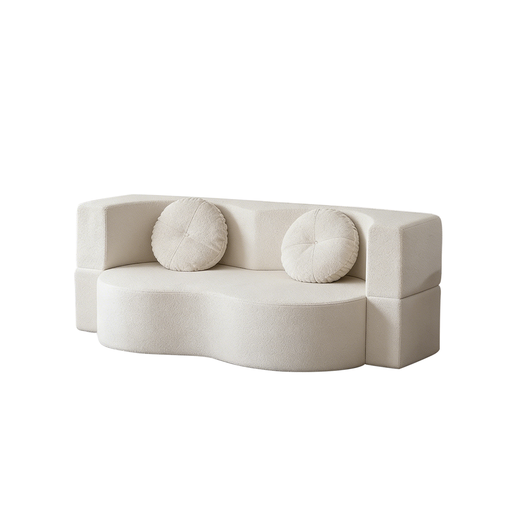
Why it's a great fit: A classic yet modern solution for the living room. It easily converts into a temporary double bed and is an excellent choice for a comfortable guest sofa.
Designed as a sofa bed without a complex folding mechanism, it relies on a 38 cm thick foam base that forms the sleeping surface directly. This ensures solid comfort without a thin secondary mattress.
Its weight capacity of up to 250 kg offers excellent stability. Two matching cushions are already included.

Why it's a great fit: Perfect for families or anyone who needs a spacious and adaptable seating area. The movable ottoman allows for various configurations, and the adjustable armrests provide customised comfort.
Instead of a dedicated sleeper mechanism, it offers a flexible sleeping area by using the ottoman. The cushioning, featuring pocket springs and high-resilience foam, is designed for lasting sitting and sleeping comfort.
The three-position adjustable armrests and the four included cushions allow for highly personalised adjustments to suit various sitting and lounging positions.
We have compiled a complete, up-to-date list of products that fully meet these strict selection criteria and safety standards.
A frameless sofa delivered compressed typically needs about 72 hours to fully expand and reach its final shape and firmness. We recommend letting it rest in a well-ventilated room after unboxing and fluffing it gently to aid the process.
While a floor sofa made of high-density foam offers good comfort for occasional overnight stays and is a significant improvement over thin folding mattresses, it is primarily designed as versatile seating and a temporary bed. For daily use as a primary bed, adding a mattress topper can further enhance comfort.
Measure not only the space the sofa occupies when folded but also the full area it requires when unfolded. Remember to account for the clearance needed to move comfortably around the room. Pay attention to the length of the sleeping surface—ideally, it should be at least 15-20 cm longer than the height of the person who will be sleeping on it.