
Lieferung heute & morgen

Qualitätsgarantie

Willkommens-Angebote freischalten: KOSTENLOSE Lieferung | Bis zu 80 % RABATT | Kostenlose 30-Tage-JoyPlus-Testphase
App herunterladen
A sofa bed has to serve several purposes in everyday life: it should be comfortable to sit on, convert into a bed when needed and fit the space available. Particularly in small flats, apartments, student accommodation or guest rooms, choosing one is about more than just design. Its dimensions, upholstery, mechanism and care requirements all affect how practical it will be in the long term.
Many models look compact when folded, but take up considerably more room when opened out. Before buying, check not only the sofa’s dimensions but also the sleeping area when unfolded. You should also allow space in front of the sofa, consider the distance from other furniture and check the position of doors and radiators.
With a corner sofa bed, the orientation of the chaise can also be crucial. A model with a reversible or modular layout offers more flexibility than a fixed corner sofa.
A very soft seat may feel pleasant at first, but that does not necessarily mean it offers enough support. Details about the upholstery construction, foam density and, where applicable, spring core construction are more useful. A sofa with high-density foam may retain its shape better, although the overall construction determines how firm it actually feels.
You should also consider the backrest. Adjustable back sections or cushions that can be positioned separately allow you to sit in different ways. This is particularly useful with a sofa bed if you regularly use it for reading, watching TV or relaxing.
Corduroy, chenille and velvet covers all differ in feel, care requirements and appearance. For households with children or pets, specific guidance on stain removal and abrasion resistance is more helpful than general claims such as “high quality”.
Also check what’s included in the delivery. A sofa bed that requires no assembly can be used as soon as it’s unpacked, although vacuum-packed models often need time to expand fully. Other models arrive in several packages and require you to assemble the frame or fit the castors.
Measure the space where you plan to put the sofa, including the area it will take up when opened out. A 2-seater sofa bed will often fit into smaller rooms, while a corner sofa bed offers more seating and sleeping space but takes up considerably more floor space.
Also check how the sofa converts:
Always check whether the manufacturer’s maximum weight capacity applies per seat or to the entire piece of furniture. For example, the vidaXL model has a maximum capacity of 110 kg per seat, while the Joyic 2 Seater Sofa Bed can support up to 360 kg, according to its product details. These figures are not directly comparable because the construction and the basis for each rating are different.
A metal or steel frame can provide a sturdy base. For upholstery, details such as high-density foam, memory foam or pocket springs are relevant. However, they are no substitute for checking the seat height, seat depth and your own seating preferences.
Chenille often feels soft and textured. Corduroy has a ribbed surface that can add texture to a room. Velvet has a smooth finish, but some types are more prone to pressure marks. Always follow the specific care instructions provided by the manufacturer.
A damp cloth may be suitable for surface cleaning on some covers. Avoid rubbing stains too vigorously. Removable or separately washable covers can be a practical advantage if the sofa will see heavy use.
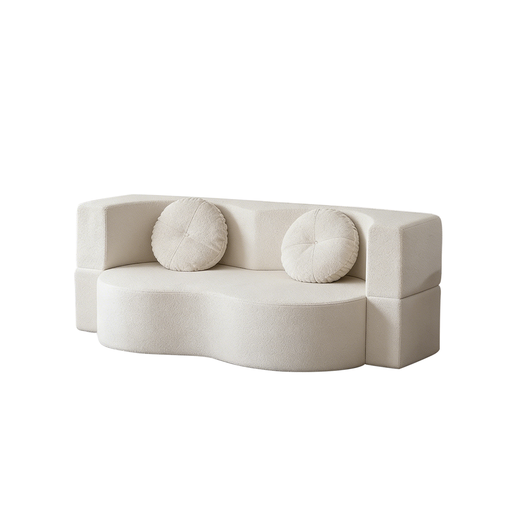
Why it suits this profile: This compact 2-seater sofa bed has a pull-out double sleeping area for occasional use, two cushions and a stated weight capacity of up to 250 kg for three people.
The product details specify the upholstery thickness, type of foam, weight capacity and tool-free assembly, rather than relying on vague claims about comfort.
38 cm-thick upholstery, two extra cushions and delivery with no assembly required, according to the product description.
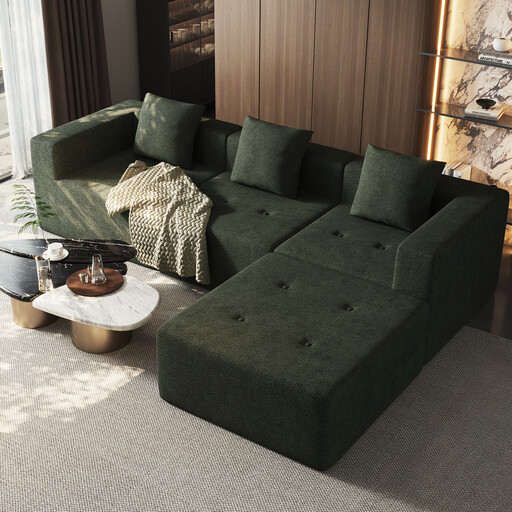
Why it suits this profile: This spacious corner sofa is designed for households looking for generous seating, a 183.5 × 258.5 cm sleeping area and a flexible layout.
The product details specify pocket springs, overall dimensions and a reversible chaise option. This makes it easier to plan how much space you’ll need.
258.5 cm overall width, chenille upholstery, three scatter cushions and a 24-month warranty, according to the product details.

Why it suits this profile: This model combines seating, lounging and sleeping functions. Its backrest adjusts continuously from 90 to 180 degrees.
The pull-out sleeping area measures 184 × 132 cm, and the reinforced steel frame is specified in the product details. This makes it easier to plan for a guest room or second home.
Side pockets, corduroy cover, high-density foam and a stated weight capacity of up to 360 kg.

Why it suits this profile: This 160 cm chaise longue is designed as a space-saving sofa for apartments, studios or individual living areas.
The product description gives the unfolded dimensions as 160 × 110 × 40 cm, the seat height as 48 cm and the time needed to expand fully as up to 72 hours.
No assembly required, according to the product details, plus pockets on the armrests and a corduroy cover with high-density foam.
We’ve put together a comprehensive, regularly updated list of products that meet these strict selection criteria and fully comply with the safety regulations in force in the EU.
A sleeper chair is designed for one person and takes up less floor space than a sofa bed. If you often read or watch TV, an electric recliner with an independently adjustable backrest and footrest may be worth considering. Remember to check the power supply, cable routing, space needed for movement and assembly requirements.
A folding sofa or compact sofa bed is better suited to occasional overnight stays. A corner sofa offers more seating for couples or families, but requires careful room planning. A modular sofa is a good choice if your living arrangements may change.
Its lifespan depends on the frame, upholstery, mechanism, level of use and care. It would be misleading to give a specific number of years without consistent testing criteria. Look for clear information about materials, weight capacity, warranty and spare parts. The conversion mechanism should operate smoothly without catching.
Not every model is designed for this. Many sofa beds are described as temporary guest beds. If you plan to sleep on one every day, check the sleeping area, how level it is, the upholstery construction and ventilation especially carefully. The manufacturer’s guidance on intended use is key.
As well as the width and depth when used as a sofa, you’ll need to allow for the sleeping area when it’s extended. Leave extra room to pull it out or fold it down. With corner sofas, you should also consider which way the chaise faces. A scale drawing is the best way to make sure you won’t block doors, cupboards or walkways.