
Lieferung heute & morgen

Qualitätsgarantie

Willkommens-Angebote freischalten: KOSTENLOSE Lieferung | Bis zu 80 % RABATT | Kostenlose 30-Tage-JoyPlus-Testphase
App herunterladen
A sofa bed should work as a sofa by day and provide an extra place to sleep at night. In practice, however, not every model suits every room or household. It’s often not the obvious design features but the dimensions, cushioning and ease of use that determine how well a sofa bed works day to day.
A sofa may look compact, but it can take up considerably more space when unfolded. Before buying, check the sleeping area dimensions, the distance from walls and furniture, and the space in front of the sofa that you’ll need to move around. With a corner sofa bed, you’ll also need to consider which side the ottoman is on.
Very soft cushioning may feel pleasant when you first sit down, but that doesn’t necessarily mean it offers enough support. Check the details about the cushioning material, the frame and the maximum weight capacity. Claims such as “high-density foam” should ideally be backed up with specific product details.
Corduroy, chenille, velvet and other fabrics vary in feel, care requirements and appearance. If you have children or pets, check the cleaning instructions, abrasion resistance and whether you can spot-clean the fabric. Delicate upholstery may need considerably more care than expected if the sofa is used every day.
Start by measuring the space in your living room, bedroom or guest room. For a sofa bed for small spaces, seat height and depth also matter. A pull-out sofa bed needs plenty of clear floor space in front of it. With a folding sofa or floor sofa, check whether the backrest can be fully reclined to 180 degrees.
Also check:
Product details about high-density foam, pocket springs or a reinforced metal frame give you an idea of how a sofa is constructed. They don’t replace checking the specific weight limit, though. If several people will use the sofa, consider the stated maximum weight capacity for the whole structure, not just for one seat.
A model with pocket springs may appeal if you prefer a firmer seat. A foam model is often lighter or easier to move around. With a modular sofa, also check how the individual sections connect and whether they might shift during everyday use.
A corduroy or chenille sofa can add a textured, homely feel to a room. For your buying decision, though, it’s the specific cleaning and material details that count. Some product descriptions say a damp cloth is suitable for everyday care; even so, it’s best to treat stains as quickly as possible with a suitable mild cleaning product.
If the covers are removable, check whether they’re actually machine-washable. Don’t assume this from the appearance of the fabric: the product details should confirm it.
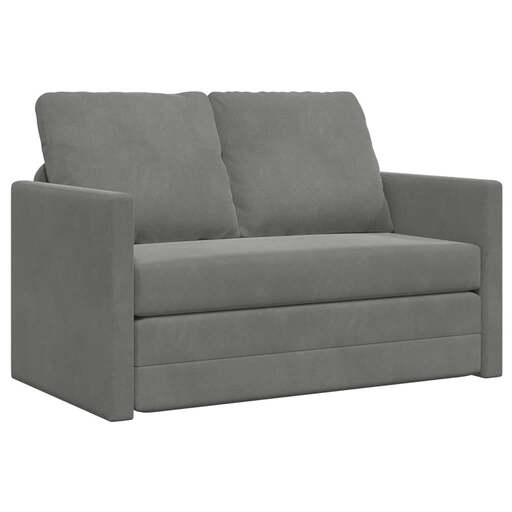
Why this product suits this profile: This two-seater sofa bed is relatively compact as a sofa, measuring 122 × 70 × 55 cm. Simply reposition the seat cushions to create a sleeping area measuring 122 × 204 cm.
It converts without a complicated pull-out mechanism. Even so, remember to check the seat cushion and sleeping area dimensions before buying.
Metal frame, velvet upholstery, extra cushions and a stated weight capacity of 110 kg per seat.
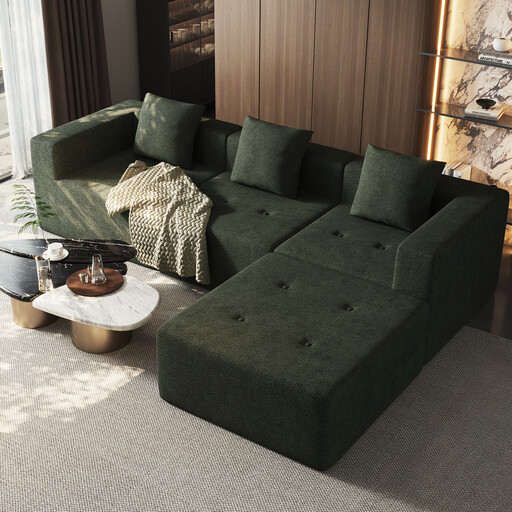
Why this product suits this profile: This corner sofa is 258.5 cm wide, with a large ottoman and a stated sleeping area of 183.5 × 258.5 cm. It’s designed for homes with enough space to accommodate it.
The product description specifies the pocket springs and gives the exact external dimensions. This makes it easier to assess the cushioning and space needed before you buy.
Pocket springs, chenille upholstery, three scatter cushions and an ottoman that can be positioned on either side, according to the product details.

Why this product suits this profile: This pull-out sofa bed measures 132 × 90 × 88 cm, and converts into a bed measuring 184 × 132 × 45 cm. The infinitely adjustable backrest and side pockets make it a flexible choice for a guest room or flat.
Use the handle and concealed wheels to convert it into a bed. Before several people use it, check the sleeping area and stated total weight capacity.
Backrest adjusts from 90 to 180 degrees, steel frame, corduroy upholstery and a stated weight capacity of up to 360 kg.
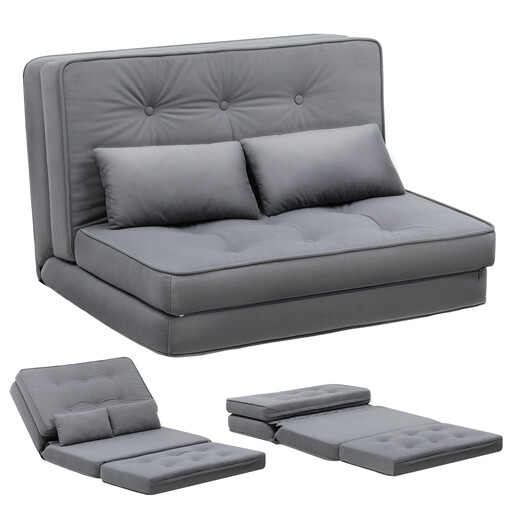
Why this product suits this profile: This compact model measures 90 × 53 × 57 cm and can be used as a sofa, a reclining chair or a flat sleeping surface. It’s suitable for student flats, home offices, guests and occasional camping trips.
The six backrest positions make it easy to see how you can adjust the sofa. At the same time, bear in mind that its low height may affect how easily you can get on and off it.
Folding design, metal frame, linen upholstery, two lumbar cushions and a removable cover, according to the product description.
We’ve put together a complete, regularly updated list of products that meet these strict selection criteria and fully comply with the safety regulations in force in the EU.
That depends on the specific design. For everyday use, a sufficiently large sleeping area, a sturdy frame and even cushioning are particularly important. Some models are explicitly described as temporary guest beds. Keep this in mind when choosing one.
There’s no reliable way to give a single figure. It depends on how often it’s used, the users’ weight, the mechanism, the cushioning and how well it’s cared for. Regular airing, staying within the weight limit and spreading use evenly can help reduce wear. With pull-out models, check the mechanism regularly for damaged or loose parts.
An electric recliner only uses electricity while the motor is moving, not continuously in every sitting position. The motor’s power rating, how long you use it for and its standby consumption all affect running costs. Check these figures in the technical details or instruction manual. An electric recliner isn’t a substitute for a sofa bed if you need a simple extra sleeping space.