
Lieferung heute & morgen

Qualitätsgarantie

Willkommens-Angebote freischalten: KOSTENLOSE Lieferung | Bis zu 80 % RABATT | Kostenlose 30-Tage-JoyPlus-Testphase
App herunterladen
A sofa bed should work as a seat during the day and provide an extra sleeping area at night. In small flats, guest rooms, student rooms or home offices, a sofa bed can take the place of several pieces of furniture. The options range from compact fold-out sofas to spacious corner sofas with a bed function.
However, attractive product photos and general promises of comfort don’t automatically lead to the right purchase. What matters are verifiable details about dimensions, mechanisms, weight capacity, materials and assembly. Comparing these points before you buy can reduce the risk of ending up with a piece of furniture that’s impractical or too large.
An extendable sofa may look compact when folded away, but need considerably more space when opened out. Armrests, backrests and the distance from the wall also affect how practical it is to use. So be sure to check at least:
For example, a sleeping area of 90 × 200 cm is generally better suited to one person, while a 140 × 198 cm area offers more room for two.
Depending on the model, a sofa bed may fold out, pull out, form a sleeping area by lowering the backrest, or use separate seat cushions to make a bed. These options differ in how easy they are to convert each day and how stable they are.
Look for a clear description of the mechanism. A fold-out sofa with an adjustable backrest may be enough for occasional overnight guests. For more frequent use, sturdy frames, an even sleeping surface and smooth-running fittings are important. If you’re considering a sofa bed with storage, also check whether you can easily access the storage when the bed is set up.
An attractive covering doesn’t tell you much about how well a sofa will stand up to everyday use. More important details include:
Weight capacity figures should always be treated as manufacturer specifications. They shouldn’t automatically be applied to every seating position, dynamic loads or use by several people.
For a sofa for small flats, compact overall dimensions and a straightforward conversion mechanism are especially important. A floor sofa measuring 90 × 53 × 57 cm can be set up with minimal space and laid flat when needed. A corner sofa bed, on the other hand, needs more floor space but offers a larger seating and sleeping area.
Measure the space where you plan to put it twice: once for the sofa in its folded position and once for the sleeping area when fully extended or unfolded. If you’re choosing a modular corner sofa, also check whether the ottoman can be fitted on either the left or right.
A simple, flat upholstered surface is often enough for occasional guests. If you’ll use it regularly, look for an even sleeping surface, ample seating and sleeping space, and a seat height that suits the people using it. A low sleeping height can be practical in smaller rooms, but it won’t be equally comfortable for everyone.
Terms such as ‘high quality’ or ‘especially comfortable’ shouldn’t be the only deciding factors. Specific details about the spring system, foam, mattress, adjustable backrest and covering are more useful.
A sofa bed with storage can hold bedding, blankets or cushions. Check whether the storage area is ventilated, easy to access and large enough. Removable covers make care easier, while velvet, corduroy and linen-look fabrics each have different cleaning and stain-removal requirements.
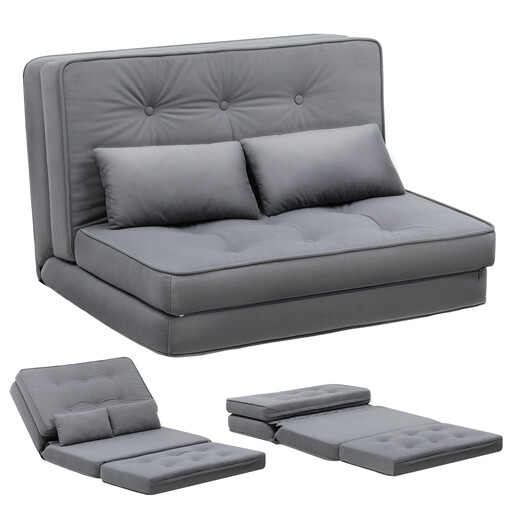
Why this product suits this profile: This compact floor sofa is designed for flats, halls of residence, home offices or occasional camping. Its backrest adjusts to six positions and folds flat.
The product description lists the sofa, sleeping and intermediate positions, along with the dimensions of 90 × 53 × 57 cm. This makes it easier to assess how much space you’ll need before buying.
Six-position adjustable backrest, metal frame, removable cover and two lumbar cushions, according to the product details.
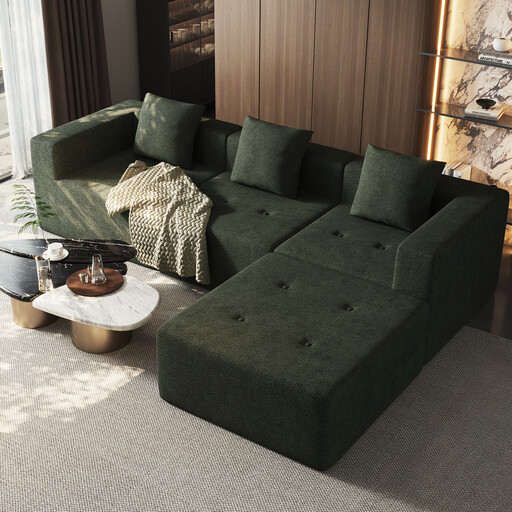
Why this product suits this profile: This corner sofa is designed for households with a larger living room and a need for a generous seating and sleeping area. It measures 258.5 cm wide and 160 cm deep, with a sleeping area of 183.5 × 258.5 cm.
The product details give specific overall and sleeping-area dimensions, as well as a 24-month warranty. This lets you check the space requirements and service terms before buying.
Pocket-sprung seat cushions, chenille covering, a large ottoman and no assembly required, according to the product description.
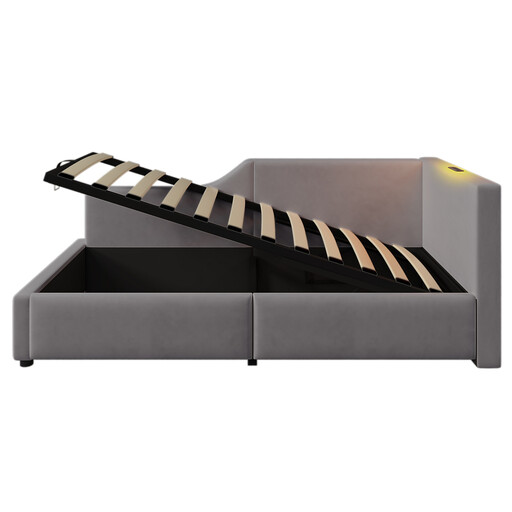
Why this product suits this profile: This day bed works as a guest bed, bedroom furniture for a teenager, or a place to sit and lie down with extra storage. Its 90 × 200 cm sleeping area matches a standard single-bed size.
The dimensions of 213 × 98 × 70.5 cm and delivery in two parts are specified. This helps you plan the space, access route and assembly in advance.
Hydraulic storage beneath the sleeping area, a USB-C port and an integrated reading light, according to the product description.
We’ve put together a complete, regularly updated list of products that meet these strict selection criteria and fully comply with the safety regulations in force in the EU.
You’ll need extra room to open it and get up, as well as space for the sleeping area itself. Measure the model’s depth or pull-out direction, then allow for clear space in front. If you’re looking at a corner sofa bed, remember to account for the ottoman and side access too.
That depends on its construction, upholstery and sleeping area. For everyday use, you’ll want an even sleeping surface, a sturdy supporting frame and dimensions that suit the people using it. Many compact sofa beds are intended mainly for occasional overnight stays. Check the manufacturer’s guidance on use and weight capacity.
Remove dust regularly using a suitable attachment, and follow the care instructions for the covering. Treat stains locally where possible, without soaking the fabric. If the cover is removable, check whether the manufacturer says it’s machine washable. Hinges, screws and pull-out castors should be checked regularly.