
Lieferung heute & morgen

Qualitätsgarantie

Willkommens-Angebote freischalten: KOSTENLOSE Lieferung | Bis zu 80 % RABATT | Kostenlose 30-Tage-JoyPlus-Testphase
App herunterladen
A sofa is usually a long-term purchase. But striking product photos and general marketing claims don’t automatically help you make the right choice. What matters are the dimensions, construction, upholstery, weight capacity and how you plan to use it. This applies to a classic sofa just as much as to a corner sofa, sofa bed or modular sofa.
A sofa measuring 200 cm wide can take up a lot of space in a small living room. Armrests, the backrest and a pull-out bed function also need extra room. Before buying, measure not only the overall width but also the depth, seat height and space in front of the sofa.
With a corner sofa, you’ll also need to account for the depth of the chaise section. If you’re buying a sofa bed, check that the sleeping area can be pulled out fully without blocking doors, radiators or walkways.
Labels such as “easy-care sofa” or “pet-friendly upholstery” aren’t technical standards in themselves. More useful details include the specific material, cleaning instructions and – where stated – abrasion resistance. If you’re considering a corduroy or chenille sofa, bear in mind that textured surfaces can show dust and pet hair.
Clear care instructions are useful: vacuum regularly, spot-clean with a slightly damp cloth and avoid harsh cleaning products. Not every model has removable covers, so check that this is clearly stated in the product description.
An especially soft sofa may feel comfortable when you first sit down, but the seat construction, foam density and resilience also matter for everyday use. Details such as 32D foam, T30 foam, memory foam or pocket springs describe different aspects of the construction. They don’t, on their own, guarantee a particular lifespan.
Also check the maximum weight capacity, seat width and whether the seat cushions are loose, fixed or removable. If the sofa will see heavy use, a sturdy base may matter more than an especially soft surface.
Measure the available floor space, including doorways and stairways. Compact models around 160 to 170 cm wide are often a good fit for flats, bedrooms or small living rooms. A 2-seater sofa may be designed to seat two people, depending on its seat width, but it may not offer enough room to stretch out.
Larger corner sofas or modular systems may suit families. Depending on the model, a modular sofa can be arranged as a straight seating group, an L-shape or a separate lounge-style layout. Check whether the individual modules can genuinely be arranged in different combinations, or whether the sofa comes in a fixed configuration.
The following product details can help you make your choice:
If comfort is a priority, compare the seat height, seat depth and backrest height. A higher seat can make it easier for older people to stand up, while a low lounge sofa offers a relaxed, close-to-the-floor seating position.
Chenille and corduroy have a textured surface. In homes with children or pets, dark or mottled colours often show everyday marks less readily than very light, plain upholstery. Even so, try to keep claws, sharp objects and liquids away from the fabric.
An advertised abrasion rating or Martindale figure is a measurable material specification. However, it applies to the upholstery fabric and doesn’t automatically tell you about the sofa’s overall construction.
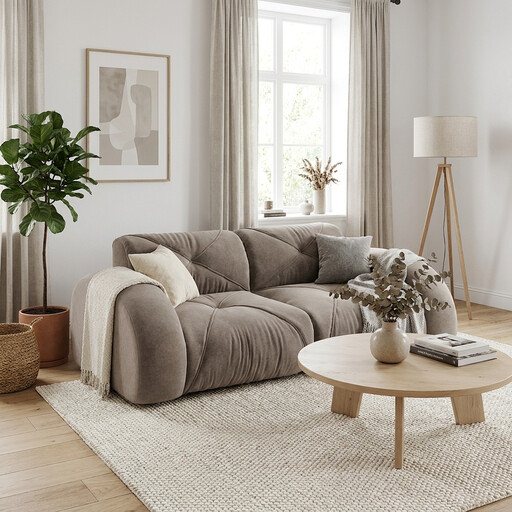
Why this product suits this profile: At 204 × 95 × 76 cm, this frameless 2-seater sofa has clearly defined dimensions that suit smaller living spaces. According to the product description, it has chenille upholstery and a single-piece 32D foam core.
The product description gives specific dimensions and material details, as well as a weight capacity of up to 200 kg per seat. This makes it easier to assess than vague claims about comfort.
Frameless construction, chenille upholstery and mix-and-match modules; according to the product description, it can be assembled without tools.
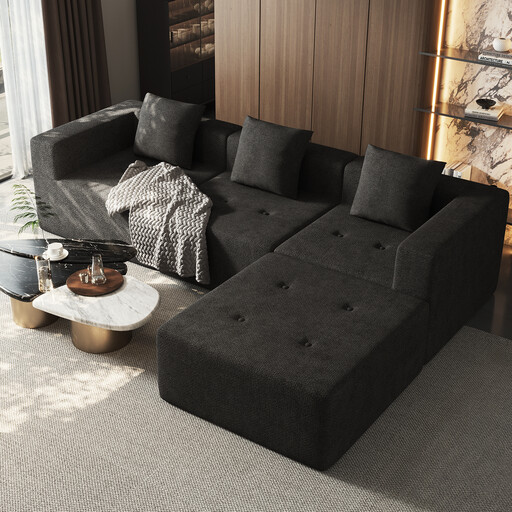
Why this product suits this profile: Measuring 258,5 × 160 cm, this corner sofa has pocket springs in the seat and flexible foam cushioning in the backrest and armrests, according to the product description.
The seat construction is specifically described as having pocket springs. This lets buyers compare its cushioning more directly with simpler foam-only models.
Spacious L-shape, textured chenille, three scatter cushions and a stated sleeping area measuring 183,5 × 258,5 cm.
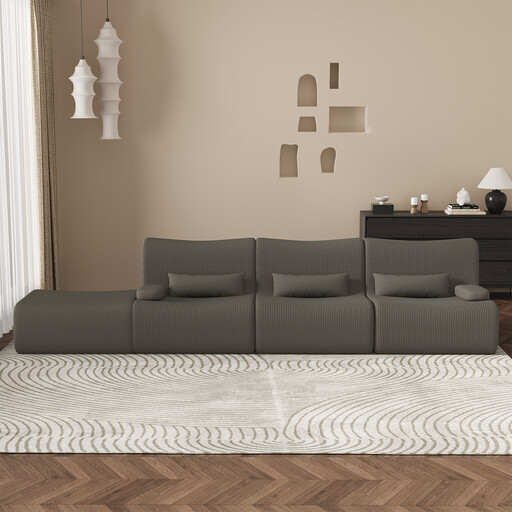
Why this product suits this profile: Measuring 250 × 170 × 76 cm, this modular sofa combines an L-shape with a sleeping option. Its 65 cm seat depth and corduroy upholstery are designed for extended use in the living room or bedroom.
The product description lists the dimensions, foam material, seat depth and the approximate 72-hour expansion time required. This makes it easier to plan the space needed in advance.
Sleeping function, freely combinable modules, corduroy upholstery and a stated static weight capacity of 540 kg, according to the product description.
We’ve put together a complete, regularly updated list of products that meet these strict selection criteria and fully comply with the safety regulations in force in the EU.
Compact 2-seater sofas around 160 to 170 cm wide are worth considering for small rooms. Seat depth, armrest width and the distance from doors or other furniture matter too. A modular sofa can be a good option if you want to rearrange the modules after moving house or changing your room layout.
There’s no reliable one-size-fits-all answer. A sofa’s lifespan depends on how it’s used, its cushioning, the weight it carries, how it’s cared for and the room conditions. Check the material details, frame construction, springs, weight limits and warranty terms. Regular vacuuming and following the manufacturer’s cleaning instructions can help protect the upholstery in everyday use.
Measure the sleeping area when it’s fully extended and leave enough room to move around it. Also check how the mechanism works, whether the sleeping surface is level and whether there’s space to store bedding. A sofa with storage, such as a built-in bedding compartment, can be especially useful. If you’ll be sleeping on it regularly, pay close attention to the sleeping area dimensions and cushioning.