
Lieferung heute & morgen

Qualitätsgarantie

Willkommens-Angebote freischalten: KOSTENLOSE Lieferung | Bis zu 80 % RABATT | Kostenlose 30-Tage-JoyPlus-Testphase
App herunterladen
A soft toy can be a companion for many children for years. But not every cuddly toy makes a good everyday purchase. Products often advertise features that are rarely used, while important details about age suitability, care or small parts can be overlooked. This guide explains what parents, grandparents and gift buyers should look for when choosing soft toys for children.
A soft toy for a baby shouldn’t be chosen on colour or size alone. For babies, stitched-on details, easy-to-grasp features and a clear age recommendation all matter. Products with button eyes, plastic parts, ribbons or small accessories may not be suitable for children under three.
Always check the information on the product page and packaging. A soft toy for children aged 3 and over isn’t automatically suitable for a baby, even if it feels especially soft.
An interactive soft toy with lights, sounds or movement can be part of a bedtime routine, but it’s no substitute for a safe sleep environment. Check battery compartments, cables, pull cords and detachable modules regularly. With musical toys, make sure fastening ribbons aren’t left loose in the baby’s cot.
Soft toys can quickly get dirty when used by the whole family. For washable toys, check whether they can go in the washing machine as they are, or whether electronic components, music boxes or plastic parts need to be removed first. “Easy-care” doesn’t mean the same thing for every product.
Start by checking the age recommendation. For babies from birth, choose models with a clearly stated minimum age and as few detachable parts as possible. For older children, extra features such as pockets, zips or role-play accessories may be useful, provided they’re suitable for their age.
Also look for:
Polyester, cotton and blended fabrics are common materials for soft toys. The materials information should clearly state what the outer fabric and filling are made from. For sensitive skin, a soft, non-scratchy cover can be practical, but this doesn’t mean the product has any medical benefits.
For a soft toy for a baby, the surface texture matters as well as the material. Longer fibres, loose ribbons or decorative charms may be less suitable for very young children. A small, lightweight toy is also easier to grasp and carry.
A large soft toy can make a good plaything or decoration, but it takes up more space in a bed, pushchair or when travelling. Compact toys measuring around 15 to 25 cm are often more practical on the go. So when choosing a soft toy as a gift, think about how it will be used day to day, as well as how it looks.
If you’re considering a musical soft toy, check that the music box can be removed if the toy needs to be washed regularly. Mechanical music boxes don’t need batteries, but they do need to be wound by hand. Electronic models often offer a choice of sounds, but they need batteries and careful cleaning.
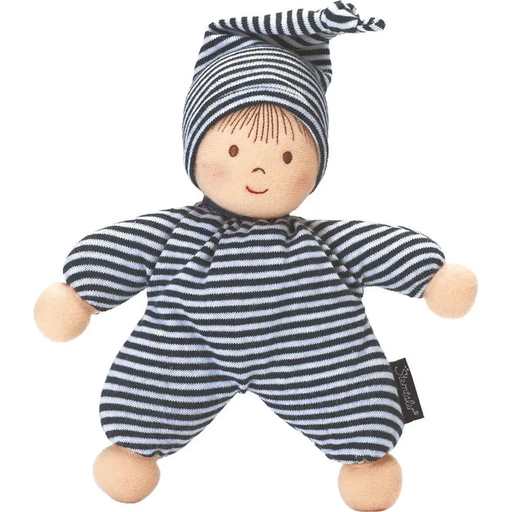
Why this product fits the bill: This compact rag doll has an embroidered face, a rattle and movable arms and legs. It’s a good choice for families looking for a simple grab-and-cuddle toy with no batteries.
It has no electronic features and a clearly described fabric design. Check the specific age recommendation on the product packaging before buying.
Embroidered face, built-in rattle and no batteries required.
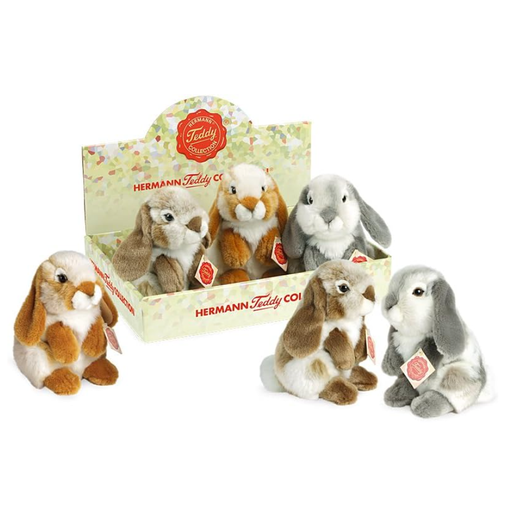
Why this product fits the bill: This sitting rabbit combines a natural design with recycled polyester filling and clear care instructions for washing at 30 °C. It’s a good choice for families who pay particular attention to materials and care details.
The care instructions specify the wash temperature, gentle cycle and air-drying method. Tumble drying isn’t recommended, so you know exactly what care is involved.
Suitable from 18 months, with recycled polyester filling and machine washable at 30 °C.
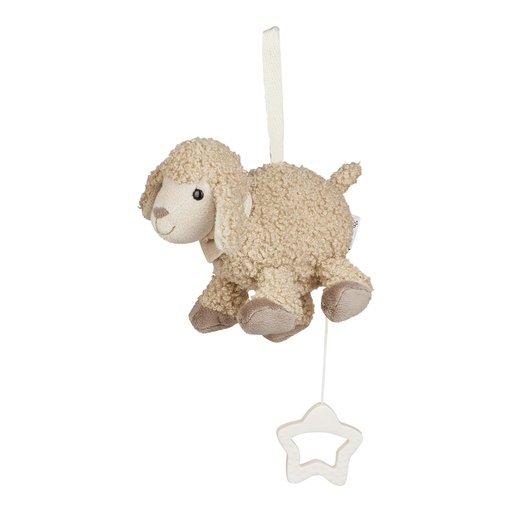
Why this product fits the bill: This musical toy is suitable for babies from birth and has a removable music box and fastening ribbons for attaching it to a pushchair, infant car seat or baby carrier.
The music box can be removed using the safety fastening before washing. Check the ribbons regularly to make sure they’re securely attached and undamaged.
Mechanical music box, removable insert and machine washable at 40 °C.
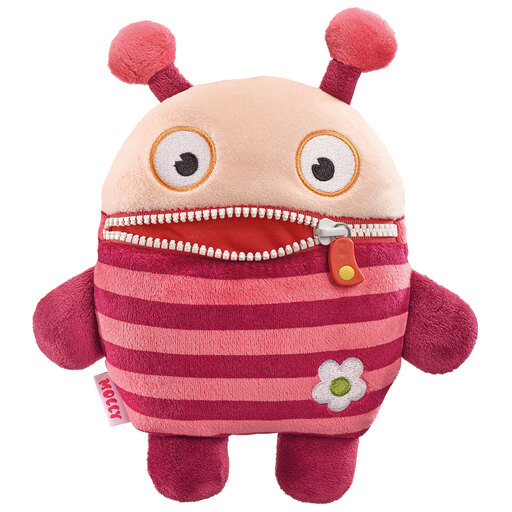
Why this product fits the bill: This worry-eating soft toy has a zip-up mouth where children can symbolically tuck away drawings or notes. It’s designed for children who are ready to engage with this kind of imaginative play.
Its purpose is clearly limited to imaginative play. Parents should talk through what’s inside with their child; the soft toy is no substitute for support with serious problems.
23 cm tall, with a zip-up mouth and washable according to the product information.
We’ve put together a complete, regularly updated list of products that meet these strict selection criteria and fully comply with the safety regulations in force in the EU.
For washable soft toys, read the care instructions before first use. Electronic modules and mechanical music boxes shouldn’t go in the washing machine. After washing, let the toy dry completely before putting any inserts or batteries back in.
For babies, also remember to:
Check the stated age recommendation, look for as few detachable parts as possible, sturdy construction and clear care instructions. A soft toy for a baby should be checked regularly for loose threads and damaged seams. Always follow the manufacturer’s safety guidance for the sleep environment, too.
There’s no fixed lifespan. It depends on the materials, how heavily the toy is used and how it’s cared for. A soft toy can continue to be used as long as its seams, filling, eyes, fastenings and any electronic parts remain undamaged. Discard it if you notice any visible damage.
A battery-powered model needs replacement batteries, and how often they need changing depends on how long and how often the toy is used and which features are switched on. A mechanical musical toy doesn’t need batteries. For electronic soft toys, parents should also check whether batteries are included and how the battery compartment is secured.