For stationery sets arranged in an open layout, a continuous-light softbox kit gives you more freedom to change the lighting angle and framing, but you’ll need space for the light and stand. A light tent can make things simpler when photographing small subjects arranged in a similar way, but it limits how you can position them inside. If you already have a suitable light, a separate light modifier is another option. Before buying, check the dimensions of the entire setup, the mount and what’s included.
Which setup is right for you?
Flat-lay photographers with limited space
When you’re arranging notebooks, cards and pens on a small table, you need to find room for the subject, camera and light all at once. Adobe lists a light source and a stable camera position as key elements of flat-lay photography. When setting up, you’ll also need to allow for the stand’s feet and the light itself.
Photographers shooting colourful paper goods
If you want to show paper, ink and envelope colours consistently across repeat shots, consider your light and white balance together. Nikon describes white balance as a factor in colour reproduction, so test the setting with your materials and the light you plan to use.
Photographers shooting glossy stationery sets
With foil packaging or glossy pens, being able to adjust the light position can help you manage visible reflections. Check the angle with your own subject: a softbox won’t automatically eliminate every reflection.
What should you look for when buying?
Continuous-light softbox kit
A good choice if: you don’t yet have a photography light and arrange your subjects openly on a table.
The trade-off: stand feet, cables and the distance from the subject all need extra space.
Separate light modifier
A good choice if: you already have a suitable light and mount.
The trade-off: the modifier doesn’t produce light itself, so the mount and the rest of your setup need to be compatible.
Light tent with built-in lighting
A good choice if: you often arrange small sets in a similar way and they fit inside, with room for the camera opening.
The trade-off: the tent walls limit how freely you can arrange your subject and position the light at the side.
Two-softbox kit
A good choice if: you’d like to position two lights independently and have room for them.
The trade-off: two stands take up more space than a single light.
| What to consider |
What to look for |
Who is this important to? |
| Space for your subject and lighting setup |
Measure your largest arrangement and the available table and floor space. Check the tent opening, softbox and stand position separately. |
When my subject, camera and a stand all have to fit around a small table, the space needed for the whole setup matters to me. Around 31% of consumers say space is their top buying priority. |
| Colour reproduction |
Compare the specifications of the specific light and take a test shot with a neutral reference. Keep the white balance consistent across a series of images. |
If I want to show paper and ink colours as consistently as possible in repeat shots, I check the light and white balance together. Around 25% of consumers put colour consistency first. |
| Shadows and reflections |
Check glossy surfaces in a test shot and adjust the light angle and distance. See whether a diffuser or grid is included. |
With glossy pens or foil-covered envelopes, I want to be able to control the light angle and visible reflections. For around 25% of consumers, reflection control is their top buying priority. |
| What’s included and the mount |
Check that the light, mount, power supply and stand are compatible with your existing equipment. A softbox on its own isn’t a lighting kit. |
If I still need a light or mount for my setup, getting the right items in the box is essential. Around 19% of consumers put having all the equipment they need first. |
Common buying mistakes
-
Assuming a single softbox is a complete lighting kit
A light modifier diffuses existing light, but doesn’t produce any itself. Without a compatible light and mount, it isn’t a complete lighting setup.
Check what’s included and make sure the mount is compatible with your existing equipment before choosing a separate light modifier.
-
Measuring only the front of the softbox
The light and stand need to fit beside or above your small table. With a light tent, the entire arrangement also takes up table space.
Draw a scaled plan of your subject, camera position, light and stand feet before choosing between an open softbox and a tent.
-
Assuming CRI or Kelvin ratings guarantee accurate product colours
Manufacturer ratings apply to a particular light. White balance and the actual lighting conditions also affect your photo.
Test your papers alongside a neutral reference under the light you plan to use.
Brands worth considering
NEEWER
The manufacturer’s German range includes continuous-light softbox kits and a light tent with built-in lighting for different table setups.
- According to NEEWER, the SF40 includes one light and one stand, while the NK103 includes two lights and two stands. The LP40 has LEDs built into the tent.
- Space requirements and options for positioning the light vary by setup. The manufacturer’s specifications don’t guarantee image quality with your own stationery.
Godox
According to Godox, the SB-FW6060 is a separate light modifier with a 60 × 60 cm front and a Bowens mount.
- Its size and mount can help you decide whether it’s suitable for an existing setup.
- You’ll need to consider the light, mount and space required for the entire setup separately. The specifications don’t guarantee a particular image result.
Rollei
Rollei describes one of its product ranges as featuring Quick-Fold light modifiers with a grid and Bowens mount.
- A Quick-Fold mechanism may be useful if you regularly set up and pack away your equipment.
- Check the specific version, mount and what’s included. A light modifier isn’t a complete continuous-light setup.
BRESSER
According to the manufacturer, the range includes softboxes for product photography and light modifiers designed for specific models.
- The manufacturer’s product overview distinguishes between light modifiers by design and mount.
- Accessories specifically designed for the BR-S36B PRO shouldn’t be assumed to be universally compatible.
Photo boxes at Joybuy
This selection features light-up photo boxes for compact tabletop product photography.
 No image available
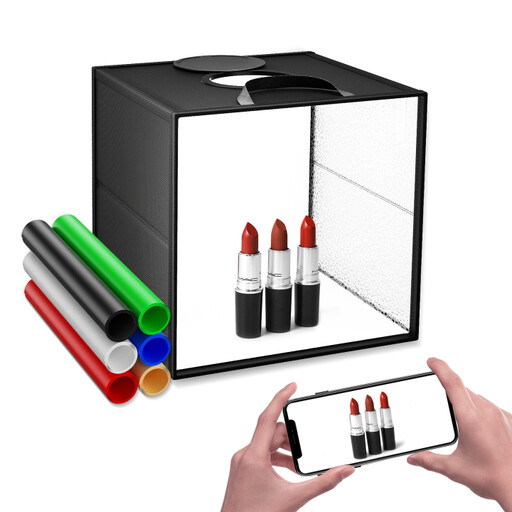
30 × 30 cm photo box with dimmable lighting
For compact stationery sets, if a photo box with openings for top-down or front-on shots suits your subject.
The box measures 30 × 30 cm. According to the product details, six coloured backdrops are included.
The light is dimmable. The stated CRI rating doesn’t guarantee colour reproduction in your finished photos.
View at Joybuy
 No image available
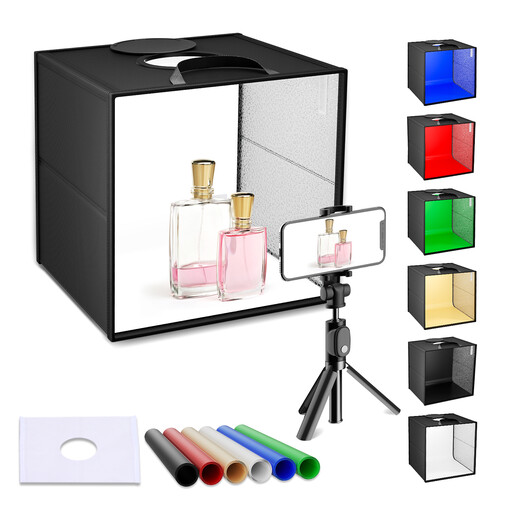
Foldable LED photo box with coloured backdrops
For product photography, if a foldable photo box with built-in lighting and different viewing angles suits your setup.
The product description lists six backdrops, three light colours and nine brightness levels.
Openings for horizontal and vertical shooting angles are also listed. Check that the size and openings will work for your arranged set.
View at Joybuy
Frequently asked questions
Can I photograph stationery sets from above if I buy a light tent?
According to the manufacturer, the NEEWER LP40 has an opening at the top. Check that your fully arranged set fits inside and that you can position the camera as you want. Outside a tent, you have more freedom to arrange an open flat lay.
How should I set up lighting for coloured paper?
First, take a test shot under the lighting you plan to use and check the white balance against a neutral reference. A Kelvin or CRI rating alone doesn’t guarantee true-to-life colours in the finished image.
What should I check about what’s included and my right to cancel?
Before buying, check whether a light, stand, any necessary adaptors and a power supply are included. For online consumer purchases in Germany, you generally have a 14-day right to cancel. According to the Verbraucherzentrale, you must notify the other party to the contract that you wish to cancel; simply returning the item isn’t enough.
What marking should I look for on an electric photography light?
For products covered by the relevant EU regulations, the required CE marking is the manufacturer’s declaration of conformity, not an independent quality mark. When inspecting electric lighting products, the Bundesnetzagentur lists factors including product markings, manufacturer details and German-language instructions. Check these details for the specific light. A passive fabric softbox shouldn’t automatically be treated in the same way as an electric light.


