For the most even overall image, using two lights with similar settings, positioned on either side of the collage, is a sensible starting point. The Canadian Conservation Institute describes positioning lights at an angle of around 45 degrees to reduce reflections, although fine surface details may then be less visible. If relief or glossy details matter, plan to take an additional photo with more directional lighting. Before buying, check that the lights, softboxes, stands and power supplies suit the set-up you have in mind.
Who is this set-up for?
Collage artists who need to document their work
If you want to capture a collage as a whole, even lighting can help. Take a separate photo if you also want to show its surface texture. The Canadian Conservation Institute explains how lighting from both sides can illuminate the whole surface.
Archivists working with a colour reference
For repeat photography, it helps to reset the white balance whenever the lighting changes and to take a colour reference shot. The Canadian Heritage Information Network recommends doing this at the start of a session with new lighting.
Photographers with studio lights already in place
If you already own lights or stands, first check that the light modifier fits the mount and confirm exactly what’s included with the specific version. A softbox on its own is not a light.
What should you look for when buying?
Two lights with softboxes
Best for: capturing the entire collage as evenly as possible, with room to light it from both sides.
The trade-off: Even lighting can make relief and surface damage less distinct. Check that the package includes everything you need for both sides.
Individual lights and compatible modifiers
Best for: using parts of a studio set-up you already own, or choosing the softbox mount and size yourself.
The trade-off: You’ll need to check separately that the number of lights, stands and power supplies work together. A light’s published specifications don’t automatically describe the complete softbox set-up.
An additional photo with raking light
Best for: showing raised edges, layers or uneven areas of the collage.
The trade-off: Light coming from the side reveals relief, but it doesn’t replace an evenly lit overall photo.
| Buying criterion |
What to look for |
Who is this important to? |
| Even overall coverage |
Check whether you can position two comparable light sources on either side, and whether softboxes and stands are included for both. |
If I want to photograph the whole collage as evenly as possible, with fewer distracting reflections, I’ll plan to light it from both sides; around 36% of consumers prioritise even overall coverage. |
| Consistent colour reproduction |
Check the colour temperature settings and the manufacturer’s specifications for the specific light. Reset the white balance when the lighting changes, and take a colour reference shot. |
If I want to compare photos taken in different sessions, I need a consistent white balance and a reference; around 29% of consumers put consistent colour documentation first. |
| Visible surface texture |
Check whether you can move at least one light independently and position it safely to the side of the collage. |
If I want to document layers, ripples or raised elements, I’ll plan an additional photo with side lighting; around 21% of consumers prioritise visible material relief. |
| A compatible, complete set-up |
Compare the number of items and what’s included with the specific version. For individual components, check the mount, stand and power supply required. |
If I want to reuse equipment I already own or adapt the set-up to the space available, I’ll check that every part is compatible; around 14% of consumers prioritise a suitable, complete set-up. |
Common misconceptions
-
CRI or colour temperature guarantees accurate colour in your photos
Manufacturer specifications describe the properties of the light itself, not the colour accuracy of your finished photo. The lighting set-up and camera settings matter too.
Compare the specifications for the exact model, keep your set-up as consistent as possible, and photograph a colour reference whenever you use new lighting.
-
Light that minimises reflections automatically shows every layer of a collage
Even lighting from both sides can make texture and damage less distinct.
Take one photo for the overall view, then, if needed, take a separate photo with more directional lighting to show the texture.
You may need to reposition the lights and allow extra time for an additional photo.
-
A softbox is a complete lighting kit
A light modifier isn’t the same as a light. Individual components may also be supplied without a stand or power supply.
Check the item list for the specific version, along with the mount and any components you already own.
You may need to buy any missing lights, stands or compatible accessories separately.
Brands worth considering
NEEWER
The documented NL660 Bi-Colour kit is a bundled option for a two-light set-up.
- According to NEEWER, this version includes two LED panels, two softboxes, two stands and two power supplies. The manufacturer lists 3200–5600 K and CRI 96+.
- These are manufacturer specifications, not independent measurements of a complete set-up used to photograph a collage.
amaran
The amaran 100x S by Aputure is a single Bi-Colour COB light for a set-up with a separately chosen modifier.
- Aputure lists 2700–6500 K, CRI 95, TLCI 99 and a Bowens mount for this model.
- You’ll need additional components for a softbox arrangement on both sides. Brightness figures with a reflector or without a modifier don’t describe the complete softbox set-up.
Rollei
The documented click softbox is a light modifier for buyers who already have a compatible light.
- For the 60 × 90 cm version, Rollei lists a Bowens S-Type mount, plus inner and front diffusers.
- The softbox isn’t a light. Check that its mount is compatible with your existing set-up.
Godox
The SL100Bi is a Bi-Colour continuous light for buyers who want to choose their light and modifier separately.
- Godox lists 2800–6500 K and CRI/TLCI 96/97 in its own catalogue.
- These manufacturer specifications don’t confirm the lighting quality of a complete softbox set-up or what’s included in a specific retailer’s offer.
Joybuy products for small tabletop subjects
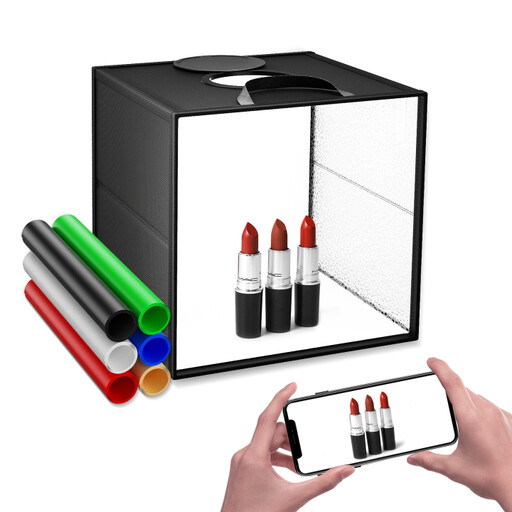
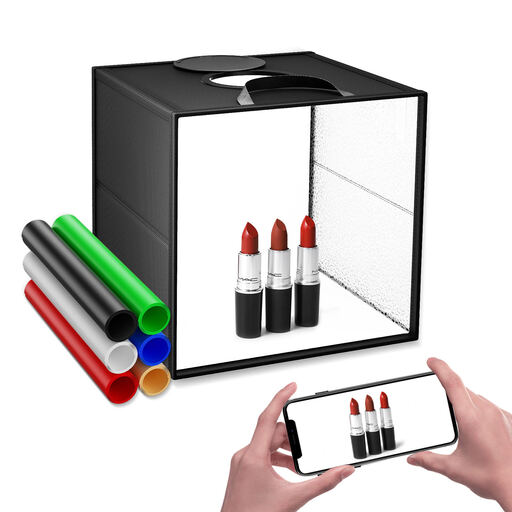
The photo boxes below are described as suitable for small tabletop subjects. They’re compact product photography set-ups, not softbox lights for illuminating a separately arranged collage.
 No image available
30 × 30 cm photo box with six backdrops
For small, flat tabletop subjects; the product description says it has dimmable lighting and a foldable housing.
This version is described as a compact photo box for product photography, not as a softbox kit for a separate lighting set-up.
View on Joybuy
 No image available
40 cm mini photo studio, 5600 K, 120 dimmable LEDs
For small tabletop subjects; the product title lists 120 dimmable LEDs and six coloured backdrops.
The foldable light tent is described as a mini photo studio for product photography, not as a softbox light for a collage.
View on Joybuy
Frequently asked questions
Is one evenly lit photo enough for a collage with raised elements?
Not always. The Canadian Conservation Institute explains that even lighting can obscure texture. An additional photo with more directional lighting can make surface features more visible.
What should I adjust before a new photography session?
Set the white balance for the new lighting arrangement and take a colour reference shot. The Canadian Heritage Information Network recommends doing this at the start of a session when the lighting has changed.
Are a power supply and stands automatically included with a softbox?
No, the contents depend on the specific version. The documented NEEWER kit lists two power supplies and two stands, while the documented Rollei softbox is a light modifier, not a light. Check the item list before buying.
What should I know about CE marking and disposal in Germany?
The European Union explains that CE marking is only required for product types covered by relevant harmonised EU rules; it doesn’t confirm that an individual model complies. According to the German Environment Agency, waste electrical equipment can be taken to local collection points free of charge, subject to the applicable conditions. The Agency’s information dated 24 September 2026 also describes return options at certain retailers.


