For glaze samples on a small table, a diffused light source that you can position to the side is a sensible starting point. Move it around and check the camera image to see whether the reflection obscures the surface. Adding more lights won’t automatically solve the problem, as broncolor explains when discussing shiny subjects. If you don’t already own a light, compare complete kits and how much space they need. If you do, first check the connection and what’s included with the light modifier. For consistent colours, keep your setup the same and check the white balance against a neutral reference.
Which setup is right for you?
Testing glossy glazes
If you want to position reflections so that the glaze and surface texture remain visible, it’s worth carefully checking where you place the light source. In its guidance on shiny subjects, broncolor explains that more light isn’t automatically the better solution.
Potters comparing a range of colours
If you want to compare several samples, consistent shooting conditions and a checked white balance can help. Adobe explains the benefits of a controlled environment, while Nikon describes how to set the white balance using a neutral reference.
Photographers working at a small table
If your light, modifier and stand all need to fit beside the table, you’ll want to plan for the whole setup. NEEWER and SmallRig’s product specifications show that light modifiers can vary considerably in size.
What should you look for when buying?
With glossy glaze, it’s worth checking the position of reflections first, then considering space, colour consistency and the equipment you already own. broncolor advises against simply adding more lights for shiny subjects; Nikon explains how a controlled white balance can help you compare images.
| Priority |
What to check |
Who will find this especially important? |
| Reflections |
Check for a light source you can position and diffuse; assess the effect on a sample in the camera image. |
If I want to assess the glaze texture despite reflections, I first check where the light is reflected. Around 33% of consumers put reflection control first. |
| Colour comparison |
Check the light colour and, where applicable, the stated colour rendering index of the specific light; take photos using a consistent setup and a neutral reference. |
If I want to compare the colours of several glaze samples, I keep the light and white balance as consistent as possible. Around 27% of consumers put consistent colours first. |
| Available space |
Allow for space beside the table, as well as room for the stand and mount. |
If I don’t have much room around my table, I plan for the light, stand and modifier together. Around 20% of consumers prioritise limited space. |
| Existing equipment |
Check that the connection and mount work with your existing light, and confirm exactly what’s included. |
If I already own a light, I want to choose a modifier that will actually attach to it. Around 20% of consumers put compatibility with existing equipment first. |
Common misconceptions
-
A large or bright softbox will eliminate reflections on its own
With glossy glaze, the position of the light source affects where reflections appear in the image. Additional lights can create more reflections.
Start with a light source you can position, moving it around while checking the camera image.
-
A single light modifier is a complete lighting kit
A softbox won’t produce light without a compatible light source. According to the manufacturer, the panel isn’t included with the NEEWER softbox for 660 LED panels. The light shown with Rollei’s Quick Parabolic is also not included.
Check the connection and all the necessary components against the specific listing and the equipment you already own.
-
Lux figures for different lighting setups can be compared directly
Godox gives lux figures for its SL60II lights at a distance of one metre with a standard reflector. This measurement doesn’t describe the brightness you’ll get from a softbox on your own table.
For every figure, check the measurement distance and the light modifier used.
-
Matching Kelvin figures automatically produce matching glaze colours
Lighting and white balance affect how colours appear in a photo. A Kelvin figure alone therefore doesn’t guarantee a consistent impression of colour across your images.
Photograph your samples in consistent conditions and use a neutral reference to set the white balance.
Relevant brands and light modifiers
The details below relate to the models and manufacturer information specified. They aren’t a general assessment of the brands as a whole.
Godox
For a modular setup with a compatible Bowens mount, you could use a separate softbox and a light source sold separately.
- According to the manufacturer, the SB-FW6060 has a Bowens mount and measures 60 × 60 cm.
- Godox states that the SL60IIBi has an adjustable colour temperature.
- The SB-FW6060 isn’t a complete kit. The published lux figures for the light are based on a standard reflector at a distance of one metre, not on this softbox on a table.
NEEWER
The models include both an LED softbox kit and a light modifier designed for a specific LED panel.
- The manufacturer lists two 60 × 60 cm softboxes, E27 fittings, LED bulbs and stands for the NK200.
- You’ll need space for two stands. The softbox for the 660 LED panel doesn’t include the panel and isn’t a universal Bowens light modifier.
SmallRig
The RA-D30 is specified as a compact light modifier for the RC-60/100 COB lights listed by the manufacturer.
- SmallRig gives the opening diameter as approximately 29 cm and lists a grid.
- The softbox alone doesn’t include a light or a complete setup; the stated compatibility applies to the specified lights.
Rollei
The Quick Parabolic softbox is designed for a setup with a compatible Bowens light and enough room for a round light modifier.
- Rollei lists a Bowens S-Type mount, inner and outer diffusers, and a grid.
- According to the manufacturer, the light shown isn’t included. Check that the 65 cm diameter and the space needed for a stand will fit beside your table.
Joybuy products related to this topic
The following Joybuy products are photo boxes for compact product photography, not freely positionable softbox light modifiers. For glossy glaze, check in a test image before choosing whether reflections and surface texture remain visible as you want them to.
 No image available
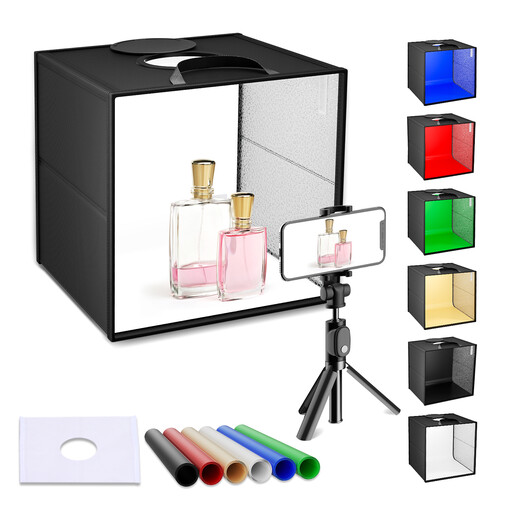
Foldable LED photo box with coloured backgrounds and adjustable brightness
This photo box is a compact alternative for product photography, but it isn’t a softbox light modifier. If you’re photographing glossy glaze, check the reflections and surface texture in a test shot.
The product description lists 120 built-in LEDs, three light colours, a colour temperature of 3000–5600 K and nine brightness levels.
According to the description, six background cards are included. The CRI figure given is 95+.
Joybuy
 No image available
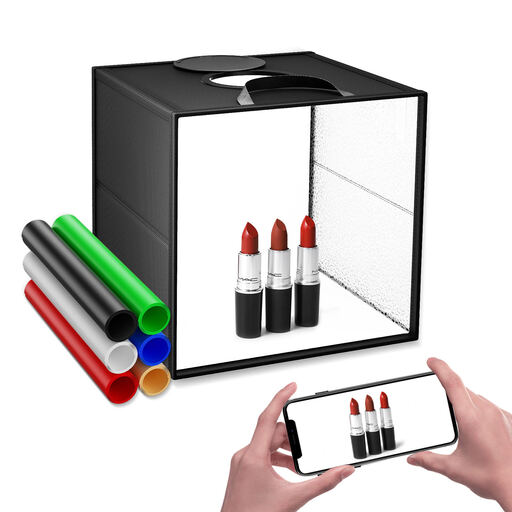
40 cm mini photo box with 5600 K and dimmable LEDs
The mini photo box is described as being for a compact product photography setup, not as a freely positionable softbox. Before using it with glossy glaze, check whether the box shows reflections and the surface as you want.
The product name specifies a size of 40 cm and 5600 K; the description lists 120 dimmable LEDs and built-in diffusion material.
According to the product description, six background cards are included.
Joybuy
Frequently asked questions
Do I need two softboxes for glossy glaze?
Not necessarily. First, use a light source you can position and check where the reflection appears in the camera image. A white reflector can direct existing light towards the shadow side, but it doesn’t produce light of its own.
How can I photograph several glaze samples so their colours are comparable?
Keep your lighting setup and camera settings as consistent as possible, and check the white balance against a neutral reference. A CRI figure given by the manufacturer alone doesn’t show how a particular glaze will look in your photos.
Can I use a softbox bought on its own straight away?
Only if you have a compatible light and mount. According to the manufacturer, the Godox SB-FW6060 has a Bowens mount; the NEEWER softbox for the 660 LED panel is designed for that panel, which isn’t included.
What details should I check when buying a photographic light in Germany?
Check the product labelling, the manufacturer’s information and the required details in a German-language instruction manual. Your Europe explains that CE marking is only required when the relevant harmonised EU rules require it for the product; the European Commission points out that it isn’t a 100% guarantee of safety. The German Federal Network Agency lists product labelling and a German-language instruction manual as points to check.
Is a manufacturer’s guarantee the same as the statutory warranty?
No. The statutory warranty covers claims against the seller for faulty goods; a guarantee is an additional voluntary promise with its own terms. The consumer advice centre explains the difference.


