Bakers with cold butter
If you need to soften butter at short notice for a dough, it must remain pliable without melting. King Arthur Baking describes the ideal texture as soft enough to press, but still firm and not greasy.


You don’t necessarily need a combination microwave to soften butter quickly for baking. What matters is being able to control the microwave function: the butter should be soft enough to press, but not greasy or melted, as King Arthur Baking recommends for certain doughs. A combination model is more worthwhile if you also want to bake or brown dishes for guests, and the dish, usable space and available worktop space are all a good fit. The F.A.Z. Kaufkompass recommendation in the baking category is not a test of how well a microwave softens butter.
If you need to soften butter at short notice for a dough, it must remain pliable without melting. King Arthur Baking describes the ideal texture as soft enough to press, but still firm and not greasy.
If you want to bake or brown smaller dishes as well as prepare ingredients, check whether a combination microwave can handle these tasks and fit in the space you have available. The F.A.Z. Kaufkompass lists a Samsung model in its ‘For baking’ category.
If you want a choice of cooking functions, make sure the appliance’s footprint and usable interior space are suitable for your baking dish. CASO Design and SEVERIN provide model-specific dimensions that you can compare.
Best for: If your main aim is to soften butter and occasionally heat food.
The trade-off: It won’t have grill or baking functions, but you don’t need them for this task.
Best for: If you also want to brown or grill food.
The trade-off: A grill doesn’t automatically mean the appliance has a dedicated convection baking function. For softening butter, the microwave function is what matters.
Best for: If you want to cook smaller baked or oven-cooked dishes in the same appliance when entertaining guests.
The trade-off: Extra functions take up space. Before buying, check that the appliance’s external dimensions and usable interior space suit your kitchen and baking dish.
Best for: If you’re only baking for a one-off occasion and can take the butter out of the fridge in good time.
The trade-off: Softening at room temperature takes planning; the time needed depends on the butter and the room temperature.
| Priority | What to check when buying | Who is it important to? |
|---|---|---|
| Soften butter without melting it | Can you select the microwave power and use short heating intervals? Can you check the butter between intervals? | When I cream butter and sugar, the butter needs to be soft enough to press without melting. Around 36% of consumers put getting the right butter texture first. |
| Use the same appliance for baking too | Does it explicitly have convection, or just a grill? Can you select the cooking functions separately? | When entertaining, I’d like to use the same appliance to bake or brown smaller dishes too. Around 29% of consumers give extra baking functions the greatest weight. |
| Worktop space and suitable baking dishes | Check the external dimensions and installation guidance; compare the interior dimensions or usable base area with your dish. | If my kitchen has limited space or I need to fit in a particular dish, both need to be suitable for the appliance. Around 21% of consumers prioritise the appliance’s footprint and whether their dish will fit. |
| Controls and cleaning | Can you set the cooking function, power and time directly? How do you clean the cavity, base or turntable? | When I’m short on time, I want to set the right function easily and clean the cavity without a fuss. Around 14% of consumers prioritise ease of use and cleaning. |
Butter that’s too warm can affect the texture needed for some doughs.
Check the consistency before using it: it should be soft enough to press, but still offer some resistance, and it shouldn’t be greasy or liquid.
These functions are designed for other kinds of cooking. When softening butter, the priority is controlled heating.
Before buying, decide whether you’ll actually use the appliance to bake or brown other foods as well.
The stated cavity capacity alone won’t tell you whether a particular dish will fit inside.
Measure your dish and compare it with the usable space in the specific appliance. If it has a turntable, check its diameter too.
The Samsung MC32DB7746KDE1 is a 32 l combination microwave with a grill and convection. The F.A.Z. Kaufkompass lists this model in its ‘For baking’ category.
The manufacturer describes the HCMG 25 Ceramic Chef as a microwave with convection and a grill, with a flat base and no turntable.
The MW 7773 combines a microwave, grill and convection function, which the manufacturer says can be used separately or together.
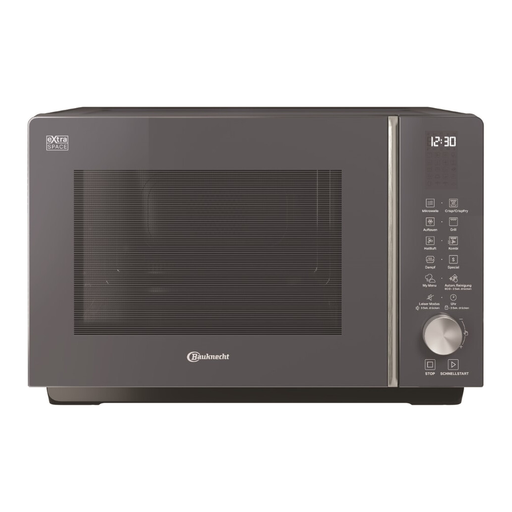
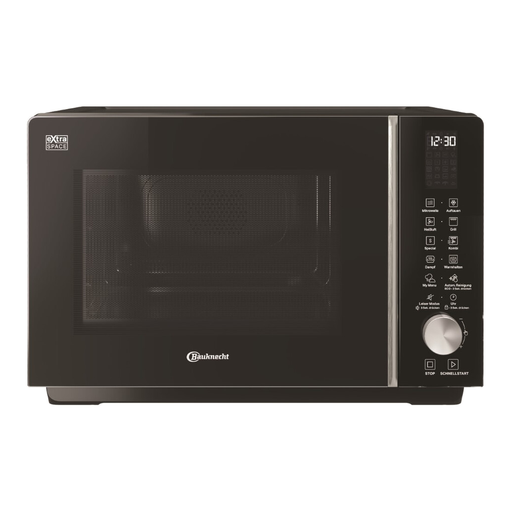
For the MW 179 IN, Bauknecht lists convection, a 33-l cavity and a Crisp function.
The Panasonic NN-GD39 is a combination microwave with a grill, inverter technology, and separately specified microwave and grill power levels.
This selection features Bauknecht combination microwaves with convection and a grill, for softening butter and preparing other dishes.
 No image available
The appliance description lists a butter-softening programme. Keep an eye on the butter anyway, so it stays pliable and doesn’t melt.
The product name specifies a 25 L capacity, a cavity without a turntable, convection, a quartz grill and steam cooking.
 No image available
The appliance description lists a butter-softening programme. Keep an eye on the butter anyway, so it stays pliable and doesn’t melt.
The product name specifies a 25 L capacity, a cavity without a turntable, convection, a quartz grill and steam cooking.
It should be soft enough to press, while still offering some resistance, and shouldn’t be greasy or liquid. King Arthur Baking describes this consistency for doughs made by creaming butter and sugar together.
You don’t need a combination microwave for this task alone; what matters is having a controllable microwave function. A grill or convection function is more useful if you also want to bake or brown food, and the appliance, dish and available space are all a good fit.
Only use containers and accessories that are marked as suitable for microwave use and approved in the appliance instructions. The Verbraucherzentrale lists suitable types made from glass, ceramic and certain plastics. Check separately whether they’re suitable for use with the grill or convection function.
The Federal Office for Radiation Protection describes safety features and an automatic shut-off when the door is opened. Don’t continue using a damaged appliance, and always follow the instructions for your specific model.
Appliances sold in Germany must meet the relevant EU product requirements. Where CE marking is required, it must be present on the specific appliance. According to the European Union, CE is the manufacturer’s declaration of conformity, not an independent quality mark. Check the marking and make sure the model matches the one in the listing.