
Lieferung heute & morgen

Qualitätsgarantie

Willkommens-Angebote freischalten: KOSTENLOSE Lieferung | Bis zu 80 % RABATT | Kostenlose 30-Tage-JoyPlus-Testphase
App herunterladen
A well-lit outdoor area not only deters unwanted visitors but also enhances safety on pathways, driveways, and in the garden. An outdoor solar floodlight with a motion sensor is an energy-efficient and easy-to-install solution for this purpose. However, the market is flooded with products whose performance claims often don't hold up in practice.
As your Joybuy Product Recommendation Officer, I'm here to help you separate the wheat from the chaff. Instead of falling for marketing hype, you should focus on verifiable facts. We'll shine a light on the three most common pitfalls and show you which technical features truly matter.
Many buyers are disappointed shortly after their purchase because their new floodlight doesn't deliver the expected performance. This is often due to these three common weaknesses:
To avoid a bad purchase, you should base your decision on objective technical data. The following three parameters are crucial for the performance and longevity of a solar floodlight.
The actual brightness of a light is measured in lumens (lm), not in watts or the number of LEDs. For orientation lighting on paths, 300–500 lumens are often sufficient. To illuminate larger areas like driveways or patios and to create a deterrent effect, models with 1000 lumens or more are recommended. Also, pay attention to the beam angle: a wide angle of 120° or more provides broad-area illumination, while adjustable heads allow for targeted aiming of the light.
The IP rating indicates how well a device is protected against the ingress of foreign objects (first digit) and water (second digit). For an outdoor light with a motion sensor exposed to rain and snow, a waterproof IP65 rating is a sensible minimum standard. This certification ensures that the housing is protected against strong water jets from all directions, guaranteeing a long service life even in adverse weather conditions.
A good motion sensor should have a detection angle of at least 120° and a range of 5–8 metres. Adjustable modes (e.g., on-motion only, dim continuous light, full brightness on motion) offer flexibility. The battery capacity, measured in milliamp-hours (mAh), determines the illumination time. Values from 2000 mAh upwards are recommended for reliable operation. A solar garden lamp equipped with a remote control significantly increases user convenience, as settings can be adjusted without having to climb a ladder.
Based on these objective criteria, we have identified some products that are suitable for different user profiles and requirements.
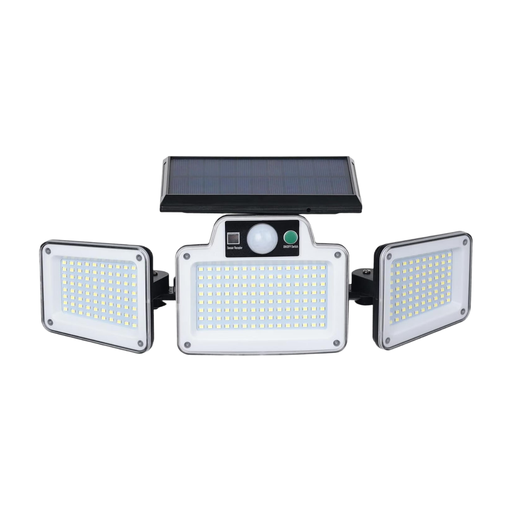
Why This Fits Their Persona: Ideal for users looking for a straightforward and affordable solution for their garden, garage, or pathways. The three adjustable heads allow for flexible illumination of specific areas.
With an IP65 rating, the device is armed against bad weather. The separate solar panel with a long cable allows for optimal alignment with the sun, thus avoiding the trap of inefficient charging.
Three lighting modes controlled by a remote, and a 2400 mAh battery offer a good balance of functionality and endurance for everyday use.
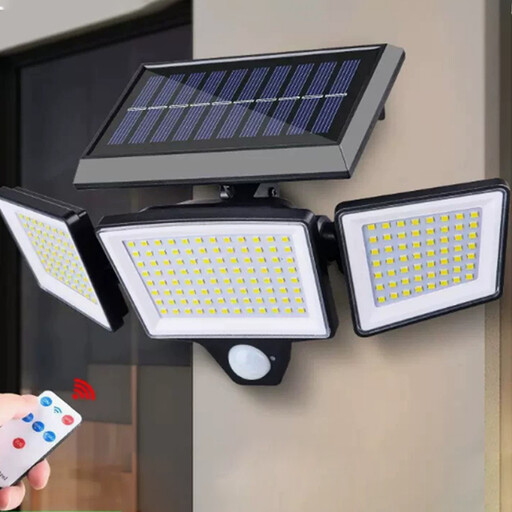
Why This Fits Their Persona: Perfect for homeowners who need maximum brightness for deterrence and for illuminating large areas like driveways, yards, or the entire entrance area. A true solar security light.
This model avoids the pitfall of insufficient brightness with a stated light output of 3000 lumens. The wide 270° illumination angle of the three heads ensures comprehensive coverage without dark corners.
According to the manufacturer, the improved sensor offers a long detection range. The IP65 certification and robust ABS housing ensure durability in all weather conditions.
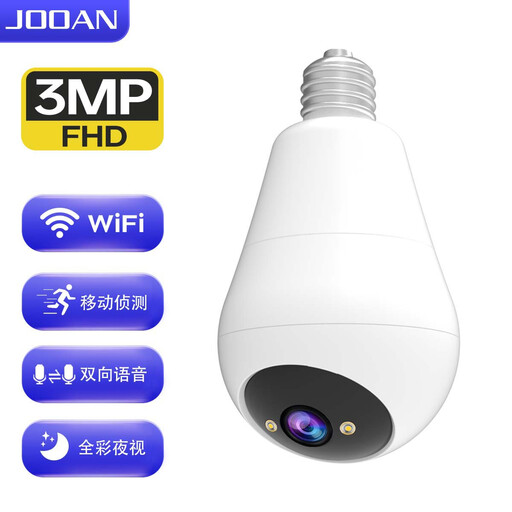
Why This Fits Their Persona: A 2-in-1 solution for those who want not just light, but also active surveillance. Ideal for porches or covered entrance areas with an existing E27 light socket.
This model is hardwired, thus bypassing the typical battery and charging issues of solar lights. It offers consistent performance and advanced features that are difficult to achieve with solar power alone.
Combines a floodlight with a sensor and a 360° surveillance camera featuring app control, colour night vision, and two-way audio. Installation is incredibly simple: just screw it into an existing E27 socket.
We have compiled a complete, up-to-date list of products that fully meet these strict selection criteria.
The IP (Ingress Protection) rating classifies the degree of protection a housing provides against the ingress of foreign objects and water. The first digit represents protection against solids (e.g., dust), and the second against water. For a solar LED floodlight exposed to the weather, a minimum rating of IP65 is recommended. This means the device is dust-tight and protected against strong water jets.
The illumination time in winter depends heavily on the amount of sunlight during the day, the battery capacity (mAh), and the selected lighting mode. On overcast days, the battery charges less. Models with large, efficient solar panels and high-capacity batteries (e.g., over 2200 mAh) are better suited for winter. A mode where the light only activates upon motion detection will significantly extend battery life compared to a permanent dusk-to-dawn dim light.
No, an electrician is generally not required for an outdoor solar floodlight with a motion sensor. Since the devices are self-sufficiently powered by the solar panel, there is no need for complex wiring to the household's electrical system. Installation is usually limited to screwing the floodlight and the solar panel into a suitable location. This makes them an ideal solution for DIY enthusiasts.