
Lieferung heute & morgen

Qualitätsgarantie

Willkommens-Angebote freischalten: KOSTENLOSE Lieferung | Bis zu 80 % RABATT | Kostenlose 30-Tage-JoyPlus-Testphase
App herunterladen
Solar garden lighting is ideal for paths, flower beds, balconies, patios and gazebos, without the need to lay power cables. There’s plenty to choose from, from decorative string lights to smart solar lights with RGB colour-changing effects and Bluetooth Mesh control. However, product claims aren’t always directly comparable. Short lighting times, a poorly positioned solar panel connection or a misunderstanding of an IP rating can all limit how useful a light is in practice.
This buying guide explains which details matter when shopping for solar outdoor lighting, and which models may suit different situations.
Claims such as ‘up to 12 or 24 hours’ are usually based on specific charging conditions. In winter, on cloudy days or in a shady spot, less energy may be available. So it’s important to consider more than just battery capacity and maximum lighting time. Also check:
A solar string light with lots of LEDs can look decorative, but it will use more energy if left at a high brightness setting.
The IP65 rating indicates a dust-tight design and protection against water jets. This means the product is suitable for rain and splashes, but not for full immersion. IP67 also offers protection against temporary immersion under the conditions defined by the standard.
Even with IP65-rated waterproof garden lighting, the solar panel, light housing and cable connections should be installed so that water can’t collect around them. An IP67 product may be a good choice for applications close to the ground, such as a solar ground light, but it’s no substitute for correct installation.
RGB colour-changing effects, app control and Bluetooth Mesh outdoor lighting offer more options, but they also mean you’ll need to check a few more things when choosing a product. Before you buy, consider:
For a single light on a balcony, complex connectivity may not be necessary. But if you have several lights along a patio or across a larger garden, Bluetooth Mesh can make central control easier.
A monocrystalline solar panel can deliver a high rated output from a limited surface area. However, actual charging performance depends on the sun’s position, shade, dirt and panel orientation. A separate panel is useful if the light itself is installed in the shade of a gazebo or against a house wall.
For batteries, type and capacity matter. Lithium batteries are used in many modern solar lights. Capacity is usually given in mAh. However, a higher figure alone doesn’t guarantee a longer run time, as light output, controls and operating mode also play a part.
Light output is measured in lumens (lm). Decorative solar string lights usually need less light than a lamp used to help you find your way along a path. That’s why light output is more important than the wattage alone when choosing a functional solar wall light or solar ground light.
If you can change the light colour, look out for these options:
Solar garden lights work most reliably when the panel receives as much direct, unshaded sunlight as possible. With models that have a separate panel, you can hang or position the light somewhere suitable without affecting where the panel is placed.
Before ordering, check the length and position of the cables too. A longer connecting cable is useful for a solar pendant light in a gazebo. If the LEDs on a string light are set at fixed intervals, make sure the spacing suits the area you want to cover, so you don’t end up with unnecessary loops of cable.

Why this product suits this use case: These solar string lights are designed for decorative use on balconies, patios and in gardens, as well as for parties. They don’t need a mains connection.
The product details give an IP65 rating, a charging time of 4–6 hours and up to 12 hours of lighting. These figures help you plan realistically, but the lights still need a sunny position.
160 warm-white LEDs, a 10-metre string, eight lighting modes and a 1200-mAh lithium battery, according to Aigostar.
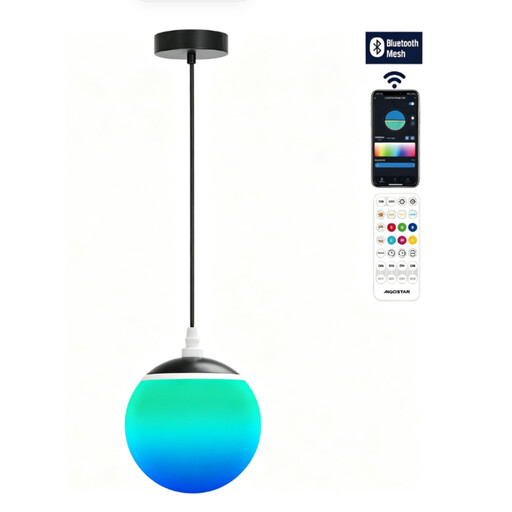
Why this product suits this use case: This solar pendant light combines a separately positioned panel with adjustable light colour. It’s well suited to gazebos, covered patios and seating areas.
The separate monocrystalline solar panel can be placed in a sunny spot, while the light itself can hang in a partially sheltered area. However, IP65 protection doesn’t cover permanent immersion.
RGBCCT with 2700–6500 K and RGB, Bluetooth Mesh 5.0, 200 lumens, a 4-Ah lithium iron phosphate battery and up to 24 hours of run time, according to Aigostar’s product details.
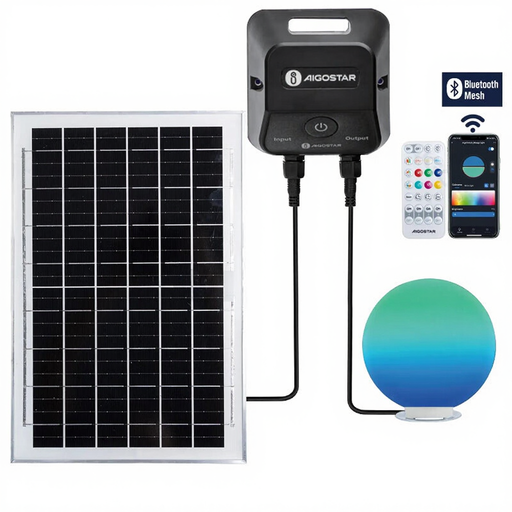
Why this product suits this use case: This freestanding light is designed for larger outdoor spaces where you want to synchronise several light sources and create different lighting effects.
The specifications state an IP65 rating, a charging time of 4–6 hours and a separate cable connection between the panel and the light. This makes it easier to plan where to install it.
Bluetooth Mesh connectivity for more than 200 devices, 350 lumens, RGB plus 2700–6500 K, and an 8000-mAh lithium battery, according to Aigostar.
We’ve put together a complete, regularly updated list of products that meet these strict selection criteria and fully comply with the safety regulations in force in the EU.
The solar panel should receive several hours of direct, unshaded sunlight wherever possible. Trees, house walls and covered areas can reduce charging performance. Before installing it permanently, check the spot at different times of day. Clean the panel regularly with a soft, slightly damp cloth.
Its lifespan depends on the battery, charging cycles, temperature, seals and maintenance. The manufacturer’s stated lifespan for the LED components isn’t necessarily the same as the battery’s lifespan. If the light doesn’t last as long as it used to, first check whether the panel is dirty or partly shaded.
During normal operation, the solar panel provides the energy for charging. So, unlike mains-powered lights, there are no ongoing electricity costs. However, you should factor in the purchase price, a possible battery replacement and seasonal changes in charging performance. If you need bright light at all times, regardless of the weather, take the limitations of solar outdoor lighting into account when planning.