
Lieferung heute & morgen

Qualitätsgarantie

Willkommens-Angebote freischalten: KOSTENLOSE Lieferung | Bis zu 80 % RABATT | Kostenlose 30-Tage-JoyPlus-Testphase
App herunterladen
Solar garden lighting is a practical solution for many garden owners, homeowners and renters with a balcony or patio. The lights don’t need a fixed mains connection, can usually be installed without tools and switch on automatically when they have the right features. However, solar garden lights vary considerably in brightness, battery capacity, IP rating and installation method.
If you focus only on a decorative product image or the claim “weatherproof”, you could miss important details. The following criteria will help you choose solar garden lights that suit their location and avoid common buying mistakes.
The term “weatherproof” alone says little about the level of protection. The stated IP rating is what matters. The first digit indicates protection against solid objects, while the second indicates protection against water.
For example, a solar light with IP44 protection is protected against solid objects 1 millimetre or larger, as well as water splashes from different directions. However, it should not be placed in a permanently wet hollow or submerged. A light with IP65 offers greater protection against dust and water jets, although the manufacturer’s instructions still apply. For sets, the IP rating may apply only to the string lights, not automatically to the solar panel or battery compartment.
Claims such as “8 to 12 hours” assume suitable charging conditions. Shade from house walls, trees or balcony railings, short winter days and cloudy weather all reduce the energy available. So don’t choose a solar light based only on its maximum stated lighting time.
RGB solar lights create colourful accents, but they don’t automatically provide bright path lighting. For steps, entrances or potential trip hazards, warm-white or neutral-white outdoor LED solar lights are often more practical. Colour-changing solar lights are better suited to flower beds, lawns, patios and festive displays.
Solar lights need a spot that is as free from shade as possible. For solar ground lights and solar path lights, the panel should face upwards and receive plenty of sunlight during the day. Before buying, check that the intended location gets enough direct sun. Charging may be limited on a north-facing balcony or beneath dense tree cover.
Check the battery type, stated charging time and expected operating time. Rechargeable Ni-MH and lithium batteries differ in shape, capacity and intended use. Treat the figures as a guide to performance in suitable conditions, rather than a guarantee for every kind of weather.
Common materials for outdoor use include ABS, polycarbonate, plastic and stainless steel. Make sure the design suits the surface: ground stakes need soft soil or lawn, while solar ground lights for hard surfaces need a suitable base. Also check whether the solar panel, battery compartment and light all have the same IP rating.

Why this product suits this need: This compact solar path light is designed for simple uses along garden paths, driveways or flower-bed edges. It can be installed without cables using its ground stake.
The product description explains that it is powered by an integrated solar panel and a rechargeable AAA battery, and switches on automatically when it gets dark. This makes the basic operating conditions clear.
Two LEDs, black plastic finish, 6.5 × 34 cm size and cable-free installation with a ground stake.
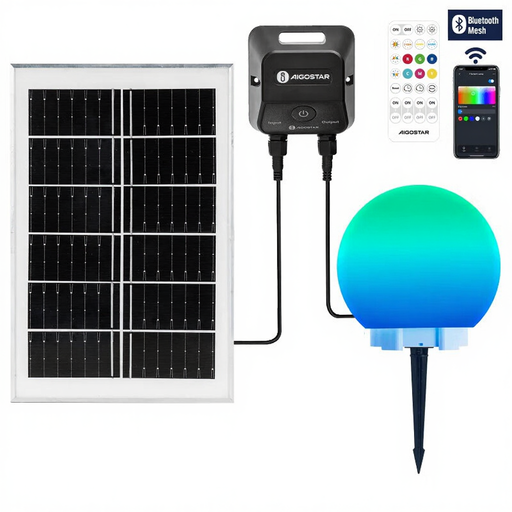
Why this product suits this need: If you want to group several lights and fine-tune their colours, this model offers app control with RGB+CCT from 2700 to 6500 K, as well as Bluetooth Mesh connectivity.
You’re not limited to a single preset for colour or brightness. Before installation, though, check the stated IP54/IP44 rating and the installation instructions.
RGB+CCT lighting, AigoSmart app, schedules and the option to group several lights; solar powered with an integrated lithium battery.

Why this product suits this need: Two flexible solar string lights, each 8 metres long, are ideal for balconies, patios, trees, railings and seasonal decorations.
The specifications state a charging time of 6–8 hours, a lighting time of 8–14 hours and eight lighting modes. According to the product information, the IP65 rating applies to the string lights; the solar panel and battery compartment must not be submerged.
80 LEDs per string, several flashing and lighting modes, a memory function and flexible copper wire for easy styling.
We’ve put together a complete, regularly updated list of products that meet these strict selection criteria and fully comply with the safety regulations in force in the EU.
Their lifespan depends on the LED module, battery, materials, charging conditions and care. Manufacturer claims about LED lifespan don’t guarantee the lifespan of the entire light. Clean the solar panel regularly with a soft cloth, and only replace a battery that’s losing capacity if the design allows it and the instructions say it’s safe to do so.
Yes, they can generally be used in winter. However, shorter days, low winter sun, cloudy weather and snow on the panel can all reduce charging performance. Position the light in as open a spot as possible, and carefully remove any dirt or snow. For areas where lighting is important for safety, take its actual performance in winter conditions into account.
They don’t need to be connected to the mains while in use. The solar cell charges the integrated battery during the day, which powers the LEDs later. There are no ongoing mains electricity costs, but the lights are still electrical products with batteries and must be disposed of in accordance with local regulations for electrical equipment and batteries.