
Lieferung heute & morgen

Qualitätsgarantie

Willkommens-Angebote freischalten: KOSTENLOSE Lieferung | Bis zu 80 % RABATT | Kostenlose 30-Tage-JoyPlus-Testphase
App herunterladen
Solar garden lighting is ideal for gardens, balconies and patios where you don’t want to install mains wiring. But not every solar light is right for every location. Unclear information about how long lights stay on, a poorly positioned solar panel or a misunderstood IP rating can all lead to disappointment.
Joybuy’s Product Recommendation Officer filters relevant product information and highlights what to check before buying solar string lights, a decorative solar garden light or an outdoor LED solar light.
Claims such as ‘up to 8–14 hours’ depend on several factors: direct sunlight, the time of year, shade, dirt on the solar panel and the condition of the battery. A solar garden light can stay on much longer in a sunny spot than beside a north-facing wall or under a dense tree.
So check whether the manufacturer gives charging and lighting times together. A stated charging time of six to eight hours in direct sunlight is more useful than an isolated maximum lighting time.
An IP rating consists of two digits. The first indicates protection against solid objects, while the second indicates protection against water. An IP65 solar light, for example, is protected against dust and water jets. However, this doesn’t mean the solar panel or battery compartment can be submerged for extended periods.
An IP44 solar light is protected against solid objects larger than 1 mm and splashing water from different directions. That may be enough for a sheltered balcony or covered patio. If you’re installing a light in an exposed part of the garden, make sure its location is suitable for its IP rating.
More LEDs don’t automatically mean brighter light. Brightness also depends on factors such as power, the distance between LEDs, light colour and lighting mode. A short copper wire string light may be enough for a narrow balcony. For a hedge or pergola, a longer version with evenly spaced LEDs is more practical.
Also check whether the stated length applies to one string light or to the whole set.
The solar panel should get as many hours of direct daylight as possible. Installing it in the shade reduces the energy available for charging. Before you put it in place, check when the area you have in mind actually gets sunlight.
An integrated battery stores the energy generated during the day. Decorative lights don’t always specify battery capacity. In that case, charging time, stated lighting duration and recommended placement are useful points of comparison.
Warm white solar lights at around 2700 Kelvin give off a soft, yellow-toned light and are often a good choice for seating areas, paths and decorative planters. Multicoloured LEDs are better suited to parties, seasonal decorations or bold accents.
For subtle patio lighting or balcony lighting, steady warm white settings are usually more understated. Multiple flashing and colour settings can be useful for Christmas, wedding or party decorations.
Copper wire can be wrapped around railings, branches or decorative objects. ABS plastic is often used for housings and solar panel mounts. Whatever the material, take care not to install the light with sharp bends.
Installation should be possible without tools or additional wiring wherever possible. The solar panel will work more efficiently if you regularly wipe away dust and leaves with a soft, dry cloth. Avoid harsh cleaning products, and don’t submerge the solar panel or battery compartment.
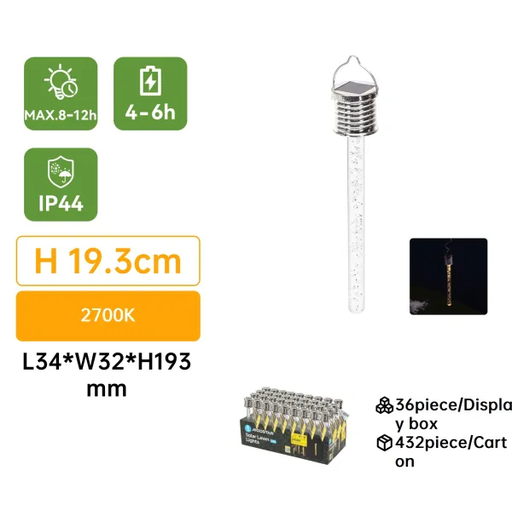
Why this product suits you: This compact decorative solar light is designed for smaller outdoor spaces, planters and sheltered balconies or patios. Its warm white light at 2700 Kelvin is ideal for subtle accents.
The product information clearly states the charging time, lighting duration and IP44 rating. This makes it easier to assess where to use the light, without mistaking IP44 for complete protection against heavy rain or submersion.
Warm white light at 2700 Kelvin, dimensions of 34 × 32 × 193 mm, an integrated Ni-MH battery and a stated lighting duration of 8–12 hours, depending on charging conditions.
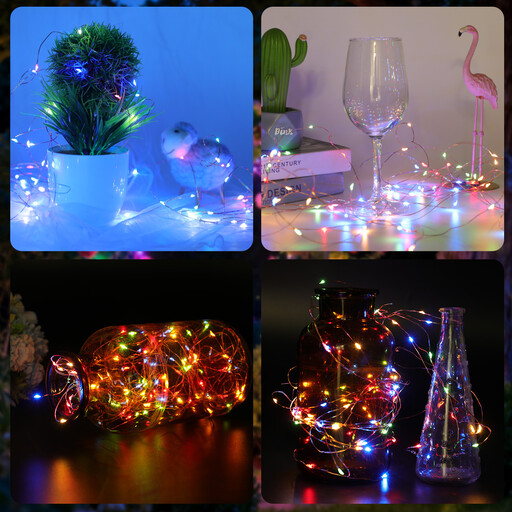
Why this product suits you: These two flexible copper wire string lights, each 8 metres long, are ideal for railings, trees, trellises and decorative displays in the garden or on the patio.
The product information distinguishes between the string lights and the solar panel: the lights are rated IP65, but the solar panel and battery compartment must not be submerged.
Each string is 8 metres long and has 80 multicoloured LEDs, eight lighting modes with a memory function, and a stated lighting duration of 8–14 hours, depending on the weather.
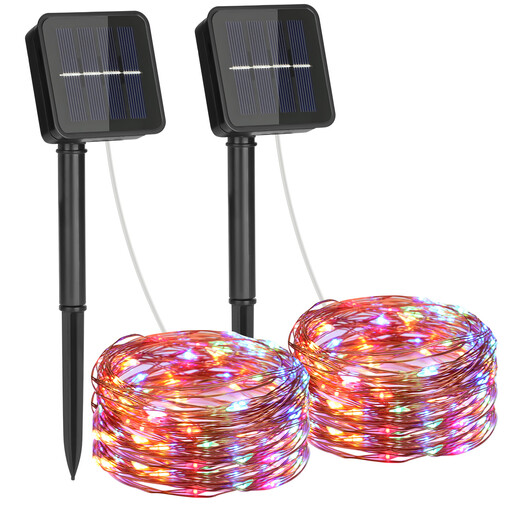
Why this product suits you: With 12 metres per string and 120 LEDs, this version is designed for larger hedges, pergolas and trees, as well as parties, weddings and seasonal decorations.
The length and number of LEDs are given for each string. The product information also clarifies that IP65 means protection against rain and splashing water, but the solar panel or battery must not be submerged.
Two strings, each 12 metres long, with 120 multicoloured LEDs, eight modes with a memory function, and automatic switching on and off when positioned appropriately.
We’ve put together a comprehensive, regularly updated list of products that meet these strict selection criteria and fully comply with the safety regulations in force in the EU.
This depends on the solar panel, sunlight and battery. For the products mentioned, the manufacturers state charging times of around four to eight hours in direct sunlight. Cloud, shade and dirt can all reduce charging performance.
An IP65 rating indicates protection against dust and water jets. It’s suitable for many outdoor areas, but it doesn’t mean every component can be submerged. With solar string lights, check whether the rating applies only to the lights or also to the solar panel and battery compartment.
Solar lights don’t need an external mains power supply while they’re in use. The solar panel charges the integrated battery during the day. The actual lighting duration depends on charging conditions, battery condition, lighting mode and temperature. So don’t compare solar lights on the basis of the term ‘energy-efficient’ alone; look at the specific technical details too.