
Lieferung heute & morgen

Qualitätsgarantie

Willkommens-Angebote freischalten: KOSTENLOSE Lieferung | Bis zu 80 % RABATT | Kostenlose 30-Tage-JoyPlus-Testphase
App herunterladen
The right lighting can transform a garden, patio, or balcony into an atmospheric space. However, installing traditional lamps is often complex and costly, requiring you to lay cables and plan for power connections. Solar lights for the garden offer a practical and eco-friendly alternative. They harness the sun's energy, require no wiring, and switch on automatically at dusk.
This article serves as your guide. We will introduce different types of solar lights and explain the key features to consider, making your selection process easier.
The range of solar garden lighting is vast. To find the perfect solution for your needs, a few technical aspects are crucial.
The runtime of a solar lamp depends directly on the battery's capacity (measured in milliampere-hours, mAh) and the efficiency of the solar panel. A high-performance monocrystalline solar panel can absorb more energy than a polycrystalline one, even on overcast days. A higher-capacity battery stores more energy, enabling a longer runtime, often between 6 and 12 hours after a full charge. Pay attention to the specified charging and illumination times to ensure the lighting meets your evening needs.
Modern solar lights for the garden offer more than just simple illumination. Many models are equipped as LED solar lights with a dusk-to-dawn sensor, which activates automatically at nightfall and switches off again at dawn. Other useful features include:
Since an outdoor solar light is placed outside, its resistance to weather conditions is critical. The IP rating indicates how well a device is protected against the ingress of foreign objects (first digit) and water (second digit). For garden use, a rating of at least IP44 (protection against splashing water) is recommended. Models with IP65 are dust-tight and protected against water jets, making them even more robust against rain and dirt.
Based on functionality and application, we have curated a selection of models that cater to different needs.
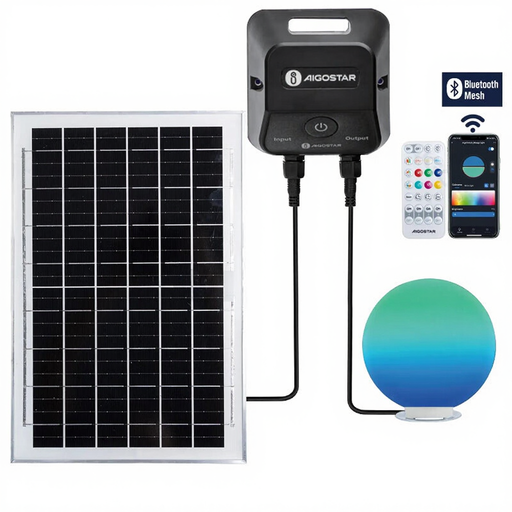
Why It Stands Out This model is distinguished by its smart connectivity and high performance. Using Bluetooth Mesh technology, over 200 lights can be networked and controlled centrally. The lighting effects can be adjusted separately for the upper and lower sections, enabling complex lighting scenarios.
Advantages
Who Is It For? For users seeking a powerful and flexibly controlled lighting solution for patios, larger garden areas, or events, who value integration into a smart lighting system.

Why It Stands Out This set from Grundig offers a straightforward and decorative way to add accents to your garden. The five globe lights are easily anchored in the ground with stakes, instantly creating atmospheric lighting along paths or in flowerbeds.
Advantages
Who Is It For? Ideal for garden owners looking for a simple, cost-effective, and decorative solution to illuminate flowerbeds, garden paths, or patio edges without dealing with technical settings.

Why It Stands Out These outdoor solar string lights offer maximum creative freedom. The flexible copper wire can be easily wrapped around trees, railings, plants, or other objects. With 80 multi-coloured LEDs on an 8-meter string, each light creates a magical atmosphere.
Advantages
Who Is It For? Perfect for creative decorators who want to adorn balconies, patios, shrubs, or festive areas with a playful and atmospheric lighting effect.
The products featured here cover common use cases. However, the market offers an even greater variety, from functional wall lights with motion sensors to decorative lights shaped like animals or plants.
If you are looking for specialised designs such as decorative flower lights or other shapes, you can find a broader selection in our Solar Garden Flower Lights category.
The lifespan of a solar light is determined by several components. The LEDs themselves have a very long durability, often exceeding 30,000 hours. The battery is typically the component with the shortest lifespan and may need to be replaced after 1 to 3 years, depending on quality and usage. The runtime per night on a full charge is usually 6 to 12 hours.
Yes, solar lights do work in winter, but with reduced performance. The shorter days and lower angle of the sun result in less energy absorption. This shortens the illumination time in the evening. Models with high-efficiency monocrystalline solar panels have an advantage here, as they can generate more energy even in diffuse light.
The IP (Ingress Protection) rating classifies a housing's protection against the entry of foreign objects and water. The first digit describes protection against solids (e.g., dust), while the second describes protection against water. For example, an outdoor solar light with an IP65 rating is dust-tight (digit 6) and protected against water jets from any angle (digit 5). It is therefore well-equipped for use in rain and wind.