
Lieferung heute & morgen

Qualitätsgarantie

Willkommens-Angebote freischalten: KOSTENLOSE Lieferung | Bis zu 80 % RABATT | Kostenlose 30-Tage-JoyPlus-Testphase
App herunterladen
Solar lights for the garden promise a simple and cost-effective way to illuminate paths, accentuate patios, or give your balcony an ambient atmosphere. With no wiring and no additional electricity costs, they are an attractive solution. But the market is crowded, and not every product lives up to its advertising.
Many buyers are left disappointed: lights that fail after the first heavy rain, a runtime that barely lasts past dusk, or materials that become brittle and unsightly after just one season. To help you avoid these experiences, we'll show you which technical details really matter and how to find the perfect solar lights for your needs.
Before we dive into the technical features, it's important to know the three most common problems that can lead to a bad purchase:
To make an informed decision, you should check three core parameters. These are crucial in determining the performance and durability of your new garden lighting.
The IP rating (Ingress Protection) is one of the most important technical specifications. It indicates how well a light is protected against the ingress of foreign objects (first digit) and water (second digit).
The performance of a solar lamp depends directly on the combination of its battery and solar panel.
Solar lights serve different purposes, which are reflected in their functionality.
To make the selection easier, we have matched some products to different user profiles.
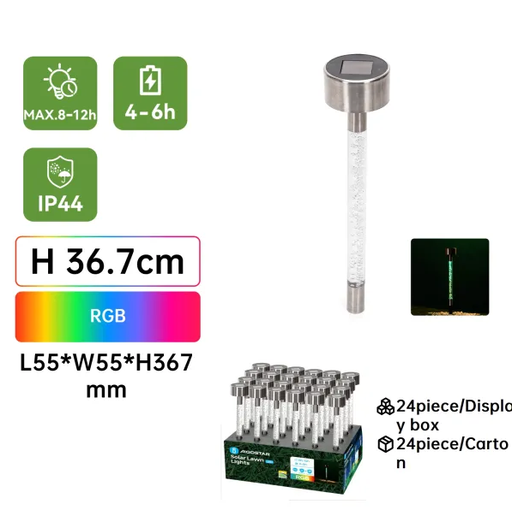
Why it's a good fit: Ideal for anyone looking to add the first pops of colour to their garden or balcony on a small budget. The ground stake is easy to place in flowerbeds or planters.
The product sets realistic expectations for an accent light. The IP44 rating is sufficient for its use as a decorative ground stake, and according to the manufacturer Aigostar, the stated 8–12 hour runtime is aligned with the small battery capacity (40mAh) and panel.
The simplest tool-free installation and a colour-changing RGB light for a playful, decorative effect.
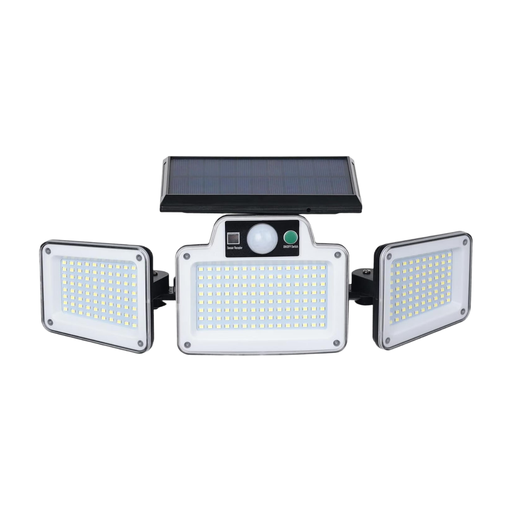
Why it's a good fit: Designed to illuminate driveways, garages, or dark corners of your property. The motion sensor provides light exactly when it's needed.
With an IP65 rating, the light is robust against the elements. The separate solar panel, connected by a long cable (approx. 4.7 m), solves the problem of shady installation spots: the light can be mounted under an eave while the panel is placed in full sun.
Three flexibly adjustable light heads for wide-area illumination and a remote control for conveniently choosing between three different operating modes.
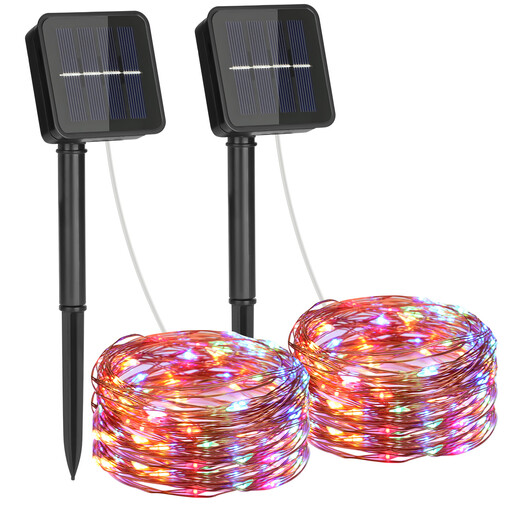
Why it's a good fit: The flexible copper wire of these string lights can be versatilely draped around trees, railings, or along fences. The multi-coloured LEDs are ideal for parties, holidays, or simply to add a cheerful accent.
The string light itself is very well protected against rain with an IP65 rating. The separate, larger solar panel can be optimally aimed at the sun, which improves charging efficiency and thus the runtime, even on less sunny days.
A practical 2-pack with a total length of 24 metres for large-scale decorations. Eight different lighting modes with a memory function provide variety.
We have compiled a complete, up-to-date list of products that fully meet these strict selection criteria and safety regulations.
The lifespan of a solar light is determined by two main components: the LED and the battery. The LEDs themselves are very durable; many manufacturers specify a lifespan of 15,000 hours or more. The limiting factor is usually the rechargeable battery. After several hundred charge cycles (typically 2-3 years), its capacity can diminish. However, on many higher-quality models, the battery can be easily replaced, which significantly extends the light's lifespan.
Yes, solar lights do work in winter, but with reduced performance. The shorter days and lower angle of the sun result in less energy absorption, which shortens the runtime per night. To maximise performance, the solar panel should be placed in a location that receives as much direct sunlight as possible, even in winter (ideally south-facing), and kept free of snow and debris.
Installation is incredibly simple, as no wiring is required. The most important aspect is the placement of the solar panel. It must be positioned to receive several hours of direct sunlight. Shade from buildings, trees, or eaves should be avoided, as this drastically reduces charging performance. For models with a separate panel, you have more flexibility to mount the light in the shade and the panel in the sun.