
Lieferung heute & morgen

Qualitätsgarantie

Willkommens-Angebote freischalten: KOSTENLOSE Lieferung | Bis zu 80 % RABATT | Kostenlose 30-Tage-JoyPlus-Testphase
App herunterladen
By Joybuy Product Recommendation Officer, published on July 21, 2026
Thoughtful garden lighting transforms paths, flowerbeds, and patios into atmospheric havens after sunset. However, installing conventional lamps often requires significant effort and incurs ongoing electricity costs. Solar garden lights offer a practical and energy-efficient alternative. They harness the power of the sun, are wire-free, and switch on automatically at dusk.
The market offers a vast array of models, from simple decorative lights to networked smart systems. This guide is designed to help you understand the technical features and make an informed decision that satisfies your needs for both aesthetics and functionality.
To find the right solar garden lighting, it helps to understand a few technical basics. The following three points are crucial for satisfactory performance.
A light's brightness is measured in lumens (lm). For subtle accent lighting in flowerbeds or as path markers, models with a low lumen count (approx. 10–50 lm) are often sufficient. However, if you need to illuminate paths or entrance areas for safe navigation, higher values (100–300 lm or more) are recommended.
The runtime is directly dependent on the battery's capacity, measured in milliampere-hours (mAh). A higher-capacity battery can store more energy, thus powering the light for longer, especially on days with less sunshine. Look for a battery capacity of at least 600 mAh for decorative purposes and 1,200 mAh or more for functional light.
Outdoor LED solar lights must withstand the elements. Their resistance is classified by the IP (Ingress Protection) rating.
Materials like stainless steel, aluminium, and high-quality plastics (e.g., ABS) offer excellent durability and corrosion resistance.
Modern solar lights offer more than just automatic on/off functionality.
Based on functionality, material, and application, we have compiled a selection of different models.
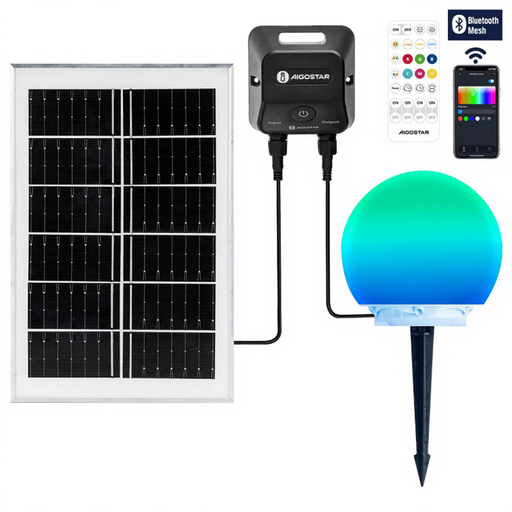
Why This Model Stands Out This model stands out with its Bluetooth-Mesh technology. It allows you to network and synchronously control over 200 lights via a single app. The separate 5W solar panel with an extended cable offers maximum placement flexibility, ensuring optimal sun exposure while the light itself can be positioned in the shade.
Advantages
Who Is It For? For tech-savvy users who want comprehensive control over their garden lighting and wish to create complex, synchronised light scenes for paths, patios, or larger garden areas.

Why This Model Stands Out This solar light set from Grundig offers a straightforward and cost-effective solution for decorative lighting. It consists of five spherical lights that can be easily installed as solar garden stakes. An integrated switch allows you to choose between atmospheric warm white and an automatic colour-changing mode.
Advantages
Who Is It For? For budget-conscious buyers and garden owners looking for simple, effective, and maintenance-free decorative lighting for flowerbeds, garden paths, or the patio, without wanting to deal with technical details.
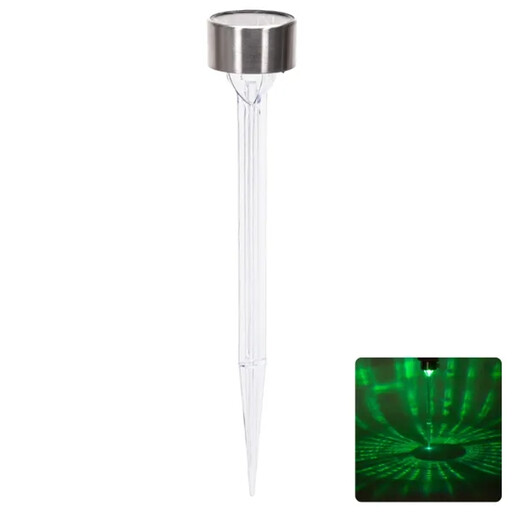
Why This Model Stands Out The Aigostar Solar Lawn Light combines a sleek, modern stainless steel design with an automatic RGB colour-changing effect. Its integrated ground stake design makes it a discreet yet stylish marker light for garden borders and pathways.
Advantages
Who Is It For? For users who prioritise aesthetics and are looking for stylish, maintenance-free accent lighting. Ideal for highlighting garden structures, paths, or flowerbeds with a dynamic, colourful light effect.
The models featured here cover a range of different needs. However, if you are looking for more specific solutions, such as path lights with motion sensors or more powerful spotlights, you can find more options in our collection.
? Discover more models in our Low-Voltage Outdoor Post Lights category
1. Do solar garden lights work on cloudy days or in winter? Yes, solar lights also charge in diffuse light, although less efficiently than in direct sunlight. This results in a shorter runtime in winter or on heavily overcast days. For year-round use, it's important to place the solar panel in a location that receives daylight for as long as possible without being shaded. Models with a larger, more efficient solar panel and a high-capacity battery are better suited for the darker seasons.
2. What is the lifespan of solar lights? The lifespan of a solar light is determined by two main components: the LED bulb and the battery. Modern LEDs have a very long lifespan, often 15,000 hours or more. The battery is a wear-and-tear part, and its capacity will diminish after about 2–3 years. On many higher-quality models, the battery (usually a standard type like AA or AAA Ni-MH) can be easily and inexpensively replaced, which significantly extends the light's service life.
3. What does the IP rating on solar lights mean? The IP rating indicates how well an electrical device is protected against the ingress of foreign objects (first digit) and water (second digit). For weather-resistant solar lights, the most relevant ratings are IP44 (protection against splashing water from all sides) and IP65 (protection against water jets). While IP44 is sufficient for most sheltered areas in the garden, IP65 offers a higher level of protection for lights that are fully exposed to the weather.