
Lieferung heute & morgen

Qualitätsgarantie

Willkommens-Angebote freischalten: KOSTENLOSE Lieferung | Bis zu 80 % RABATT | Kostenlose 30-Tage-JoyPlus-Testphase
App herunterladen
Solar lights for the garden promise a simple, wireless, and eco-friendly way to bathe paths, patios, and flowerbeds in atmospheric light. But the reality is often quite different: lights that only glow dimly after a few weeks, fail after the first autumn storm, or whose batteries give out after a short time. As a Joybuy Product Recommendation Officer, I'm here to help you identify the common pitfalls and make an informed choice.
Many products on the market entice buyers with lofty promises that don't hold up to scrutiny. Pay close attention to these three points to avoid disappointment:
To find a durable and functional solar light, you should carefully examine three technical features. These determine performance, longevity, and convenience.
Brightness is measured in lumens (lm). For orientation lighting on pathways, 20-50 lumens are often sufficient. To effectively showcase a seating area or plants, 100-300 lumens or more are advisable. The ratio to battery capacity, specified in milliampere-hours (mAh), is critical. As a rule of thumb: A battery with at least 2000 mAh is a good foundation for lights intended to last all night, even during less sunny periods.
A high protection rating is essential for reliable outdoor performance.
Modern smart solar lights offer far more than just an automatic dusk-to-dawn function. Models with app-controlled garden lights allow for flexible customisation to suit your needs. Look for the following technologies:
Here are some recommendations tailored to different needs and locations in the garden.
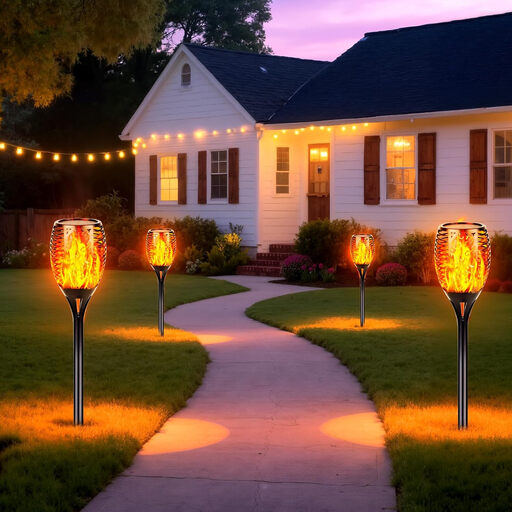
Why This Fits Their Persona: Ideal for users who want to create a warm and inviting atmosphere. These solar garden torches use 96 LEDs to simulate a realistic, dancing flame effect, perfect for garden parties, patios, or for marking pathways.
With an IP65 rating, the light is protected against water jets, making it suitable for year-round outdoor use and thus avoiding the trap of poor weather resistance.
The realistic flame effect creates a special ambience. The automatic on/off function offers high convenience without manual intervention.
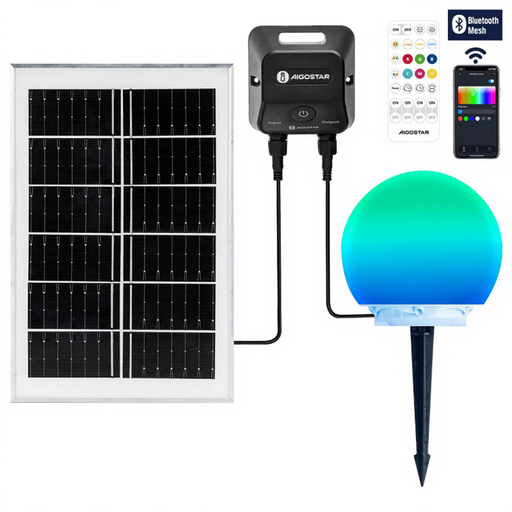
Why This Fits Their Persona: Perfect for smart home users who want full control and creative freedom. Thanks to Bluetooth Mesh and app control, over 200 lights can be networked and programmed for synchronised light shows or custom schedules.
A separate, efficient 5W monocrystalline solar panel and a powerful 4000mAh battery bypass the weak performance trap. This ensures a runtime of up to 24 hours, even in less-than-optimal lighting conditions.
Full RGBCCT colour control for unlimited design possibilities. The flexible panel installation ensures optimal sun exposure.
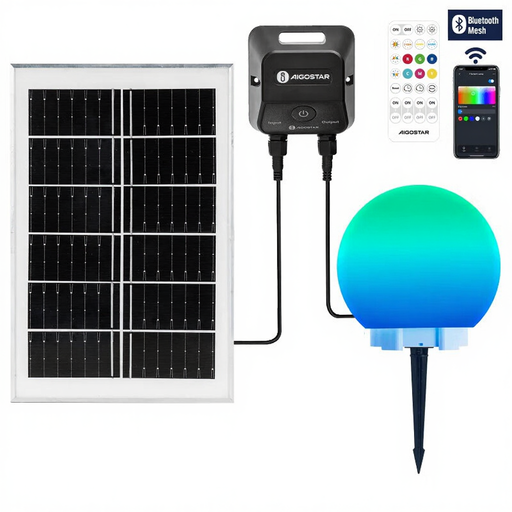
Why This Fits Their Persona: The ideal solution for anyone looking for discreet and flush-mounted lighting for paths, driveways, or patio edges. As a solar in-ground light, it integrates seamlessly into the ground, providing safety without being obtrusive.
Despite its compact design, this model offers full smart functionality. The app control allows you to schedule the runtime to use the battery charge efficiently, thus avoiding the short-runtime trap.
Combines the subtlety of an in-ground light with the advantages of a smart solar light, including Bluetooth Mesh and RGBCCT colour control.
We have compiled a complete, up-to-date list of products that fully meet these strict selection criteria and safety standards.
The lifespan of a solar light depends on three components. The LEDs themselves are extremely durable, with over 50,000 operating hours. The battery is the most common wear-and-tear component, lasting 1-3 years depending on quality and use. On higher-quality models, the battery can be replaced. The solar panel and housing should last for many years if made from high-quality materials (e.g., weather-resistant ABS plastic).
Yes, but with limitations. Charging performance is reduced due to shorter days and a lower sun angle. Models with high-efficiency monocrystalline solar panels and large battery capacities have a clear advantage here. Smart features like dimming the brightness or setting shorter runtimes via an app can help conserve energy throughout the night.