
Lieferung heute & morgen

Qualitätsgarantie

Willkommens-Angebote freischalten: KOSTENLOSE Lieferung | Bis zu 80 % RABATT | Kostenlose 30-Tage-JoyPlus-Testphase
App herunterladen
Solar garden lights are a practical way to illuminate paths, flower beds, lawns or balconies without a permanent power connection. However, not every light is suitable for every location. A small solar panel in the shade charges more slowly, a low IP rating is unsuitable for permanently exposed areas, and a decorative RGB function cannot replace bright path lighting.
This buying guide from the Joybuy Product Recommendation Officer explains what garden owners, homeowners and tenants in Germany should consider. The selection is based on clear product details such as light colour, battery type, protection rating, charging time, installation and intended use.
Manufacturers often specify a possible runtime of, for example, 8 to 12 hours. However, this figure depends on several factors: direct sunlight, season, shading, dirt on the solar panel and battery condition. In autumn and winter, the actual lighting duration may be considerably shorter.
For this reason, do not look only at the runtime. Also consider the charging time and the intended installation location. Ideally, a solar light should receive several hours of unobstructed sunlight each day.
RGB solar lights create colour-changing garden lighting and are suitable for decorative accents. For a driveway, steps or a longer path, however, coloured light may be less practical than clearly visible warm-white or neutral-white illumination.
Consider whether you need a decorative lighting effect or functional orientation lighting. On some models, the light colour takes centre stage while brightness is comparatively limited.
The level of protection is indicated by the IP rating. IP44 protects against solid foreign objects measuring 1 mm or more and against splashing water from various directions. A light with IP44 should not be placed in water or exposed to continuous flooding. IP54 additionally provides a higher level of dust protection, but it is also not designed for submersion.
Even with weatherproof solar lights, you should regularly remove dust, leaves and pollen from the solar panel. This helps maintain suitable charging conditions.
Solar garden lights commonly use Ni-MH or lithium batteries. A higher battery capacity alone does not guarantee a longer runtime, as LED output, the solar panel and the control system also play a role.
For the models listed here, charging times of around 4 to 6 hours and runtimes of 8 to 12 hours under suitable charging conditions are specified, depending on the product. Lower figures are possible in winter, under overcast skies or in shaded locations. Integrated batteries should not be opened or modified independently.
Solar lights with ground stakes can be installed in soft soil or lawns without electrical wiring. Installation is more difficult in hard ground; do not force the stake into the soil, as this may damage the plastic components.
Solar ground lights require a level, stable surface. Check the dimensions and installation method before purchasing. Housings made of plastic, PC or stainless-steel-effect materials differ in weight, appearance and maintenance requirements. For outdoor use, the stated IP protection rating and the manufacturer’s instructions remain decisive.
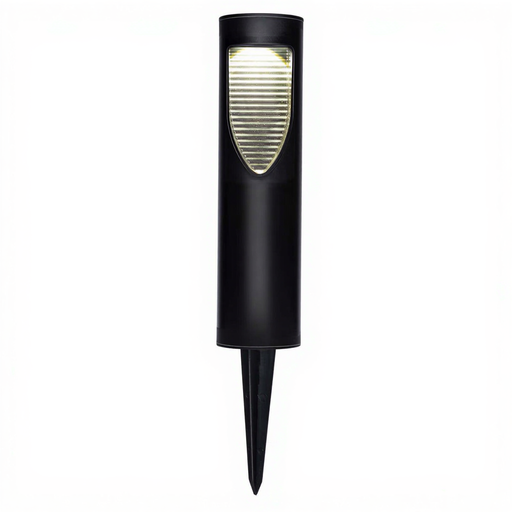
Why This Fits Their Persona: This freestanding light with a warm-white SMD LED is well suited to small flower beds, balconies and short garden paths when you are looking for a straightforward starter setup.
The specifications state that it has an integrated 600 mAh Ni-MH battery and switches on automatically at dusk. Nevertheless, the light is not designed for submersion.
Black plastic housing, an 8 cm diameter, a height of 31 cm and automatic switching on and off.
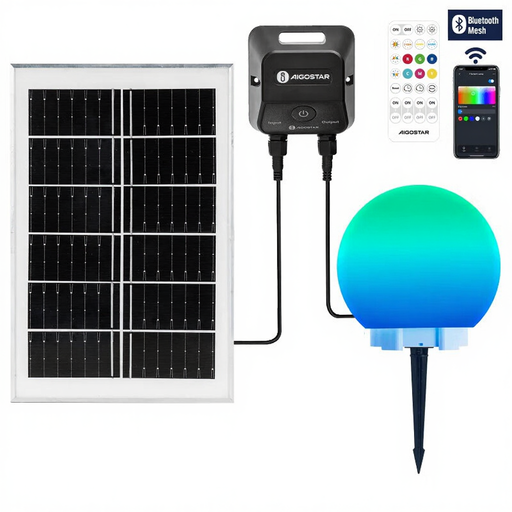
Why This Fits Their Persona: For larger gardens or users who want to group multiple lights via an app, this model offers connected control with RGB+CCT lighting.
The light colour can be adjusted from 2700 K to 6500 K. The IP54/IP44 protection ratings should be considered according to the installation position; the light is not designed for submersion.
Bluetooth Mesh control, app operation, RGB lighting and adjustable white light.

Why This Fits Their Persona: This cool-white solar path light is ideal for buyers who want to mark paths, lawn edges or driveways with clearly visible illumination.
The product specifications state a charging time of 4 to 6 hours, a possible lighting duration of 8 to 12 hours and IP44 protection. This makes the intended usage limits transparent.
6500 K light, a polycrystalline silicon solar panel, ground-stake installation and a specified operating temperature range of -10 °C to 50 °C.
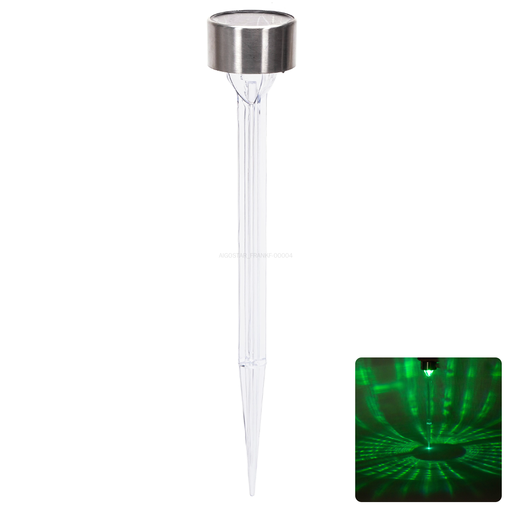
Why This Fits Their Persona: This RGB light is well suited to flower beds, lawns and patios where colour is intended to serve as a decorative design element.
The technical specifications list IP44 protection, a charging time of 4 to 6 hours and a runtime of 8 to 12 hours under suitable conditions.
RGB colour changing, a 200 mAh Ni-MH battery, ground stake and compact dimensions of 55 × 55 × 320 mm.
Choose a location with as much direct sunlight as possible and avoid shade from exterior walls, trees or tall plants. Insert the light into firm but not overly hard ground. The solar panel should face upwards and remain free of leaves.
Clean the surface regularly with a soft, damp cloth. Do not use abrasive cleaning products. In freezing conditions, where flooding is possible or during extended periods of non-use, it may be advisable to store the light according to the manufacturer’s instructions. Batteries and electronic components must be disposed of through the designated collection systems at the end of their service life and not with household waste.
We have put together a current selection of products that meet these purchasing criteria and take into account the relevant guidance for outdoor use.
The lighting duration depends on sunlight, charging time, battery capacity, temperature and LED output. For several of the listed models, 8 to 12 hours under suitable conditions are specified. Runtime may be shorter in winter or at permanently shaded locations.
Models with IP44 protection are protected against splashing water and intended for normal outdoor use. However, they should not be placed in puddles or submerged. Before installation, check whether water can drain away from the location, and always follow the product’s specific IP rating.
Solar-powered outdoor lighting does not require a connection to the mains during normal operation. The solar panel charges the integrated battery during the day. Ongoing mains electricity costs are eliminated; however, depending on the model, replacement batteries or the replacement of the entire light may eventually be required.