
Lieferung heute & morgen

Qualitätsgarantie

Willkommens-Angebote freischalten: KOSTENLOSE Lieferung | Bis zu 80 % RABATT | Kostenlose 30-Tage-JoyPlus-Testphase
App herunterladen
Solar lights promise a simple and cost-effective way to illuminate your garden. With no wiring required and no additional electricity costs, they transform paths, flowerbeds, and patios into atmospheric oases. However, the market is flooded with products whose performance often falls short of their promises. Many buyers are disappointed when their lights start to glow dimly after a short time or fail to survive the first autumn storm. This guide will show you which technical details to look for to avoid making the wrong choice and to find the right solar garden lights for your needs.
Before you make a decision, you should be aware of the typical weaknesses that often only become apparent after purchase.
To separate the wheat from the chaff, focus on three verifiable technical features. These provide reliable information about the quality and performance of outdoor solar lights.
The IP (Ingress Protection) rating indicates how well an electrical device is protected against the ingress of foreign objects and water. For outdoor use, two values are particularly relevant:
The battery is the heart of every solar light. Its capacity, measured in milliampere-hours (mAh), determines how long the light can stay on after dark. A higher mAh value generally means a longer illumination time. Equally important is the efficiency of the solar panel that charges the battery. Monocrystalline solar panels generally have a higher efficiency than polycrystalline or amorphous panels and charge more effectively even on cloudy days.
Don't be guided by wattage ratings, which are not very meaningful for LED solar lights. Two other values are crucial:
Instead of making a blanket recommendation, we have selected products for different user profiles and applications.

Why This Fits Their Persona: Ideal for users looking for a functional and durable entry-level solution for path lighting. The stainless steel design is more robust than all-plastic models, and the cool light ensures good visibility.
The light has a clear specification for light colour (6500K) and an IP44 certification. This provides a reliable basis for weather resistance and intended use, rather than vague marketing promises.
Clear, cool white light for safe illumination of paths. Easy installation with the integrated solar lights with ground stakes. Material combination of plastic and stainless steel.
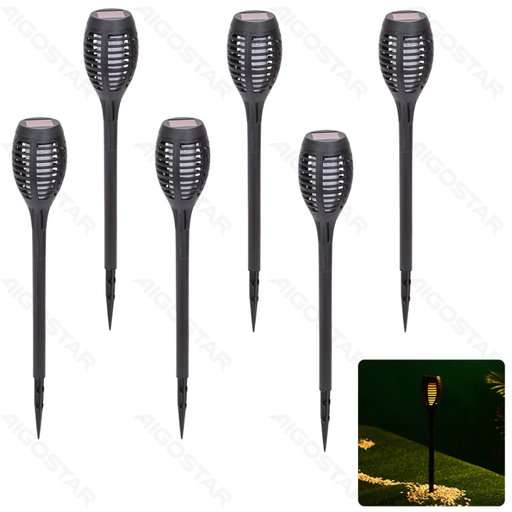
Why This Fits Their Persona: Perfect for anyone who wants to create a warm and inviting atmosphere. The realistic flame effect is an eye-catcher, and the solar light set of six allows for a uniform design along flowerbeds or patio edges.
Instead of a non-specific glow, this set offers a defined, decorative effect. The light colour is clearly stated as 2700K (Warm White), so the buyer knows exactly what mood will be created. The IP44 classification ensures it functions in the rain.
Atmospheric flame effect for a cosy environment. Practical 6-pack for large-scale and cohesive decoration. Warm white light for relaxed evenings outdoors.
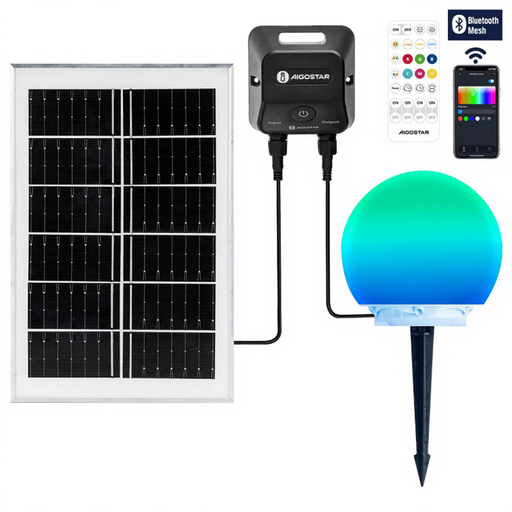
Why This Fits Their Persona: For users who want full control and customisation. Via Bluetooth Mesh and an app, you can control brightness, colour (RGB), and colour temperature (CCT), create schedules, and synchronise multiple lights.
This model overcomes the limitation of a fixed light colour and simple on/off automation. The high protection rating of IP65 promises above-average durability. The 4000mAh lithium battery and monocrystalline panel ensure reliable performance.
Full control over light colour and brightness via app. High weather resistance (IP65). Powerful battery and efficient solar panel for reliable operation.
In addition to the featured models, there are many other variants available, from practical outdoor solar string lights to high-performance spotlights. We have compiled a selection of products that meet objective quality criteria.
Yes, they generally work in winter, but with limited performance. The shorter days and lower position of the sun in the UK mean that the batteries do not fully charge. The illumination time per night is therefore significantly shorter than in summer. Models with highly efficient monocrystalline solar panels and large batteries are better suited for year-round use.
The minimum standard is IP44, which ensures protection against splashing water from all directions. This is sufficient for most applications. However, if the lights are exposed to heavy rain or garden sprinklers, a higher protection rating such as IP65 (protection against water jets) or IP67 (protection against temporary immersion) is recommended to ensure a long lifespan.
The light colour is measured in Kelvin (K). Warm white light (under 3,300 K) has a yellowish-reddish hue and is perceived as cosy and inviting. It is perfect for patios, balconies, and seating areas. Cool white light (over 5,300 K) has a bluish hue, appears brighter and more functional. It improves detail recognition and is therefore ideal for the functional lighting of paths, stairs, and entrance areas.