
Lieferung heute & morgen

Qualitätsgarantie

Willkommens-Angebote freischalten: KOSTENLOSE Lieferung | Bis zu 80 % RABATT | Kostenlose 30-Tage-JoyPlus-Testphase
App herunterladen
Solar lights promise a simple and cost-effective way to beautifully illuminate your garden, balcony, or patio. No complicated wiring, no extra electricity costs—the advantages are obvious. Yet, the reality after purchase often tells a different story. Instead of atmospheric lighting, many buyers get a faint glow that quickly fades, or products that don't survive the first autumn storm.
As your Joybuy Product Recommendation Officer, I'm here to help you recognise the common pitfalls and make an informed decision. Pay attention to the following three frequent problems to avoid disappointment.
To separate the wheat from the chaff, you should check three core technical specifications before buying. These are the primary determinants of the performance and longevity of your new garden lighting.
Forget wattage as the primary performance metric. For an LED solar light, the luminous flux, measured in lumens (lm), is the decisive value for brightness.
The light colour, measured in Kelvin (K), sets the atmosphere. Warm white light (under 3,300 K) creates a cosy mood, while daylight white light (over 5,300 K) provides clarity and security. RGB models also offer the ability to choose any colour, allowing you to create special accents.
The IP (Ingress Protection) rating indicates how well a device is protected against the intrusion of foreign objects and water. For outdoor use, two ratings are particularly relevant:
The illumination time depends directly on the battery's capacity, measured in milliampere-hours (mAh), and the efficiency of the solar panel.
Based on these objective criteria, we have curated products for various needs and user profiles.
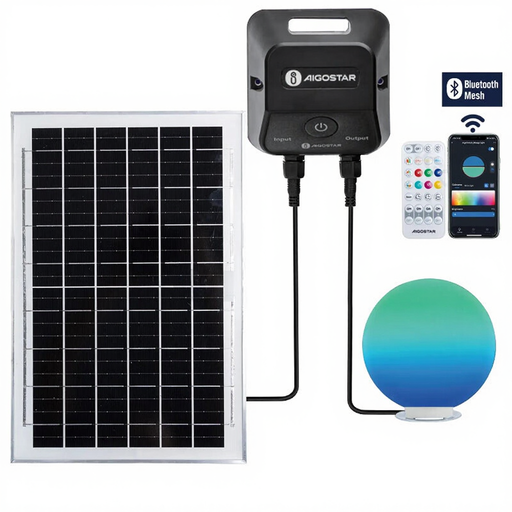
Why This Fits Their Persona: Ideal for tech-savvy users who want connected and fully controllable garden lighting. The Bluetooth Mesh technology allows for pairing over 200 lights, which can be controlled via an app to create complex lighting scenarios.
With a 350-lumen luminous flux, it bypasses the brightness trap. The IP65 certification ensures functionality in all weather. The large 8000 mAh battery and efficient monocrystalline panel provide a long illumination time.
Comprehensive control (RGB, colour temperature, brightness) via app; scalability through mesh network; high light output for use as an Outdoor Solar Floor Lamp.
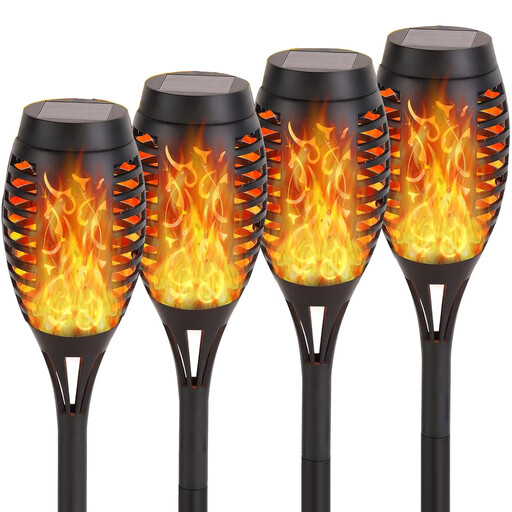
Why This Fits Their Persona: Perfect for users who want to create a warm and inviting atmosphere. The realistic flame effect of these solar torches provides a cosy ambiance for garden parties or relaxing evenings on the patio.
The IP65 rating ensures that this solar torch functions reliably even in bad weather. The focus is on the decorative effect, not maximum brightness, which clearly defines expectations for luminosity.
Atmospheric flame effect; easy installation via ground stake; automatic on/off function for hassle-free operation.

Why This Fits Their Persona: For home and garden owners seeking a reliable and straightforward solution for solar path lighting. The focus is on functionality and durability to safely mark paths and steps.
The housing with stainless steel elements is more robust than all-plastic models. The IP44 rating is sufficient for its position as a path light close to the ground. The polycrystalline panel is designed for an 8-12 hour illumination time.
Focused functionality with bright, white light (6500K) for good visibility; more durable material combination; simple, tool-free installation.
We have compiled a complete, real-time updated list of products that fully meet these strict selection criteria and safety regulations.
The lifespan of a solar light is determined by three components: the LED bulb (often 15,000 hours or more), the battery, and the housing. The battery is typically the component with the shortest lifespan and can lose capacity after 2-4 years, depending on quality and usage. High-quality housings made from materials like stainless steel or robust ABS plastic withstand weather elements longer than simple plastic models.
Yes, but with limitations. The shorter days and lower intensity of sunlight in winter result in a shorter charging time. This, in turn, reduces the illumination time per night. Models with high-efficiency monocrystalline solar panels and large batteries are better suited for winter operation. It is also important to keep the panels free of snow and debris and to position them in a location with maximum sun exposure.
This depends on the IP rating and materials. Lights with a protection rating of IP65 or higher are generally robust enough to be left outside year-round. Models with a lower rating (e.g., IP44) or those made from less durable materials can be damaged by heavy frost or continuous rain. To extend the battery's life, it can be beneficial to store the lights in a cool, dry place during periods of extreme sub-zero temperatures.