
Lieferung heute & morgen

Qualitätsgarantie

Willkommens-Angebote freischalten: KOSTENLOSE Lieferung | Bis zu 80 % RABATT | Kostenlose 30-Tage-JoyPlus-Testphase
App herunterladen
Solar garden lights promise a simple and cost-effective way to illuminate paths, create accents, or enhance security. Installation is straightforward, and there are no electricity costs. However, the market is flooded with products whose real-world performance often fails to match the promises on the packaging. As a Joybuy Product Recommendation Officer, I'll help you identify the common pitfalls and make an informed decision.
Many buyers experience disappointment shortly after their purchase. The lights fail after a rain shower, the runtime barely lasts through the evening, or the brightness is disappointingly low. These problems can be avoided if you know what to look for.
The 3 Most Common Pitfalls When Buying Solar Lights:
To avoid a bad purchase, you should focus on technical specifications that directly impact longevity and functionality.
The IP (Ingress Protection) rating indicates how well a housing is protected against the ingress of foreign objects and water. For outdoor solar lights, the following values are relevant:
waterproof solar lights that are exposed to the elements, such as solar path lights on a lawn.The battery's performance determines how long your light will stay on at night. Pay attention to two factors:
The lighting effect is determined by two key metrics that are crucial for the intended application:
solar garden globes or outdoor solar string lights, values below 100 lumens are sufficient. To illuminate paths, you should aim for at least 100-200 lumens. A solar flood light with motion sensor for securing driveways should deliver 500 lumens or more.Warm white solar lights (under 3300 Kelvin) create a cozy, inviting atmosphere. Neutral white (3300-5300 Kelvin) is well-suited for functional areas. Cool white (over 5300 Kelvin) has a very modern look and provides clear visibility, which is an advantage for security lighting.Instead of making a one-size-fits-all recommendation, we have selected products for specific user profiles and use cases.

Why It's a Match: Ideal for users seeking straightforward and functional lighting for garden paths or flowerbed borders. The ground stake installation is incredibly simple and requires no prior experience.
The stainless steel housing is more robust than all-plastic models and more resistant to weathering. The IP44 certification provides sufficient protection for normal garden use, preventing premature failures from splashing water.
The cool white light (6500K) ensures clear visibility on paths and improves orientation in the dark. The polycrystalline solar panel reliably charges the NiMH battery even with light cloud cover.
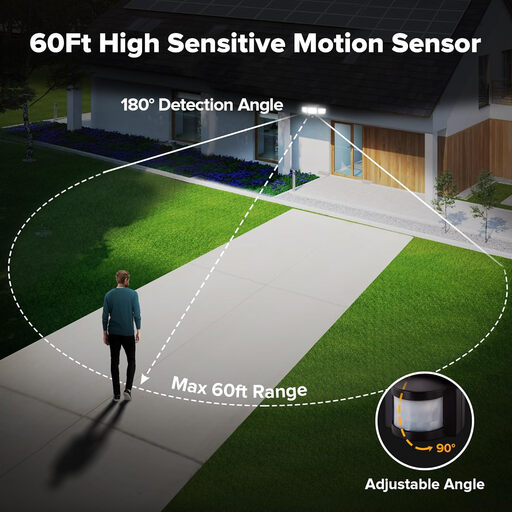
Why It's a Match: For homeowners who want to reliably and brightly illuminate driveways, garages, or dark corners of their property. The focus here is clearly on functionality and security.
Addresses the problem of insufficient brightness with a specified light output of 3000 lumens. The IP65 certification ensures the light can withstand heavy rain and weather, thus avoiding the "fails after one winter" pitfall.
Three flexibly adjustable light heads allow for wide and targeted illumination (270°). The long-range motion sensor with three adjustable modes offers a customisable security solution.
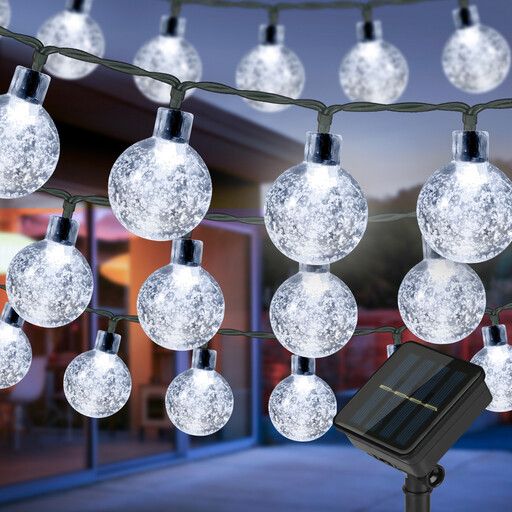
Why It's a Match: Perfect for anyone looking to create an atmospheric ambiance on a balcony, patio, or for garden parties. The string lights are versatile and produce a decorative play of light.
With an IP65 rating, these `outdoor solar string lights` are significantly more robust than many competing products and are suitable for year-round use. The specified runtime of 8-14 hours is based on an efficient solar panel that charges sufficiently even on less sunny days.
The string lights offer 8 different lighting modes (from steady on to flashing), allowing for individual customisation of the atmosphere. At 11 meters long with 60 LEDs, it provides generous coverage for trees, railings, or pergolas.
We have compiled a complete, up-to-date list of products that fully meet these strict selection criteria and UK safety regulations.
The lifespan depends on three components:
LED solar lights have a very long lifespan of 15,000 hours or more. The LED itself is rarely the point of failure.Yes, but with reduced performance. The shorter days and the lower angle of the sun's rays reduce the charging power of the solar panel. Therefore, the runtime will be shorter in winter than in summer. Models with high-quality, large solar panels and efficient batteries have a clear advantage here. Regularly cleaning the panel of snow and dirt is especially important in winter.
For optimal performance, the solar panel should be placed in a location that receives at least 6-8 hours of direct, unobstructed sunlight daily. A south-facing orientation is ideal in the Northern Hemisphere. Avoid locations in the shade of trees, walls, or eaves. Also, be careful not to place the light near other strong light sources (e.g., streetlights), as their light can interfere with the dusk sensor and prevent it from turning on automatically.