
Lieferung heute & morgen

Qualitätsgarantie

Willkommens-Angebote freischalten: KOSTENLOSE Lieferung | Bis zu 80 % RABATT | Kostenlose 30-Tage-JoyPlus-Testphase
App herunterladen
Solar lights promise a simple and eco-friendly way to illuminate your garden, balcony, or patio. No wires, no electricity costs—the concept is compelling. However, the reality is often different. Many buyers are quickly disappointed because the products fail to live up to their advertising promises. As a Joybuy Product Recommendation Officer, I'll help you recognise the typical pitfalls and make an informed decision.
Before you invest, you should know the three main reasons why many solar lights end up in the trash prematurely. Marketing terms often obscure technical shortcomings that severely limit their everyday usefulness.
To avoid these disappointments, you should focus on three objective technical features. These will give you a reliable basis for your purchasing decision.
The brightness of a light is measured in Lumen (lm), not in watts. A higher lumen number means more light. For decorative solar garden lighting, values around 10–50 lumens per light are often sufficient. In contrast, a solar floodlight with a motion sensor intended to secure an entrance area needs 300 lumens or more.
The light colour, measured in Kelvin (K), determines the atmosphere. Warm white LED solar lights (approx. 2700–3300 K) produce a cosy, yellowish light, ideal for seating areas. Cool white light (over 5300 K) appears more functional and is well-suited for practical areas.
The battery's capacity, specified in milliampere-hours (mAh), is crucial for the runtime. A 600 mAh battery can power an LED for longer than a 300 mAh model. Modern lights often use lithium-ion batteries, which have a higher energy density and longer lifespan than older Ni-MH batteries. The efficiency of the solar panel determines how quickly the battery charges in daylight. Monocrystalline panels are often more powerful than polycrystalline ones in this regard.
The IP (Ingress Protection) rating indicates how well a light is protected against the entry of foreign objects and water. For waterproof outdoor lights, two values are relevant:
Instead of making a blanket recommendation, we have selected products for specific use cases and user profiles.
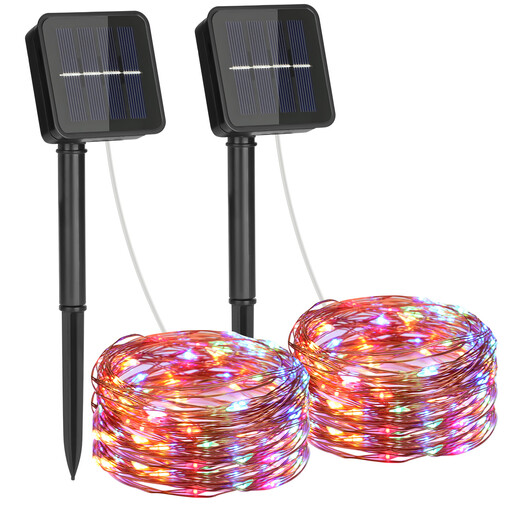
Why This Fits Their Persona: These outdoor solar string lights are ideal for creating an atmospheric setting on balcony railings, trees, or pergolas. The flexible copper wire is easy to shape, and the eight different lighting modes offer creative freedom for parties or cosy evenings.
With a specified runtime of 8–14 hours and an IP65 certification, this product bypasses the traps of short lifespan and poor weather resistance.
8 lighting modes with memory function; 12-metre length per string for large-scale decoration; set of 2 for a uniform design.
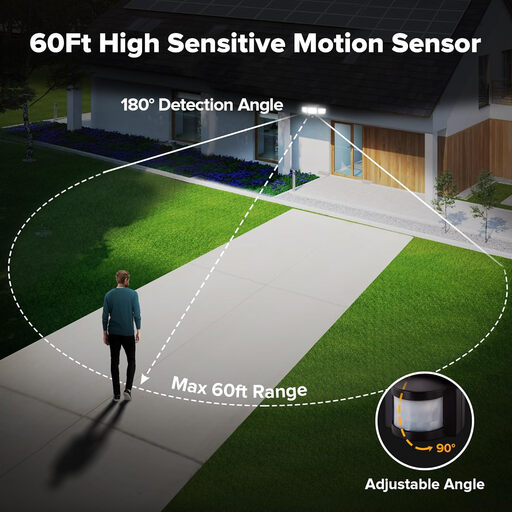
Why This Fits Their Persona: This high-performance solar floodlight with motion sensor is designed for the functional illumination of driveways, garages, or dark corners of the garden. The three adjustable heads allow for wide and targeted lighting for deterrence and enhanced security.
With 3000 lumens of brightness, this model impressively refutes the "faint glow" trap. The IP65 rating and robust ABS housing ensure high weather resistance.
Very high brightness; wide 270° illumination angle; 3 operating modes including a motion sensor to save energy.

Why This Fits Their Persona: These classic solar path lights are the straightforward solution for marking garden paths or flowerbed borders. Thanks to the ground stake, installation is done in seconds, without any tools or expertise.
The product specifies a clear runtime of 8–12 hours and has an IP44 rating, which is sufficient for use as a path light and protects against splashing water.
Very simple installation; stainless steel design for a modern look; automatic dusk-to-dawn sensor.
We have compiled a complete, up-to-date list of products that fully meet these strict selection criteria and UK safety regulations.
1. Do solar garden lights also work in winter? Yes, but with limitations. The shorter days and lower position of the sun in winter result in the battery charging less. This reduces the runtime in the evening. Performance heavily depends on the quality of the solar panel and battery capacity. For the best possible function, the lights should be placed in a location that receives as much direct sunlight as possible, even in winter.
2. What does the IP rating mean for outdoor lights? The IP (Ingress Protection) rating classifies a housing's protection against the entry of foreign objects (first digit) and water (second digit). For waterproof outdoor lights, a minimum of IP44 (protection against splashing water) is recommended. For locations exposed to heavy rain, an IP65 rating (protection against water jets) offers greater security and durability.