
Lieferung heute & morgen

Qualitätsgarantie

Willkommens-Angebote freischalten: KOSTENLOSE Lieferung | Bis zu 80 % RABATT | Kostenlose 30-Tage-JoyPlus-Testphase
App herunterladen
Solar garden lights promise an easy and cost-effective way to illuminate paths, highlight patios, and accentuate flowerbeds—all without complex wiring or added electricity costs. However, the market is flooded with products whose performance often fails to live up to their advertising claims. Many buyers find their new solar garden lights lose brightness after just a few months or fail completely after the first heavy rain.
As your Joybuy Product Recommendation Officer, I'm here to help you identify the common pitfalls and make an informed decision. We'll focus on the objective features that define a durable and functional solar light.
The 3 Most Common Mistakes When Buying Solar Lights:
To avoid a bad purchase, you should focus on verifiable technical specifications. These three parameters are crucial for the performance and longevity of your garden lighting.
The actual brightness of a light is measured in lumens (lm), not watts. Watts simply describe energy consumption. For effective garden lighting, consider these guidelines:
The runtime depends directly on the battery capacity, which is specified in milliampere-hours (mAh). A battery with a higher capacity (e.g., 2000 mAh or more) can store more energy and thus power the light for longer, especially on nights following overcast days.
The IP rating indicates how well a light is protected against the ingress of foreign objects (first digit) and water (second digit). For outdoor use, the following ratings are relevant:
A waterproof design with at least an IP65 rating is a safe recommendation for most applications in climates with variable weather.
The quality of the solar panel and battery determines how efficiently solar energy is converted and stored.
Instead of making a one-size-fits-all recommendation, we've curated products for different user profiles.
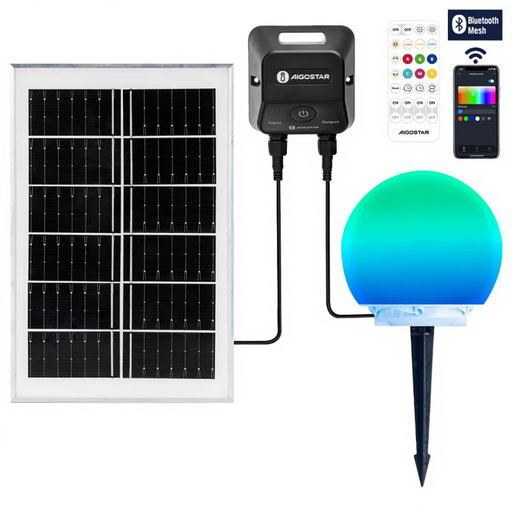
Why This Fits Their Persona: Ideal for users who want full control and connectivity. This smart solar light allows for control of colour, brightness, and schedules via an app and can be linked with over 200 other lights to create a synchronised lighting system.
This light uses an efficient monocrystalline solar panel and a powerful 4000mAh battery, enabling a runtime of up to 24 hours. The IP65 certification ensures durability in all weather conditions.
Bluetooth Mesh technology for linking multiple lights; full control over RGBCCT colours (millions of colours plus tunable white light from 2700K-6500K).
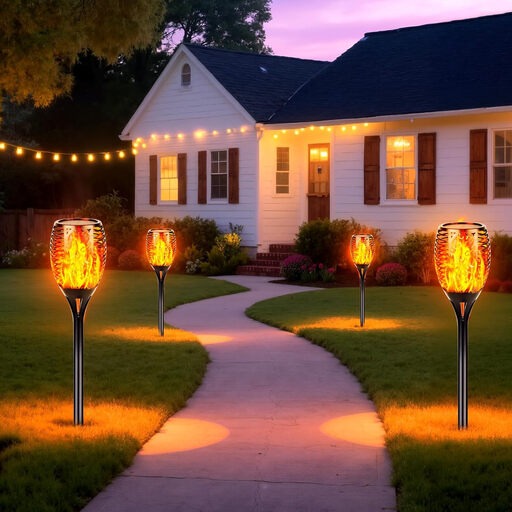
Why This Fits Their Persona: Perfect for anyone looking to create an atmospheric and decorative mood. The realistic flame effect of these solar torches provides a warm and inviting ambience on patios, along paths, or at garden parties.
This light focuses on an aesthetic effect rather than maximum brightness. The IP65 certification ensures the torches function reliably even in bad weather and won't fail after a short time.
The realistic, dancing flame effect is created by 96 individual LEDs. Installation as a solar ground stake is straightforward, and the automatic on/off function adds convenience.

Why This Fits Their Persona: The solution for places where the light itself needs to be in the shade, but the solar panel can be placed in the sun (e.g., a garden shed, covered patio, or carport). It provides bright, reliable illumination.
The product provides clear performance specs: 500 lumens of brightness and a long-lasting 5000mAh LiFePO4 battery. The 3-metre cable to the separate panel solves the problem of optimal sun exposure, thus preventing performance loss.
Separate solar panel for maximum installation flexibility. High brightness and three selectable colour temperatures (3000K/4000K/6500K) for different needs.
If you're looking for other lighting solutions that aren't exclusively solar-powered, you'll find a wide range of tested products in our collection.
The lifespan of a solar light depends on the quality of its components. The solar LEDs themselves have a very long lifespan, often exceeding 15,000 hours. The limiting factor is usually the battery. High-quality lithium-ion batteries typically last 2–4 years before their capacity noticeably declines. On many models, the battery can be replaced, which extends the life of the light.
Yes, solar lights do work on cloudy days, but with reduced efficiency. The solar panel still charges the battery in diffuse light, just more slowly than in direct sunlight. In winter, when days are shorter and often overcast, the runtime per night may therefore be shorter. Models with high-efficiency monocrystalline panels and large batteries are better suited for year-round use.
The most important factor is the placement of the solar panel. It should be installed in a location that receives direct sunlight for as long as possible, ideally south-facing and free from shadows cast by trees, buildings, or eaves. Occasionally clean the panel with a soft cloth to remove dust and dirt to maintain charging efficiency.