
Lieferung heute & morgen

Qualitätsgarantie

Willkommens-Angebote freischalten: KOSTENLOSE Lieferung | Bis zu 80 % RABATT | Kostenlose 30-Tage-JoyPlus-Testphase
App herunterladen
Installing atmospheric solar garden lighting without having to lay any cables is an attractive idea. But the market for solar garden lights is flooded with products whose real-world performance often fails to live up to the promises on the packaging. Many buyers are disappointed when their lights only glow dimly after a short time or fail completely after the first heavy downpour.
This guide, created by the Joybuy Product Recommendation Officer, shows you the crucial criteria to consider before making a purchase. We'll highlight the most common pitfalls and explain which technical specifications truly matter, ensuring your solar outdoor lights reliably create a pleasant atmosphere.
Before you make a decision, it's important to understand the typical weaknesses of many budget-friendly models. These often lead to frustration and unnecessary expense.
To avoid the problems mentioned above, you should check three core parameters. These will give you an objective basis for your purchasing decision.
The battery is the heart of every solar light. Its capacity is measured in milliampere-hours (mAh). While simple decorative garden lighting may suffice with 40-200 mAh, functional solar path lights intended to stay on all night require a higher capacity of at least 600 mAh. Ni-MH (Nickel-Metal Hydride) batteries are a common standard here. The solar panel is just as important. Monocrystalline panels are generally more efficient than amorphous silicon panels and provide better charging performance even in diffuse light.
The IP rating indicates how well a light's housing is protected against the ingress of foreign objects and water.
The light colour determines the atmosphere. For a cosy and inviting mood, you should specifically look for warm white solar lights.
Brightness is measured in lumens (lm). For pure accent lighting, a few lumens are sufficient. To safely illuminate a path, you should aim for 25 to 100 lumens per light, depending on their spacing.
Based on the objective criteria mentioned above, we have selected various models for typical user profiles.
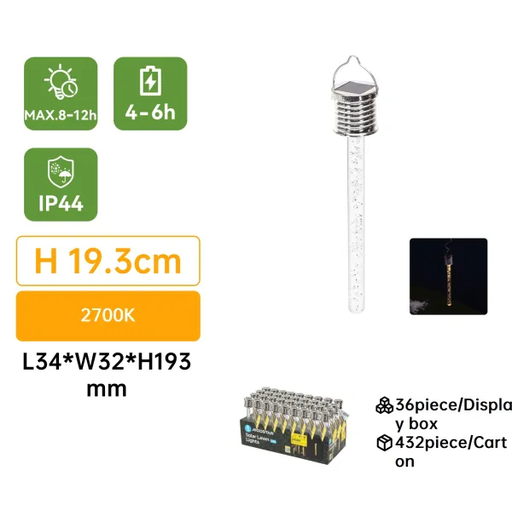
Why This Fits Their Persona: Ideal for users looking for straightforward and purely decorative lighting for flower boxes or small beds. The bubble stick pendant design adds a visual accent without being overpowering.
This model is clearly positioned as an ambient light and doesn't promise high brightness. The warm white light colour (2700K) avoids the sterile look of cool LEDs. The IP44 rating is sufficient for its intended use in sheltered areas.
Very lightweight and compact for flexible placement. The bubble stick design creates an appealing light effect.
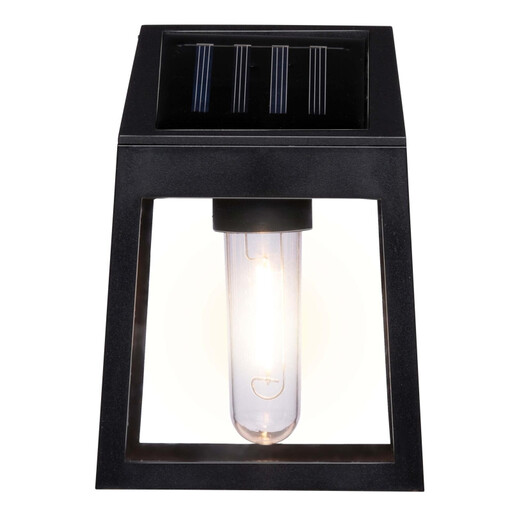
Why This Fits Their Persona: Perfect for homeowners who need reliable, automatic lighting for their entrance area, house wall, or garden fence. The focus here is on safety and orientation.
With a battery capacity of 600 mAh, this light directly addresses the weak point of many budget models. It stores enough energy to shine reliably even after less sunny days. Wall mounting also provides better protection from ground moisture.
Higher battery capacity for improved reliability. Automatic function (on at dusk, off at dawn) without manual operation.
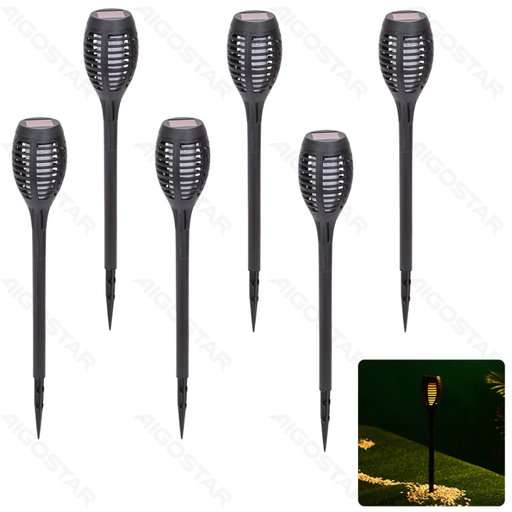
Why This Fits Their Persona: Ideal for garden owners who want to create uniform and atmospheric lighting for parties, paths, or for bordering flowerbeds. The realistic flame effect provides a special ambience.
This solar light set ensures a harmonious overall look and avoids the unattractive mix of different models. The warm white light colour (2700K) and the flame effect are clearly designed for atmosphere. The IP44 rating is suitable for use as a solar ground stake in most garden situations.
Uniform design in a practical 6-pack. The realistic flame effect creates a special, dynamic illumination.
We've compiled a complete, up-to-date list of products that fully meet these strict selection criteria and safety regulations.
Yes, but with limited performance. Modern LED solar lights can also use diffuse daylight to charge their batteries. However, the charging performance is significantly lower on cloudy days or in winter. The runtime per night is shortened accordingly. Models with high-quality solar panels and larger batteries (e.g., 600 mAh or more) have a clear advantage here, as they can store more energy and use shorter periods of sun more efficiently.
The lifespan is determined by two main components: the LED and the battery. The LEDs themselves are very durable; many manufacturers state a lifespan of 15,000 hours or more. The battery is the most common wear-and-tear component. Ni-MH batteries typically have a lifespan of 1-3 years, depending on charging cycles and environmental conditions. On many higher-quality models, the battery can be easily replaced, which significantly extends the life of the entire light.
The most important factor is placement. The solar panel should be positioned to receive as much direct sunlight as possible throughout the day. Avoid locations in the shade of trees, buildings, or overhangs. Clean the panel regularly with a soft cloth to remove dust, pollen, and dirt to maintain charging efficiency. Before first use, it is recommended to let the light charge for a full sunny day to reach full battery capacity.