
Lieferung heute & morgen

Qualitätsgarantie

Willkommens-Angebote freischalten: KOSTENLOSE Lieferung | Bis zu 80 % RABATT | Kostenlose 30-Tage-JoyPlus-Testphase
App herunterladen
Solar lights for the garden don’t need a mains connection and can usually be installed without tools. However, solar garden lights vary considerably in colour temperature, IP rating, battery capacity and intended use. If you choose a light based only on its design or stated runtime, you could end up with one that barely charges in a shady spot or doesn’t illuminate the area you had in mind.
Manufacturer claims such as “8–12 hours” assume suitable charging conditions. In autumn, on heavily overcast days or beneath trees, the solar panel receives less energy. The light may then stay on for considerably less time. So be sure to check:
The IP rating describes a product’s level of protection. IP44 generally protects against solid objects above a certain size and splashing water from various directions. However, a light with this rating isn’t designed to be submerged or left standing in water. A higher rating, such as IP65, may be more suitable for exposed locations. The key is to check that the specific light is suitable for the spot where you plan to use it.
Decorative solar ground lights and solar lights with ground stakes often provide lighting for visibility or atmosphere, but they won’t necessarily replace powerful security lighting. Warm white light at around 2700 Kelvin has a subtle effect and works well around seating areas, flower beds and patios. Cool white light at 6500 Kelvin looks much crisper and can help define paths more clearly. RGB solar lights add splashes of colour, but they aren’t primarily designed to provide even illumination.
First, decide where you want to use your solar-powered outdoor lighting:
If the ground is hard or stony, don’t force the stake into it. This could damage the housing, cable connections or stake.
An integrated NiMH or lithium battery stores the energy collected during the day. Capacity alone doesn’t tell you everything: LED power, panel size, temperature and controls also affect runtime. Figures such as “4–6 hours to charge” and “8–12 hours of light” should therefore be treated as guidelines for suitable conditions.
Clean the panel regularly with a soft, slightly damp cloth. Dust, pollen and dirt can reduce the amount of energy it can collect. Don’t use abrasive cleaning products.
Three specifications are particularly useful when choosing a light:

Why this product suits your needs: This compact black solar path light is designed for paths, driveways and smaller outdoor spaces. With two LEDs and a ground stake, it’s an easy way to get started without laying cables.
The product description specifies that it’s powered by an integrated solar panel and an AAA battery. This makes the basic power and installation details clear.
Measures 6.5 × 34 cm, with two LEDs, a black housing and a weight of 402 g.
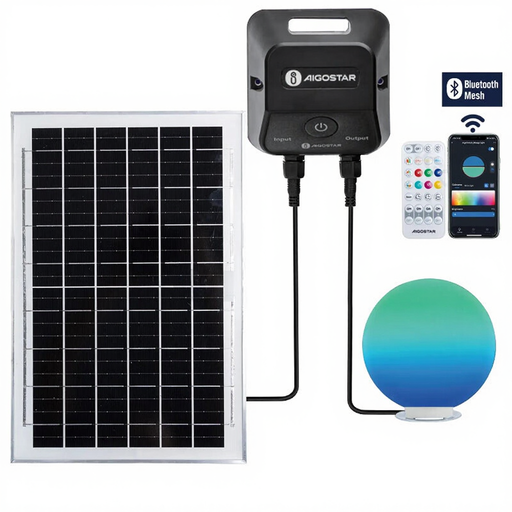
Why this product suits your needs: This model is for anyone who wants to control several lights and switch between RGB, warm white and daylight. The Bluetooth Mesh feature could be useful in larger outdoor spaces with several compatible devices.
The product details specify an IP65 rating, a charging time of 4–6 hours and control via Bluetooth Mesh. This lets you check the protection rating and control options before buying.
Specifications include 350 lm, RGB plus 2700–6500 K, a 12-W solar panel, an 8,000-mAh lithium battery and a maximum battery life of up to 24 hours.
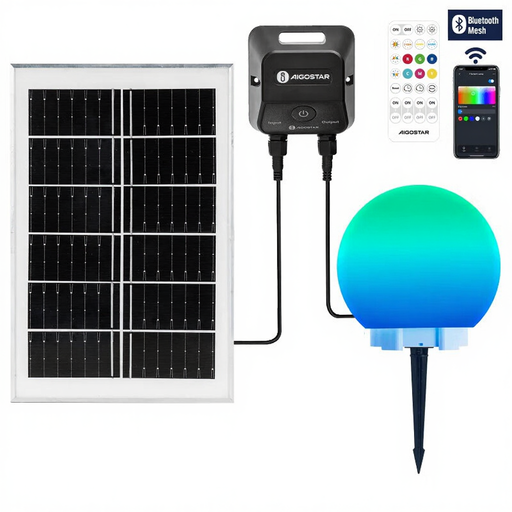
Why this product suits your needs: This smart solar light is designed for buyers who want to factor app control, group functions and adjustable light colours into their garden plans. It can be used as a solar ground light in suitable outdoor spaces.
The description lists app control, an RGB+CCT range and IP54/IP44 protection ratings. Before installation, check which rating is intended for your specific setup.
AigoSmart app, Bluetooth Mesh, adjustable colour temperature from 2700 to 6500 K and voice control via a compatible hub.
We’ve put together a complete, regularly updated list of products that meet these strict selection criteria and fully comply with the safety regulations in force in the EU.
Choose a spot that gets as much direct sunlight as possible. The panel shouldn’t be shaded by walls, trees or tall plants. Solar lights with ground stakes work best in firm, loose soil. Position the light so that it won’t be affected by watering or left standing in water.
Before using the light for the first time, it may be worth fully charging the battery according to the manufacturer’s instructions. Also check regularly:
If you notice any damage, stop using the product. Batteries and lights should be recycled or disposed of as electrical waste in line with local regulations.
Lifespan depends on the LED, battery, housing, weather and care. Figures in the product details, such as 15,000 hours, usually refer to the stated lifespan of the LED or product and don’t automatically guarantee the lifespan of the entire light. The battery may lose capacity sooner and can be replaced if necessary, in accordance with the manufacturer’s instructions.
Yes, they can still light up after cloudy days, provided the panel has collected enough energy. They may not stay on as long, though. Expect lower charging performance in winter or in a spot that’s always in the shade.
While they’re switched on, they use energy from the integrated battery, which is charged by the solar panel. The models mentioned don’t need to be connected to the mains. However, you may still incur costs for replacement batteries or spare parts.