
Lieferung heute & morgen

Qualitätsgarantie

Willkommens-Angebote freischalten: KOSTENLOSE Lieferung | Bis zu 80 % RABATT | Kostenlose 30-Tage-JoyPlus-Testphase
App herunterladen
Solar lights for the garden don’t need a fixed mains connection and can usually be set up without tools. During the day, the solar panel converts sunlight into electrical energy, which is stored in a rechargeable battery to power the lights automatically after dark. To make sure your solar garden lights are suitable for outdoor use in the UK, there’s more to consider than just their design and light colour.
Claims such as ‘all night’ depend on several factors: direct sunlight, the time of year, shade, dirt on the solar panel and the condition of the battery. A spot under trees or against a north-facing wall can significantly reduce charging performance. For this reason, place the solar panel somewhere as open as possible, where it will receive plenty of daylight.
Outdoor lighting needs suitable protection against moisture. IP44, for example, means protection against solid objects larger than 1 millimetre and splashing water from different directions. However, a light with an IP44 rating is not designed to be submerged in water or left in standing water for long periods. It’s therefore important to avoid waterlogged areas when using solar ground lights and solar lights with ground spikes.
A warm white solar light usually creates a softer effect in the garden, making it a good choice for seating areas, flower beds and decorative paths. A cool white solar light with a higher colour temperature gives a cleaner, crisper look and can work well in driveways or for practical path lighting. However, light colour alone doesn’t tell you how bright the light will actually be.
Check whether the product description gives details of charging time, lighting time and battery type. For example, one model is listed with a polycrystalline silicon solar panel, a charging time of 4 to 6 hours and a stated lighting time of 8 to 12 hours. Treat these as product specifications based on particular conditions, not as a guaranteed duration in every kind of weather.
The battery matters, too. Solar lights may use NiMH batteries, among others. Specifications such as 1.2 V and 600 mAh describe a battery’s electrical capacity, but don’t on their own provide a precise indication of how long the light will stay on. Operating time may be shorter in dull weather or during winter.
For outdoor use, the stated IP rating should be suitable for the location. A light rated IP44 is designed to withstand splashing water, but must not be submerged. Place ground spikes in firm, loose soil and avoid spots where rainwater regularly collects. For a permanent installation on stone or concrete, freestanding models with a suitable base are more practical than lights with narrow ground spikes.
A light’s height affects how visible it is along a path. Smaller solar path lights create individual pools of light, while taller models can help define the path more clearly. Outdoor LED solar lights don’t need a replaceable bulb, so check the LED’s stated lifespan, the colour temperature in kelvins and, if provided, the colour rendering index.
For even lighting along a garden path, space the lights at regular intervals. If they’re too far apart, you may end up with dark patches. For a driveway, also check that the light is protected from knocks and won’t get in the way of mowing or driving.
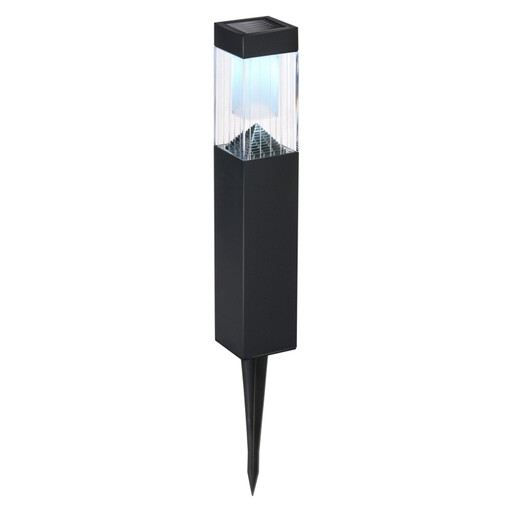
Why this product suits this profile: At 34 cm tall, this solar light has two LEDs and a ground spike, making it a simple, cordless option for basic lighting along paths or around flower beds. According to the product description, it switches on automatically using a built-in AAA battery.
The product description gives specific dimensions, confirms that it has two LEDs and states that it works without cables. Before buying, though, check whether an IP rating is provided and whether the chosen spot gets enough sun.
Two LEDs, a height of 34 cm, a black finish and ground-spike installation without fixed wiring.
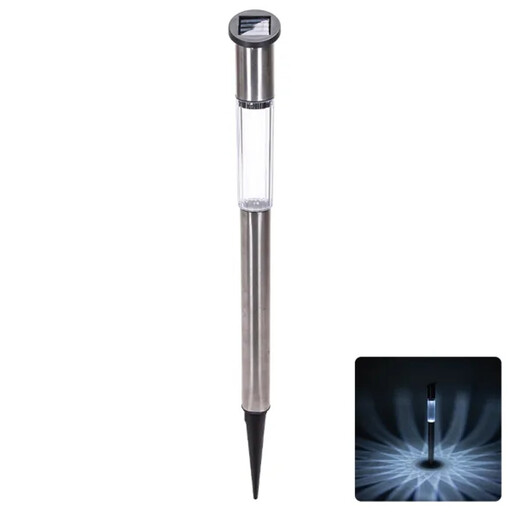
Why this product suits this profile: This model combines a plastic housing with stainless steel elements, a polycrystalline solar panel and cool white light at 6500 K. It’s a good option for buyers who want to compare technical details such as charging time, colour temperature and IP rating.
The IP44 rating indicates that the light is designed to withstand splashing water. The product also specifies a charging time of 4 to 6 hours, a stated lighting time of 8 to 12 hours and a NiMH battery.
Cool white light at 6500 K, Ra≥70, a stated LED lifespan of 15,000 hours and an operating temperature range of -10 °C to 50 °C.
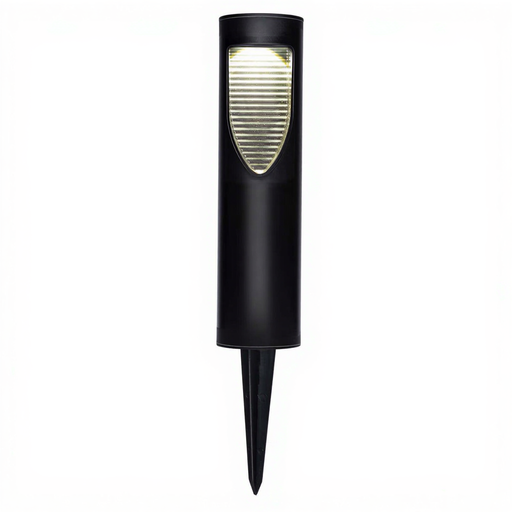
Why this product suits this profile: At 31 cm tall, this solar garden light has a warm white SMD LED, making it a good fit for seating areas, flower beds and paths where you want a softer lighting effect. According to the product description, it switches on at dusk and off in daylight.
The product details specify the light colour, dimensions, battery type and capacity. The solar panel should still be cleaned regularly with a soft, damp cloth, and the light should be protected from prolonged submersion.
Warm white SMD LED, built-in 600 mAh NiMH battery, black plastic finish and automatic switching on and off.
We’ve put together a complete, regularly updated list of products that meet these strict selection criteria and fully comply with the safety regulations in force in the EU.
Solar lights don’t use mains electricity while they’re on. Ongoing costs mainly come from replacing the battery or the whole light further down the line. Actual lifespan depends on factors including charging cycles, temperature, moisture and battery quality.
Clean the solar panel regularly with a soft, damp cloth. Don’t use abrasive cleaning products. Stop using damaged lights, and dispose of batteries in line with local requirements for electrical and battery waste.
Choose a spot that gets as much direct sunlight as possible and as little shade as possible. The ground spike should sit firmly in the soil. Avoid areas where water regularly collects, and position the light so its solar panel gets enough daylight.
It depends on battery capacity, charge level, weather, time of year and LED output. Product claims such as 8 to 12 hours refer to expected performance under specific conditions. Lighting time may be shorter in winter or after several cloudy days.
For individual paths, flower beds and small outdoor areas, solar lights remove the need for fixed electrical wiring. This can mean less installation work and lower electricity use while they’re running. For very bright, continuously controllable lighting or larger gardens, a wired solution may be more suitable.