
Lieferung heute & morgen

Qualitätsgarantie

Willkommens-Angebote freischalten: KOSTENLOSE Lieferung | Bis zu 80 % RABATT | Kostenlose 30-Tage-JoyPlus-Testphase
App herunterladen
Solar lights for the garden don’t need a mains connection and can usually be installed without tools. However, not every solar garden light provides satisfactory illumination. Products often end up barely being used after a short time because expectations around brightness, battery life or weather resistance weren’t realistic.
This guide explains which details to check before buying, which style suits different uses and how to tell decorative lighting apart from practical illumination.
Many decorative solar lights use very little power. That’s enough for accent lighting around a flower bed or along a patio, but it won’t replace bright security lighting for a driveway. To compare brightness, check the stated luminous flux in lumens. A 100-lumen model will produce a very different effect from a small LED solar light rated at just a few milliwatts.
If you want to see a path clearly, consider the arrangement of the lights, their beam angle and the distance between them. Subtle solar ground lights may be enough for individual plants or the edges of flower beds.
Manufacturer claims such as ‘8–12 hours’ usually assume plenty of sunlight and a fully charged battery. Shade from walls, trees or balconies reduces charging efficiency. Actual running time may also be shorter in winter or after several cloudy days.
So, place your solar light somewhere that gets as much direct sunlight as possible. Make sure the solar panel isn’t covered by leaves, dust or decorations.
The IP rating describes protection against solid objects and water. IP44, for example, means protection against splashing water, not permanent immersion. An IP54-rated model also offers better protection against dust, while IP65 indicates a higher level of protection against dust and water jets. Choose a rating that suits the light’s position.
Solar lights with ground stakes are usually suitable for lawns, flower beds and paths. Take extra care in dips, areas where water collects or spots close to sprinklers.
Warm white solar lights at around 2700 Kelvin give off a soft, yellowish glow. They’re well suited to patios, seating areas and decorative flower beds. Cool white light, at up to around 6500 Kelvin, looks crisper and can make paths stand out more clearly.
RGB solar lights cycle through different colours and are mainly suited to decorative lighting. If you want to synchronise the colours across several lights, check whether they come with a remote control, app or connectivity technology.
Check the battery type, capacity and stated charging time. Ni-MH batteries are common in many compact solar garden lights. Lithium batteries are more often found in higher-powered or smart models. The light’s running time depends not only on the battery, but also on LED output, brightness settings and temperature.
The ground stake should be sturdy enough for the surface it will go into. If the ground is hard, loosen the soil first rather than forcing the stake in. This puts less strain on the housing and connectors.
Smart solar lights with app control can make it easier to manage brightness, light colour, schedules and groups. For Bluetooth Mesh models, check how many devices can be connected and whether you need an additional hub for voice control. An app can’t replace a power source when there isn’t enough sunlight: smart models still need to charge during the day.

Why this product suits this profile: This compact solar path light has two LEDs, a black housing and a ground stake, so you can place it along smaller paths or flower beds without cables.
The product description gives its dimensions of 6.5 × 34 cm, notes that it has two LEDs and says it switches on automatically when it gets dark. This makes it easier to check the design and basic function before you buy.
Cable-free installation, a black design and a built-in battery with AAA battery specification, according to the product details.
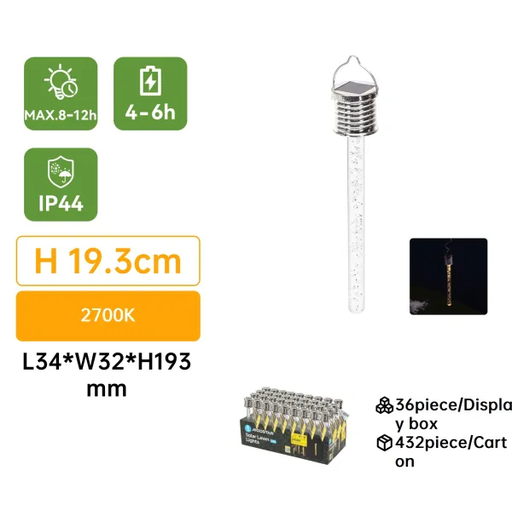
Why this product suits this profile: With its warm white 2700 K light, this decorative lamp is a good fit for patios, lawns and flower beds where a subtle glow is the priority.
The product details state an IP44 rating, a charging time of around 4–6 hours and a lighting time of 8–12 hours in suitable conditions. This helps you plan where to place it realistically.
Warm white light at 2700 K, an integrated 40 mAh Ni-MH battery and compact dimensions of 34 × 32 × 193 mm.
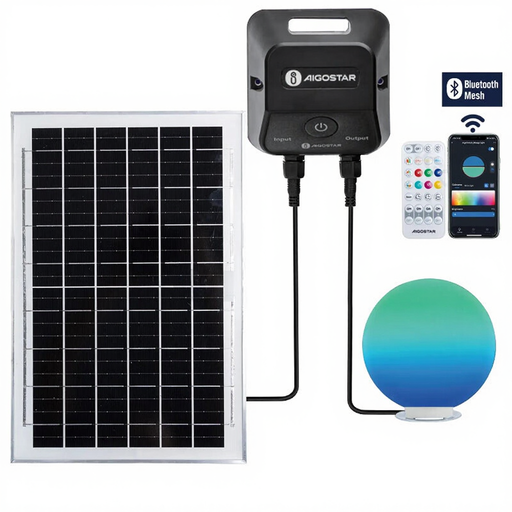
Why this product suits this profile: For larger gardens or anyone interested in app control, this solar light offers RGB and white light options as well as Bluetooth Mesh connectivity.
The product details clearly state an IP65 rating, a 12 W solar panel connection, 350 lumens and a maximum battery life of 24 hours. This makes it easier to compare its performance and protection ratings.
RGB+CCT from 2700–6500 K, Bluetooth Mesh control, the AigoSmart app and stated connectivity for up to 200 devices.
We’ve put together a complete, regularly updated list of products that meet these strict selection criteria and fully comply with the safety regulations in force in the EU.
Their lifespan depends on the battery, LED, charging conditions, temperature and care. Product details may state running times of 8–12 hours, for example, or an LED lifespan of up to 15,000 or 30,000 hours. These are manufacturer claims, not a guarantee for every location or set of conditions.
It depends on what you need them for. Small solar ground lights and warm white decorative solar lights can mark out paths, but they won’t necessarily provide strong illumination. For better visibility, compare the luminous flux, beam angle and distance between the lights. For areas where safety is a concern, separate, higher-powered lighting may be a good option.
During normal use, solar-powered garden lights get their energy from the built-in solar panel and store it in the battery. They don’t need a mains connection. However, you may need to pay for replacement batteries or damaged components. Sunlight and regular cleaning affect how long the lights can stay on.