
Lieferung heute & morgen

Qualitätsgarantie

Willkommens-Angebote freischalten: KOSTENLOSE Lieferung | Bis zu 80 % RABATT | Kostenlose 30-Tage-JoyPlus-Testphase
App herunterladen
Solar garden lights offer a way to illuminate paths, flower beds, lawns, balconies and patios without cables. During the day, the solar panel charges the built-in battery; when it gets dark, the light switches on automatically, depending on the model. However, not every solar light is suitable for every location.
Many disappointing purchases come down to three common pitfalls:
The solar panel and battery work together as a system in garden solar lights. A small battery may be enough for decorative accent lighting, while longer run times require the right balance of charging capacity, battery capacity and LED output.
Check the following details:
Keep the panel as clear as possible of leaves, dust and persistent shade. A soft cloth is all you need for regular cleaning.
The protection rating is shown by the IP code. IP44 means protection against solid foreign objects above a certain size, as well as splashing water. This is suitable for many decorative outdoor areas, but it does not replace a sheltered installation site where there is a risk of heavy rain or flooding.
Solar ground lights and solar lights with ground stakes should be firmly secured in the soil. A stake can work loose in soft ground. On hard or stony surfaces, check whether the model is designed to stand freely on a level surface.
Warm white solar lights create a subtle ambience and are often well suited to entrances, patio edges and paths. RGB solar lights change between different colours and are more often used as decorative accent lighting for flower beds, lawns and courtyards.
The design also affects how you can use a light:
The selection below groups the models by typical use. Technical details are based on the information provided for each product.
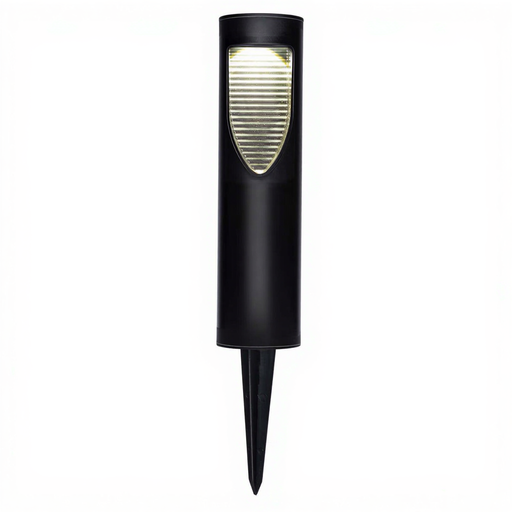
Why this product suits this profile: The warm white SMD LED, black plastic housing and compact size (8 cm in diameter and 31 cm high) make it a good choice for simple path and flower-bed lighting without a mains connection.
The product description specifies a built-in 600 mAh Ni-MH battery and says to position the solar panel in direct sunlight. This makes important operating conditions clear.
Warm white SMD LED, built-in rechargeable battery and freestanding use without professional electrical installation.
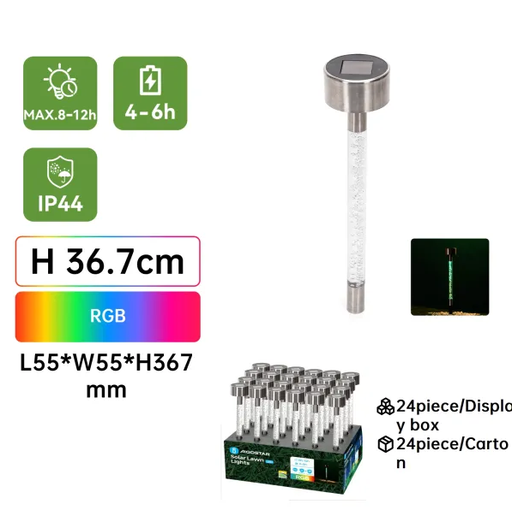
Why this product suits this profile: This model combines a decorative bubble design with RGB lighting, a height of 36.7 cm and an IP44 rating for designated outdoor areas.
The specifications explicitly state IP44, an operating temperature range of -10 °C to 50 °C, and a charging time of around 4–6 hours. This makes it easier to plan where to place the light and how it will cope with the weather.
RGB lighting, a stated run time of 8–12 hours under suitable conditions and a ground stake for lawns or flower beds.
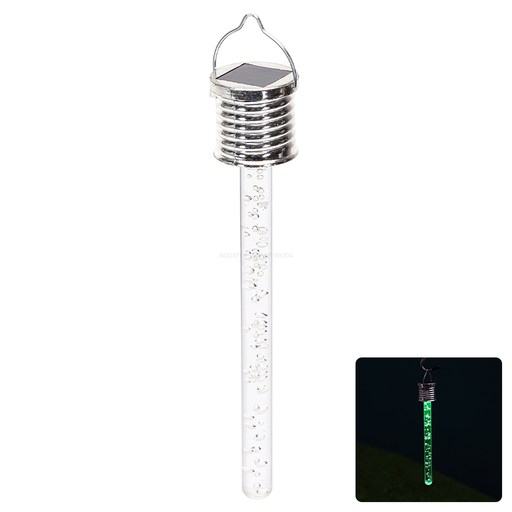
Why this product suits this profile: Its slim design, measuring 34 × 32 × 193 mm, works well in narrow flower beds, along lawn edges and in decorative group arrangements on patios or in courtyards.
The product details specify IP44, an operating temperature range of -10 °C to 50 °C and a recommended charging time of 4–6 hours. The solar panel should face upwards and be kept out of the shade.
RGB lighting, a low weight of 40 g and a stated run time of 8–12 hours under suitable charging conditions.
We’ve put together a complete, regularly updated list of products that meet these strict selection criteria and the safety regulations in force in the EU.
Choose a spot that gets as much direct sunlight as possible. Leave enough space between lights so their beams do not overlap unnecessarily. For solar path lights, it’s best to space them evenly along the path.
Before using your lights for the first time, you should:
If you are storing the light for a longer period, look after the battery in line with the manufacturer’s instructions. Built-in batteries must not be opened or replaced yourself unless the product is specifically designed for this. Dispose of electronic components and batteries separately, in accordance with local waste disposal requirements.
Run time depends on sunlight, charging time, battery capacity, temperature and LED output. Manufacturer figures such as 8–12 hours should be understood as applying under suitable conditions, not as a guarantee of a fixed daily run time.
Solar lights can be used in winter. However, shorter days, low-lying sun, snow, cloud and lower temperatures can affect charging performance and run time. Keep the panel clear of snow and dirt.
Solar garden lights do not need to be connected to the mains during normal use. This means charging the built-in battery does not add to your mains electricity use. You may incur costs later if you need replacement batteries or a replacement light.