
Lieferung heute & morgen

Qualitätsgarantie

Willkommens-Angebote freischalten: KOSTENLOSE Lieferung | Bis zu 80 % RABATT | Kostenlose 30-Tage-JoyPlus-Testphase
App herunterladen
Solar garden lights are quick to set up, need no permanent power cable and can add a decorative touch to paths, flower beds and patios. However, a few common buying mistakes can lead to disappointment: the light is placed in the shade, the stated running time is only achieved in ideal conditions, or the IP rating is mistaken for complete waterproofing.
This buying guide explains what homeowners and gardeners should look for in solar garden lighting, outdoor solar LED lights and alternative garden lamps.
Claims such as ‘up to 8–12 hours’ generally assume plenty of sunlight and a fully charged battery. In autumn and winter in the UK, in overcast weather or under trees, the actual running time may be shorter. Ideally, place your solar light in an open spot where its panel won’t be shaded.
A rating such as IP44 indicates protection against solid objects and splashing water. It does not mean a light can be left in water or submerged. For more exposed areas, waterproof outdoor lights with a higher rating may be a better choice. Even with IP66, cable connections and mounting surfaces must be properly protected.
Small solar garden lights are generally useful for guidance and decoration, but they won’t necessarily provide enough brightness for a driveway or work area. For these purposes, powerful LED floodlights with a mains connection are often more suitable. Before you buy, consider whether you need warm-white guidance lighting, coloured accent lighting or practical illumination.
For lighting a garden path, warm-white light of around 2,700 to 3,000 Kelvin is usually subtle. Cool-white light at around 6,500 Kelvin brings out contours more strongly, but can feel rather stark on a patio. RGB solar lights offer changing colours, but are intended primarily for decorative accents.
For practical lighting, also check the lumen rating. A higher lumen figure indicates a greater light output, but on its own it doesn’t tell you how the light is distributed. For a narrow path, several lower-powered solar lights placed at regular intervals may be a better choice than one very bright lamp.
Important technical details include:
A light with a built-in battery should not be opened or modified. For products with a Ni-MH battery, make sure you dispose of it in line with local requirements. To keep your solar garden lighting consistent, check the positioning throughout the year, as the sun’s position affects charging performance.
Solar lights with ground stakes should be firmly placed in soft but stable soil. In very hard ground, the stake may be damaged if you force it in. Plastic housings are lightweight and practical, while a stainless-steel look or metal components offer a different style. Always check the manufacturer’s specific information on materials, temperature range and IP rating.
For mains-powered lights, such as smart garden lights or floodlights, consider the power supply, cable routing and protection for the plug. Professional installation may be required if the light needs a fixed connection.
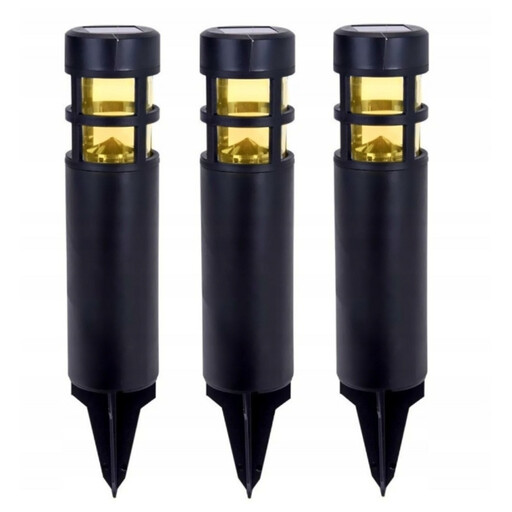
Why this product suits this type of buyer: This set of three solar lights is designed for simple guidance lighting along paths, flower beds or lawn edges. It can be set up without any permanent wiring.
Automatic dusk activation and the three-light set make it easier to position the lights evenly, without relying too heavily on a single light.
Three lights, solar-powered operation and automatic control; ideal for a straightforward starter setup.
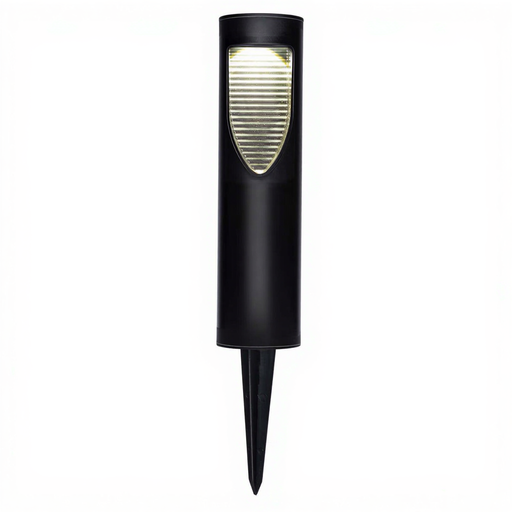
Why this product suits this type of buyer: With its contemporary black finish and warm-white SMD LED light, this subtle option works well along paths and flower beds.
The specifications list a built-in 600 mAh Ni-MH battery and a solar panel, and clearly state that the light must not be submerged for extended periods.
SMD LED, warm-white light, 8 cm diameter and 31 cm height; freestanding installation with no professional electrical work required.
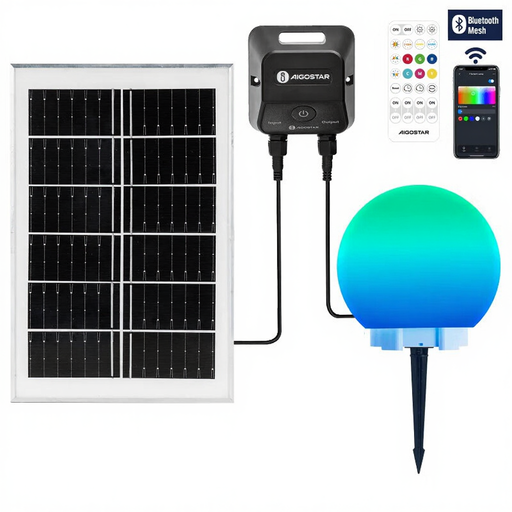
Why this product suits this type of buyer: For anyone looking to combine smart garden lighting, group control and changing colours, this model offers app control via AigoSmart as well as Bluetooth Mesh.
The product description clearly lists RGB+CCT, app control and IP54/IP44 ratings. This helps you understand the features and limitations before installation.
Solar-powered, with a lithium battery, adjustable colour temperature from 2,700 to 6,500 Kelvin and group control via Bluetooth Mesh.
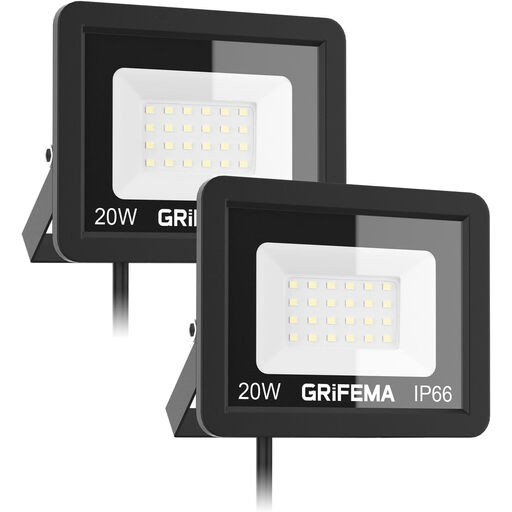
Why this product suits this type of buyer: This set of two mains-powered LED floodlights is for buyers who want to illuminate a garden, garage, courtyard or patio brightly and precisely.
With a total light output of 2,200 lumens and an IP66 rating, these are clearly different from decorative solar lights. However, you’ll need to plan the power supply separately, as no plug is specified.
Two 20 W lights, 180-degree brackets, 6,500 Kelvin and IP66 protection against dust and powerful water jets.
We’ve put together a comprehensive, regularly updated list of products that meet these strict selection criteria and fully comply with the safety regulations in force in the EU.
Running time depends on sunlight, the time of year, battery condition, the panel and the lighting mode. Manufacturer claims such as 8–12 hours assume suitable charging conditions. In winter or in a shaded spot, the lights may stay on for less time.
This depends on the model, its IP rating and its specified temperature range. IP44 lights are protected against splashing water, but shouldn’t be left standing in water. In frosty or snowy weather, or during prolonged spells of bad weather, it may be worth storing more delicate models somewhere sheltered.
Solar lights collect energy through their panels during the day and store it in their batteries. They don’t need a permanent mains connection while operating. The main costs are the purchase price, possible replacement batteries and disposal of electronic components. Mains-powered garden lamps and LED floodlights, on the other hand, need an external power supply.